 Anacortes Siding
 Cedar siding has a real pull in a town like Anacortes. It's a natural material, it ages with character, and it fits the wooded, waterfront look that a lot of Skagit County homeowners want. We understand the appeal — cedar isn't a bad product, and plenty of people fall in love with it the first time they see it fresh off the mill. But we don't install it, and we think homeowners considering it deserve the full picture of what owning cedar siding actually looks like ten and twenty years down the road, not just what it looks like on day one.
Why Cedar Gets Chosen in the First Place
Cedar is a legitimate building material with a long track record. It's naturally resistant to insects and decay compared to most other softwoods, it takes stain and paint well, it's a renewable resource, and it has a warmth and grain pattern that manufactured products spend a lot of effort trying to imitate. For a homeowner who wants an authentic wood exterior and is prepared to maintain it, cedar can look genuinely beautiful. None of what follows is meant to take that away from it.
What "Maintaining Cedar" Actually Means
The marketing around cedar siding tends to undersell the maintenance commitment. In practice, keeping cedar siding looking good and performing well requires an ongoing schedule, not a one-time sealing job:
- Restaining or resealing every 2 to 4 years, depending on sun and moisture exposure — south- and west-facing walls typically need it on the shorter end of that range
- Regular inspection for checking, cupping, and split boards, especially near ground contact, downspouts, and roof-to-wall transitions
- Cleaning to remove surface mildew and algae before it's worked into the wood grain, which requires the right pressure and technique so you don't damage the fibers
- Caulking and re-caulking joints, trim, and butt seams as the wood moves seasonally
- Prompt spot repair of any board that starts to rot, since untreated rot spreads to adjacent boards through moisture wicking
Skip that schedule for a few years — which is common, since most homeowners don't think about their siding until something looks wrong — and cedar doesn't just look tired. It starts absorbing water it can no longer shed, and that's when the real problems begin.
The Anacortes Climate Problem
Anacortes sits on the water, surrounded by the kind of marine weather pattern that is genuinely hard on wood siding. Salt air off Fidalgo Bay and the surrounding waterways accelerates the breakdown of finishes and speeds up weathering on exposed wood. Add in Skagit County's pattern of driving rain — often wind-driven, which pushes moisture into joints and seams that would stay dry in a calmer climate — and you have conditions that shorten the useful life of any exterior wood finish. Then there's moss. This part of Washington has a moss season that can run for much of the year on shaded, north-facing, or tree-covered elevations, and moss doesn't just sit on top of cedar — it holds moisture against the wood surface and creates a persistent damp layer that unfinished or under-maintained cedar has no way to shed.
None of this is unique to any one property. It's the baseline climate reality for wood siding anywhere in this part of Skagit County, and it's the reason a maintenance schedule that might be adequate in a drier inland climate isn't adequate here.
What Happens When Maintenance Falls Behind
When a cedar finish starts to fail — and it will, on a predictable clock — the wood underneath starts absorbing water directly. That leads to cupping and warping as the board's faces expand at different rates, checking (surface cracks) that trap water and grow deeper each freeze-and-thaw or wet-and-dry cycle, and eventually soft spots or rot that usually aren't visible until you press on the board or pull off a piece of trim. Board-and-batten and lap cedar both face this, though the failure points differ slightly by profile. By the time rot is visible from the ground, it has often been developing behind the finish for a season or two already.
Moss, Insects, and Other Regional Realities
Beyond moisture, cedar in this region deals with a few other pressures worth naming honestly. Woodpeckers occasionally target cedar siding, particularly on homes near tree lines, drilling into softened or insect-active wood. Carpenter ants and other wood-boring insects are drawn to any wood that's staying damp longer than it should, which ties directly back to the maintenance and moss issues above. None of these are guaranteed problems on every cedar home — but they're realistic possibilities that a homeowner should weigh against cedar's upfront appeal, not surprises to discover later.
What This Actually Costs Over Time
The sticker price comparison between cedar and manufactured siding options misses the point, because cedar's real cost shows up over the ownership period, not at installation. Here's how the two approaches compare on the factors that matter over a typical ownership window:
| Factor | Cedar Siding | James Hardie Fiber Cement |
|---|---|---|
| Refinishing cycle | Every 2-4 years (stain/seal) | None required; factory ColorPlus finish is warranted separately from the substrate |
| Moisture behavior | Absorbs water once finish fails; prone to cupping, checking, rot | Engineered fiber cement resists moisture absorption and does not rot |
| Fire exposure | Combustible | Non-combustible |
| Insect vulnerability | Attracts carpenter ants, woodpeckers when damp or softened | Not a food or nesting source for insects |
| Typical lifespan when correctly maintained | 20-30 years, contingent on consistent upkeep | 30+ years, engineered for the exposure it's installed in |
| Warranty structure | No manufacturer warranty on the wood itself; workmanship-only guarantees are typical | Strong transferable manufacturer warranty on the product |
The pattern is consistent: cedar asks for ongoing labor and money to stay ahead of exactly the conditions Anacortes throws at it, while a manufactured product engineered for this climate is designed to not need that intervention in the first place.
Where Cedar Still Makes Sense
We're not going to pretend cedar has no place on an exterior. Cedar accents, gable features, entry surrounds, and small architectural highlights can work well precisely because they're small — the maintenance burden on a single gable or a porch surround is manageable in a way that maintaining an entire home's cladding in cedar is not. If a homeowner wants that natural wood look as a design accent and understands the upkeep commitment for that limited area, that's a reasonable choice. Our concern is specifically with cedar as the primary siding material across an entire home in this climate, where the maintenance schedule and moisture exposure compound across hundreds of square feet instead of a few.
Why We Install James Hardie Instead
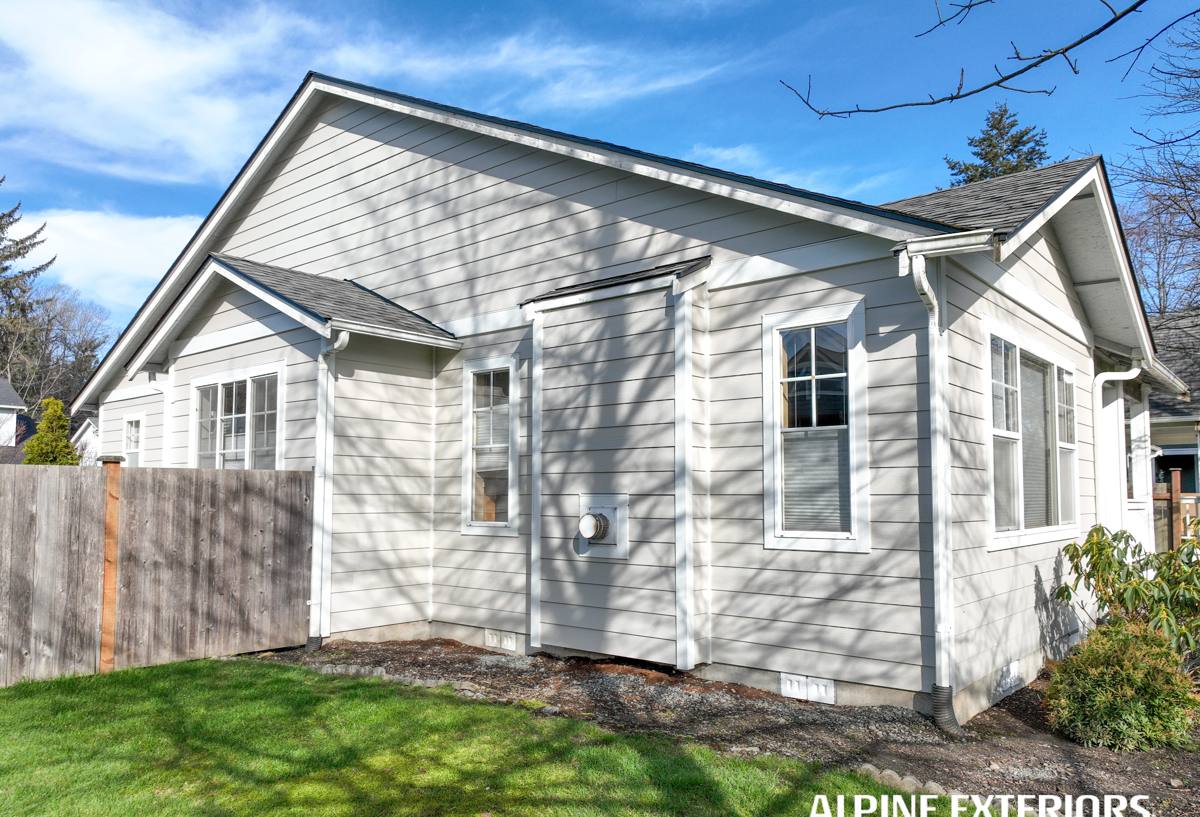
We install one siding product across every job we take on: James Hardie fiber cement. It's non-combustible, which matters both for safety and for how some insurers view a home's risk profile. It doesn't rot, it isn't a food source for insects, and it's built to handle sustained moisture exposure rather than depending on a finish layer that degrades on a fixed clock. Hardie's ColorPlus factory-applied finish is baked on under controlled conditions and comes with its own warranty against fading and peeling — a real advantage against the UV and driving rain this climate produces year after year.
Hardie also engineers climate-specific HZ product lines rather than selling one generic board everywhere in the country, so what goes on a home here is built for the moisture and temperature pattern the Pacific Northwest actually produces. It's backed by a strong transferable warranty, which matters if the home is ever sold. Installed to manufacturer spec — correct fastening, flashing, and clearances — it's the product we're willing to put our name and workmanship warranty behind, because we've seen how it performs through a full wet season in Skagit County, not just how it looks the day it goes up.
A Few Questions Worth Asking Yourself
Before committing to cedar — or any wood siding — on a full home in this area, it's worth being honest with yourself about a few things:
- Are you prepared to budget for restaining or resealing every 2 to 4 years, indefinitely, for as long as you own the home?
- Do you or will you have someone check the siding condition at least once a year, particularly after the wet season?
- Does your property have significant shade, tree cover, or north-facing walls where moss will be a persistent issue?
- Are you comfortable with a material that doesn't carry a manufacturer warranty on the wood itself?
- Would a small cedar accent area satisfy the look you want without committing the whole exterior to that maintenance schedule?
If the honest answers give you pause, that's useful information before you spend money on a full cedar installation rather than after.
Our Standard, Not a Sales Pitch
We're not telling you cedar siding is doomed to fail — homes with disciplined owners and a consistent maintenance schedule can carry cedar for decades. What we are telling you is that after years of exterior work in Anacortes and the rest of Skagit County, we've made a deliberate professional decision to install only James Hardie fiber cement, because it's the product we can stand behind through this specific climate without asking a homeowner to commit to a recurring maintenance cycle just to keep it from failing. That's our standard, not a knock on anyone who chooses differently.
If you're weighing cedar against other siding options for a home in Anacortes, we're happy to take a look at your specific property — sun exposure, tree cover, moss risk, current siding condition — and give you a straight answer about what makes sense. Reach out for a free, no-pressure estimate.