 Anacortes Siding
 Two Different Answers to the Same Problem
Engineered wood siding and fiber cement siding were both developed to solve the same set of problems that plagued traditional solid-wood siding: rot, insect damage, and short repaint cycles. They arrived at that goal from two very different starting materials, and that difference matters a lot once a product is nailed to a wall in Anacortes rather than sitting in a showroom.
Engineered wood siding (the category most homeowners know by brand names like LP SmartSide) is made from wood strands or wood fiber bonded with resins and waxes, then coated with a protective overlay. Fiber cement siding is made from cellulose fiber, sand, and Portland cement, cured into a dense, non-combustible board. Both are marketed as low-maintenance upgrades over cedar. Only one of them is a product we put on homes, and we think homeowners in Skagit County deserve a straight explanation of why.
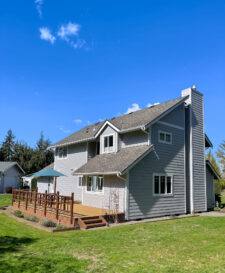
What Engineered Wood Gets Right
We're not going to pretend engineered wood is a bad product on paper. It has real strengths, and it's worth naming them before we explain our concerns:
- It's lighter than fiber cement, which can make it easier and faster to install.
- It holds paint well when the factory finish and edge-sealing are intact and undamaged.
- It machines and cuts cleanly with standard woodworking tools, without the silica dust that comes with cutting cement board.
- Upfront material cost is often somewhat lower than fiber cement.
For a builder working in a dry climate with minimal wind-driven rain, those advantages can add up to a perfectly reasonable siding choice. Anacortes isn't that climate.
Where the Concern Starts: Moisture Behavior
Engineered wood siding is still, at its core, a wood product. Wood strands and resin binders are more dimensionally stable than solid lumber, but the material is not immune to moisture — it's managed against moisture, and that management depends entirely on an intact factory coating and correctly sealed cut edges. Every cut end, every nail penetration, and every joint is a place where that protective layer can be compromised during installation or over years of freeze-thaw cycling and repeated wetting.
Anacortes sits right on the water, which means siding here deals with salt-laden air, driving rain off Rosario Strait and Guemes Channel, and a long stretch of the year — fall through spring — where surfaces simply don't dry out quickly between storms. Add the moss and algae growth that thrives in this kind of damp, shaded, marine climate, and you have conditions that stress-test any wood-based product's weak points: cut edges, butt joints, and anywhere caulking has failed or shrunk. Once moisture gets past the coating and into the substrate, wood-based siding can swell, delaminate at the edges, or develop soft spots — and unlike a cosmetic paint failure, that kind of damage isn't something a repaint fixes.
Fiber cement doesn't have that failure mode. Cement, sand, and cellulose fiber don't rot, swell, or feed fungal growth the way wood fiber can. A cut edge on a Hardie board that isn't perfectly sealed is a maintenance item, not a structural vulnerability, because there's no organic material for moisture to break down.
Installation Sensitivity: The Part Nobody Advertises
Both products are "sensitive" to installation in different ways, and being honest about that is part of giving homeowners a real answer instead of a sales pitch.
Engineered Wood
Manufacturer instructions for engineered wood siding are specific about cut-edge sealing, nailing patterns, clearance from grade, gutter and flashing details, and caulking at every joint and penetration. Skip or rush any one of those steps and you've created a moisture entry point that may not show a problem for a few years — which means a poor installation can look identical to a good one on closing day.
Fiber Cement
Fiber cement has its own installation demands: it's heavier, it requires specific fastener types and spacing, and cutting it generates silica dust that requires proper dust-control practices. It's also less forgiving of sloppy fastening — over-driven nails can crack the board. But the consequence of an installation mistake with fiber cement tends to be cosmetic or a warranty issue with the coating, not a structural rot problem, because the board itself isn't going to decompose.
Our take: we don't want our name attached to a product where a single missed caulk line five years from now becomes a rot problem hidden behind the wall. We'd rather install a product where the installation standard protects appearance and finish, not the structural integrity of the substrate itself.
Fire Performance and Insurance Considerations
This is a real difference, not a marketing point. Fiber cement is non-combustible — it's cement and sand, and it won't ignite or contribute fuel to a fire. Engineered wood, like any wood-based product, is combustible, even with a factory finish. For homes in or near wooded parts of Skagit County, or for homeowners comparing insurance considerations for exterior materials, that distinction is worth knowing about before you decide, not after.
Side-by-Side Comparison
| Factor | Engineered Wood | Fiber Cement (James Hardie) |
|---|---|---|
| Core material | Wood strand/fiber + resin | Cement, sand, cellulose fiber |
| Combustibility | Combustible | Non-combustible |
| Moisture failure mode | Edge swelling, delamination if coating is breached | None (inorganic material) |
| Weight | Lighter, easier handling | Heavier, more labor-intensive install |
| Factory finish | Overlay coating | ColorPlus baked-on finish (where selected) |
| Typical warranty | Varies by manufacturer, often shorter on finish | Long-term product warranty, transferable to a new owner |
| Cutting | Standard woodworking tools | Requires dust-controlled cutting methods |
Why We Standardized on James Hardie
We made a decision a while back to stop installing engineered wood siding, vinyl, and a few other products, and to install James Hardie fiber cement exclusively. That wasn't a marketing decision — it's a warranty and liability decision as much as a performance one. When we stand behind a product for the life of a homeowner's ownership of the house, we want that product's failure modes to be limited to things like coating wear, not hidden substrate decay we can't see until siding comes off.
James Hardie's HZ5 product line is engineered specifically for the kind of climate zone Anacortes sits in — freeze-thaw cycling, sustained moisture exposure, and coastal humidity. The ColorPlus factory finish is baked on rather than field-applied, which matters directly to the salt-air, high-moisture conditions here: a factory-cured finish resists fading and holds up to repeated wetting far more consistently than a coating applied and touched up on site. Hardie also backs its siding with a strong, transferable limited warranty, which matters to homeowners who may sell in the years after a re-side.
What Correct Hardie Installation Requires
- Proper weather-resistive barrier and flashing details at every window, door, and penetration
- Correct fastener type, spacing, and embedment depth per Hardie's published specifications
- Minimum clearance from grade, decks, and roof lines to keep moisture from wicking at the bottom edge
- Factory-cut or properly sealed field cuts to protect exposed edges
- Correct joint treatment and caulking compatible with the ColorPlus finish
Skipping any of these isn't a small shortcut — it's the difference between siding that performs for decades and siding that creates problems behind the wall.
Cost Factors Worth Understanding
Homeowners comparing bids should look past the per-square-foot number and ask what's actually included:
| Cost Factor | Why It Matters |
|---|---|
| Material grade and product line | HZ5 and ColorPlus finish cost more upfront but are matched to this climate |
| Flashing and moisture-barrier detail work | Often the difference between a warrantied install and a callback |
| Trim, corners, and joint treatment | Affects both appearance and long-term moisture performance |
| Tear-off and disposal of old siding | Varies by house, adds labor regardless of new material chosen |
| Warranty terms (product vs. labor) | A strong product warranty means little without proper installation backing it |
A Practical Checklist Before You Decide
- Ask any contractor which siding products they install — and which ones they've stopped installing, and why
- Ask what climate zone product line (HZ5, HZ10, etc.) is appropriate for your specific home's exposure
- Confirm whether the quoted warranty is a manufacturer's product warranty, a labor warranty, or both
- Ask how flashing and moisture barrier details will be handled at windows, doors, and roof lines
- Get a clear answer on whether the finish is factory-applied or field-painted
The Bottom Line
Engineered wood siding isn't a scam or a bad product in every climate — it's a product whose weak points happen to line up badly with the specific conditions Anacortes and the rest of Skagit County deal with every year: salt air, sustained wind-driven rain, and long damp stretches that favor moss and algae growth. We'd rather install one product well, understand its behavior completely, and stand behind it with confidence than offer a menu of options where some of them put us in the position of guessing how a wall will look in fifteen years.
If you're weighing a re-side and want a straight answer about what's right for your house — not just the product we sell — we're glad to walk your home with you and give you a free, no-pressure estimate.