 Anacortes Siding
 What Anacortes Siding Actually Has to Survive
Anacortes sits on Fidalgo Island, wrapped by the Guemes Channel, Rosario Strait, and Puget Sound on nearly every side. That location is beautiful and it is brutal on exterior building materials. Salt-laden air moves off the water and settles on north and west-facing walls year-round. Driving rain off the Strait doesn't fall straight down — it hits siding sideways, working into laps, seams, and fastener points that never see that kind of pressure in a drier inland town. And Skagit County's long, wet, mild winters create a moss and algae season that can run six months or longer on shaded walls and anything facing the tree line.
Put those three things together — salt, wind-driven moisture, and sustained damp organic growth — and you get a climate that is genuinely hard on siding. Some products handle one of those stresses reasonably well. Very few handle all three for the 30-40 years a homeowner actually expects a siding job to last. That's the entire reason we narrowed our installs down to one manufacturer instead of offering a menu of options.
Why We Stopped Installing Everything Else
We used to install a broader range of products, like most siding contractors do. Over enough jobs and enough callbacks on this specific coastline, a pattern showed up: the failures we were called back for were almost never workmanship failures. They were material failures — products that were fine in a lab spec sheet but struggled against this specific combination of salt air, wind-driven rain, and moss season. So we made a call as a company: install one product system we can stand behind fully, rather than installing several and hoping the homeowner picked the right one.
Vinyl Siding
Vinyl is inexpensive and low-maintenance in dry climates, and there's nothing dishonest about that. But it's a thin material that expands and contracts with temperature swings, and its seams and J-channels give wind-driven rain a lot of entry points over time. In a marine climate like ours, moisture that gets behind vinyl doesn't dry out quickly, and vinyl itself does nothing to resist the mold and mildew that thrive in six months of damp shade.
LP SmartSide and Other Engineered Wood
Engineered wood siding has come a long way and performs well in a lot of the country. Its core vulnerability is still wood — an OSB-based substrate that depends entirely on an intact factory coating and correct field caulking to keep water out. In a climate where siding gets wet, dries slowly, and gets wet again for months at a stretch, that's a lot of ongoing dependence on perfect maintenance to avoid swelling and edge failure.
Cedar and Primed Spruce
Real wood siding looks great and has a long history in this region for a reason. It also needs a maintenance commitment — recoating, caulk checks, moss treatment — that most homeowners underestimate when they buy the house. Left alone through even a couple of wet Skagit County winters, moss and algae take hold, and the wood underneath starts absorbing moisture it can't shed fast enough.
Other Fiber Cement Brands (Cemplank, Allura)
This one is the closest comparison, because the base material — fiber cement — is genuinely a good fit for this climate. Our decision here isn't about the raw material; it's about the factory finish, the climate-specific engineering, and the warranty structure behind the product, which we cover below.
Why James Hardie Is the One We Install
Fiber cement itself is the right starting point for a marine climate: it's non-combustible, it doesn't swell or rot the way wood-based products can, and it holds paint far more stably than wood substrates because it doesn't move much with moisture and temperature. James Hardie is the manufacturer we've standardized on because of how they engineer and finish that material, not just because it's fiber cement.
Climate-Engineered Product Lines
James Hardie makes region-specific formulations under its HZ5 and HZ10 designations, engineered for the freeze-thaw, humidity, and moisture patterns of specific climate zones rather than a single one-size-fits-all mix. Western Washington, including Skagit County, falls into the range these formulations are built for — a real advantage over a generic fiber cement product engineered for an average national climate rather than this one.
ColorPlus Factory Finish
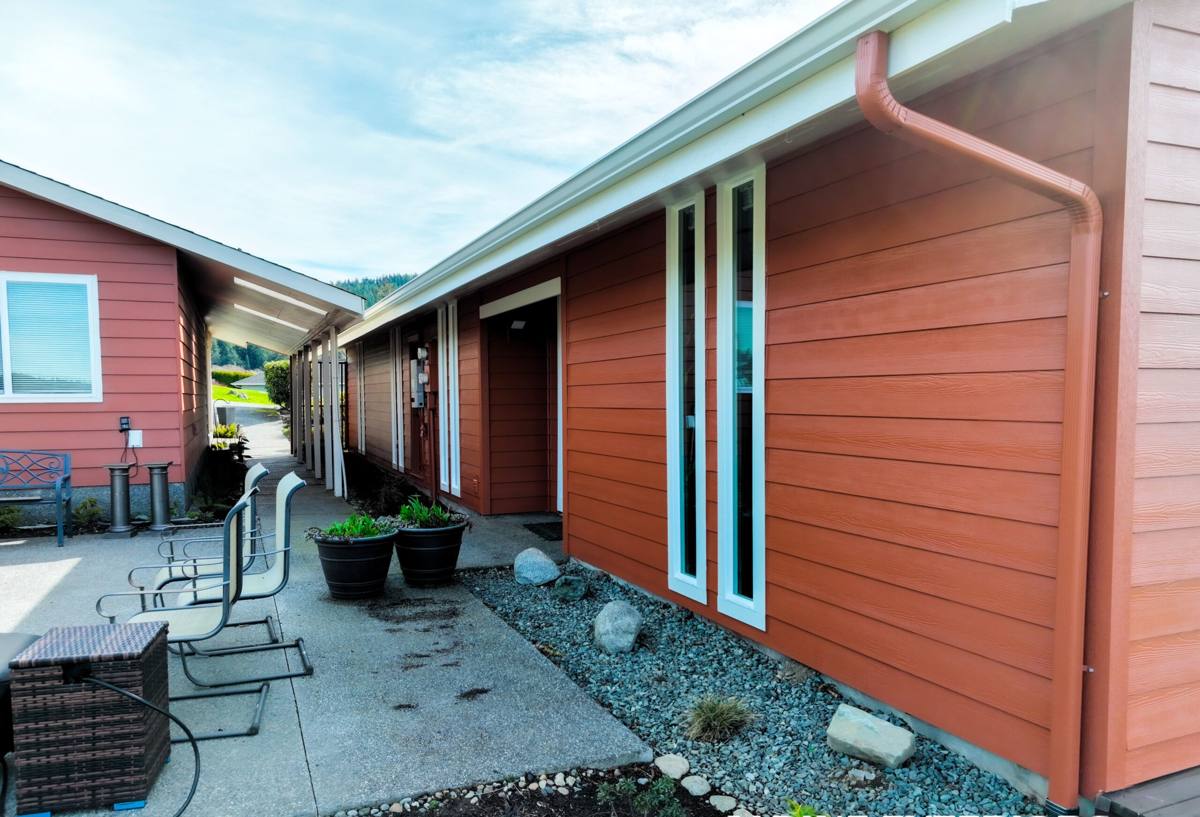
This is the detail that matters most for long-term appearance and the one homeowners underestimate. Field-painted siding — whether it's fiber cement, wood, or anything else — is only as good as the paint job and the weather conditions on the day it was applied. Hardie's ColorPlus finish is baked on at the factory in a controlled environment, cured to bond with the fiber cement substrate, and backed by its own finish warranty. In a climate where UV exposure is moderate but moisture exposure is constant, a factory-cured finish resists fading, chipping, and moisture intrusion at the surface far better than a coat of paint applied on a job site.
Moss and Algae Resistance
No siding is immune to moss in a Skagit County winter — moss will grow on anything given enough shade and dampness. But Hardie's dense fiber cement composition and factory finish give it a harder, less porous surface for spores to grab onto compared to wood-based products, and it doesn't degrade structurally if moss does take hold before a homeowner gets around to cleaning it off.
Warranty and What It Actually Covers
James Hardie backs its siding with a non-prorated limited warranty on the substrate and a separate finish warranty on ColorPlus color, both of which are transferable to a new owner if the home sells — something worth asking about explicitly when comparing products, since transferability terms vary a lot by manufacturer. That warranty structure only holds up if installation follows Hardie's published specifications, which is why installation quality is not a minor detail on this product.
Installation Is Where Fiber Cement Succeeds or Fails
Fiber cement siding has a reputation problem that mostly traces back to bad installation, not the material itself. In a climate like ours, small installation mistakes turn into real problems faster because there's more moisture testing every gap and seam.
- Correct clearance from grade, decks, and roof lines so splashback and standing water don't sit against the bottom edge
- Proper fastener placement and spacing per Hardie's specifications, not a generic siding pattern
- Correctly flashed and caulked butt joints, corners, and penetrations — the exact spots wind-driven rain targets
- Field-cut edges primed or sealed before installation so raw fiber cement isn't left exposed to moisture
- Rainscreen or proper weather-resistive barrier detailing behind the siding to let any incidental moisture dry out
- Manufacturer-approved caulk and touch-up paint used at cut edges and joints, matched to the ColorPlus finish
Skip any one of these steps and you can end up with the exact moisture problems fiber cement is supposed to solve. This is a big part of why we install only one system: we can train our crews to one spec, in depth, instead of spreading that expertise thin across several product lines with different rules.
Comparing the Trade-Offs
| Factor | Vinyl | Engineered Wood | Cedar | James Hardie Fiber Cement |
|---|---|---|---|---|
| Moisture resistance in marine climate | Moderate — seams leak over time | Depends on coating integrity | Requires ongoing maintenance | Strong when installed to spec |
| Combustibility | Combustible | Combustible | Combustible | Non-combustible |
| Finish durability | Fades over time, can't repaint easily | Depends on factory or field coating | Needs recoating every few years | Factory-cured ColorPlus finish |
| Moss/algae resilience | Low | Low to moderate | Low without maintenance | Moderate to high |
| Typical warranty transferability | Varies by brand | Varies by brand | N/A (natural material) | Transferable to new owner |
What Drives the Cost of a Hardie Project
Homeowners comparing quotes should know that fiber cement generally costs more upfront than vinyl and is comparable to or somewhat more than engineered wood, largely because of the material itself and the labor time correct installation requires. A few things move the price on any given house:
- Home size and number of stories, which affects staging, scaffolding, and labor hours
- Existing siding removal and any sheathing or moisture damage found underneath once old siding comes off
- Trim complexity — dormers, bay windows, and multiple roof lines all add cut work and detailing time
- Plank versus shingle-style Hardie profiles, since detailed profiles take longer to install correctly
- Color and finish choice, since some ColorPlus colors and accent trims carry different material costs
Any contractor should be able to walk you through these factors specifically for your house, not just hand over a flat per-square-foot number.
Get a Straight Answer for Your Home
Every house on Fidalgo Island and around Skagit County faces this climate a little differently depending on sun exposure, tree cover, and how close it sits to the water. If you're weighing siding options or dealing with an aging exterior that isn't holding up to the salt air and rain anymore, we're happy to take a look and give you a straightforward, no-pressure estimate on what a James Hardie installation would involve for your specific home.