 Anacortes Siding
 Ship Harbor's Marine Climate and What It Does to Vertical Siding
Ship Harbor sits close to the water on the western edge of Anacortes, near the ferry terminal and the open exposure of Rosario Strait. That location is part of what makes the neighborhood beautiful, and it's also exactly why siding here takes more abuse than siding a few miles inland. Homes in this pocket of Skagit County deal with salt-laden wind coming straight off the water, driving rain that hits walls at an angle instead of falling straight down, and a long stretch of the year — roughly October through April — when shade, moisture, and mild temperatures combine to grow moss and algae on anything that stays damp.
Board and batten siding is a vertical design, which means water runs down the face of the panel and along the batten edges instead of shedding off a horizontal lap. That's a good thing when the details are done right, because it gives water fewer horizontal ledges to sit on. It's a bad thing when the details are done wrong, because vertical seams and batten strips create more edges, more fastener penetrations, and more opportunities for water to find its way behind the cladding if the underlying assembly isn't built correctly. In a climate like Ship Harbor's, the difference between board and batten that looks great for 25 years and board and batten that fails at year 8 almost always comes down to what's happening behind the boards, not the boards themselves.
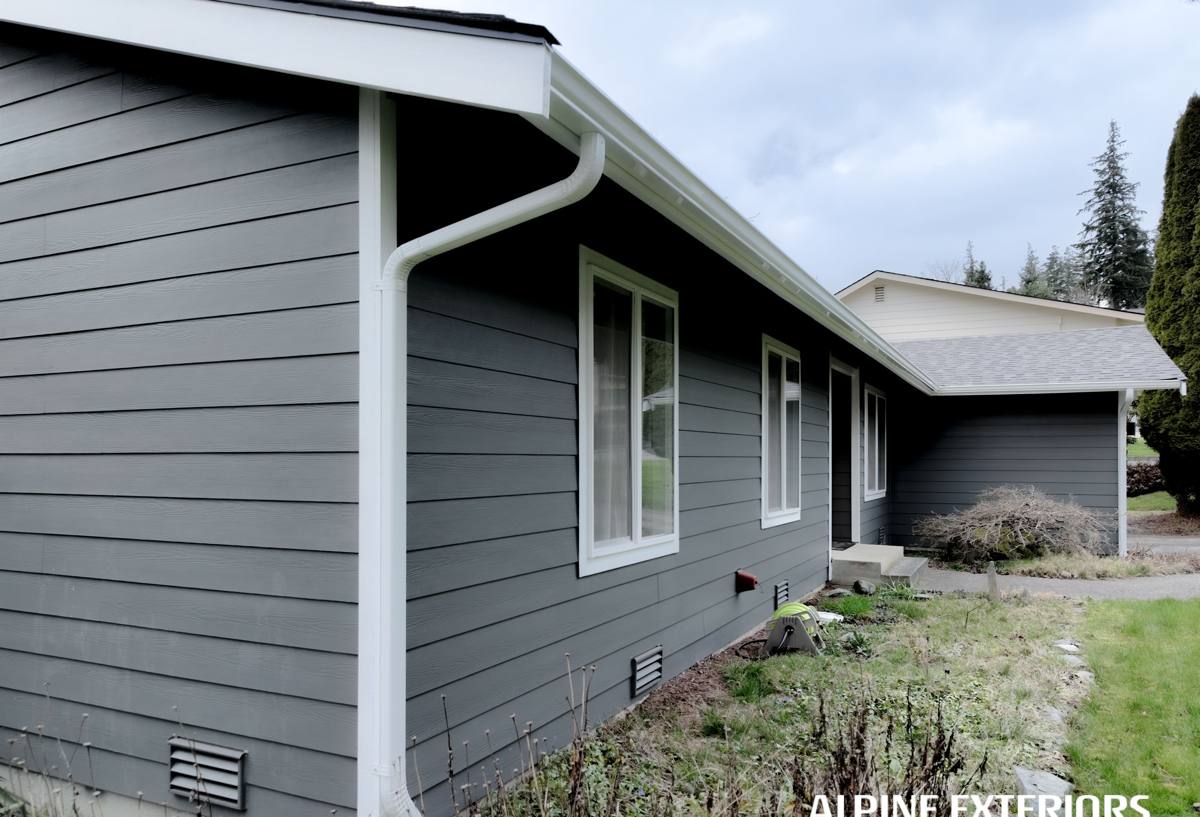
What Correct Board & Batten Construction Requires
Board and batten is a system, not just a plank pattern. Getting the look is easy. Getting the water management right is where the work actually is.
Substrate and Water-Resistive Barrier
Every board and batten installation on a home near the water needs a continuous water-resistive barrier behind it, lapped correctly from bottom to top, with seams taped or shingled so wind-driven rain can't track sideways behind the panel. On a site exposed to the wind patterns around Ship Harbor, we treat this layer as non-negotiable — it's the backup system for the inevitable moments when wind pushes water past the cladding itself.
Batten Spacing and Fastening
Battens have to be fastened into solid framing or proper blocking, not just into the panel or sheathing, and spaced to match the panel width so the reveal lines stay straight and consistent. Fastener placement matters more on vertical siding than horizontal lap siding, because a fastener driven in the wrong spot on a batten can split the panel underneath or create a path for water to travel down into the wall assembly.
Flashing at Penetrations and Transitions
Windows, doors, hose bibs, light fixtures, and the transition from siding to trim, foundation, or roofline are where board and batten siding actually fails when it fails. Every one of those spots needs proper flashing and sealant detailing, not just a bead of caulk run along the edge. We flash these transitions the same way regardless of what the finished wall looks like on the outside, because that's the part homeowners never see and the part that determines whether the wall stays dry.
Why We Only Install James Hardie for Board & Batten Work
Board and batten can be built out of several materials, and each one has real advantages. We've made the decision to install only James Hardie fiber cement, and it's worth explaining why rather than just stating it.
Cedar board and batten has a warmth and authenticity that's hard to match, and it's a legitimate choice for the right homeowner. But real wood in a salt-air, high-moisture environment like Ship Harbor needs a disciplined refinishing schedule to keep water out of the grain — skip a few cycles of staining or painting and you're looking at cupping, splitting, and rot at the exposed edges. LP SmartSide is an engineered wood product with a factory treatment that helps resist moisture, but it's still a wood-based substrate, and any breach in that factory coating — a scratch, an unsealed cut end, a fastener that missed its mark — gives moisture a way into the wood strand core. Vinyl board and batten is low-maintenance and inexpensive, but it's a thin plastic product that can warp or fade under prolonged UV and temperature swings, and it doesn't hold up structurally the way a rigid fiber cement panel does in high-wind coastal exposure.
James Hardie fiber cement is non-combustible, dimensionally stable in wet climates, and engineered specifically for the moisture patterns found in the Pacific Northwest. That combination of durability and low maintenance burden is why we standardized on it and stopped installing the alternatives — not because those products don't have a place in the market, but because we're not willing to put our name on an installation we think is a maintenance liability for the homeowner five or ten years down the road.
The James Hardie Board & Batten System We Use
For vertical applications, James Hardie offers HardiePanel vertical siding paired with matching battens, giving you the classic board and batten profile in a fiber cement assembly engineered to work as a system rather than mismatched parts. Panels come in smooth or cedar-textured finishes, so you can get a clean modern look or a more traditional wood-grain appearance depending on the style of the home.
Every panel we install comes factory-finished with James Hardie's ColorPlus coating — a baked-on finish applied under controlled conditions, which holds color and resists fading and chipping far better than a field-applied paint job. That matters in a coastal environment where sun, salt, and moisture all work against a painted finish. James Hardie's HZ product lines are also engineered by climate zone, and the HZ5 formulation used in this region is built specifically to perform in wetter, cooler climates like ours rather than a generic national spec.
Backing the material is James Hardie's transferable limited warranty, which is one more reason we don't hedge our recommendation — we're installing a product with a manufacturer standing behind it for the long haul, not asking a homeowner to take our word alone.
Material Comparison for Ship Harbor Homes
Homeowners comparing options for a board and batten project deserve a straight answer on how the materials actually stack up in this specific climate, not just on price.
| Material | Salt Air / Moisture Behavior | Maintenance Burden | Typical Lifespan Here |
|---|---|---|---|
| James Hardie fiber cement | Engineered for wet coastal climates; dimensionally stable | Occasional wash; factory finish holds up for years | Decades with correct install and upkeep |
| Cedar | Absorbs moisture at cuts and joints without diligent sealing | Regular refinishing on a strict schedule | Shorter without consistent maintenance |
| LP SmartSide | Factory-treated wood strand; vulnerable if coating is breached | Moderate; touch-up needed at damage points | Solid, but sensitive to installation quality |
| Vinyl | Doesn't rot, but can warp/fade with UV and temperature swings | Low, but limited repair options if damaged | Variable; weakest in high-wind exposure |
This isn't a claim that the other materials are bad products across the board — it's a summary of why, for the specific combination of salt air, wind, and moss season that Ship Harbor homes deal with, fiber cement is where we've landed as the standard we're willing to install.
Our Installation Process
Every board and batten project follows the same disciplined sequence, whether it's a full re-side or an addition being matched to existing siding:
- On-site assessment of the existing wall assembly, framing condition, and any moisture or rot found once old siding comes off
- Repair or replacement of any compromised sheathing or framing before new material goes up
- Installation of a continuous water-resistive barrier with properly lapped and sealed seams
- Layout and installation of HardiePanel and battens to manufacturer fastening specs, with attention to reveal consistency
- Flashing and sealant detailing at every window, door, and penetration
- Final walkthrough with the homeowner before we consider the job complete
We don't shortcut step one or two because the finished siding looks fine either way — the parts nobody sees are the parts that determine whether the wall stays dry for the next several decades.
Maintenance in a Moss-Prone, Salt-Air Environment
Even a well-installed board and batten wall benefits from a little seasonal attention in this climate. Salt residue and airborne moisture can dull a finish over time if it's never rinsed, and shaded north- and west-facing walls in this region are the most likely spots for moss and algae to take hold during the long wet season. A periodic gentle rinse-down, keeping nearby vegetation trimmed back so walls get airflow and some sun exposure, and an annual visual check of caulking and flashing points go a long way. Because ColorPlus finish is baked on rather than field-applied, routine cleaning doesn't strip or fade it the way it can with a site-painted surface.
What to Look for When Hiring a Board & Batten Contractor in Ship Harbor
Board and batten is unforgiving of shortcuts because the vertical seams and batten fasteners leave less room for error than a standard lap installation. Before hiring anyone for this kind of project, it's worth confirming a few basics:
- They can explain their water-resistive barrier and flashing approach in specific terms, not just "we seal everything"
- They're familiar with James Hardie's published fastening and batten-spacing specifications for vertical applications
- They carry manufacturer training or certification relevant to fiber cement installation
- They'll show you how they handle transitions at windows, corners, and the foundation line before work begins
- They're licensed, insured, and willing to put the scope of work in writing
- They have experience with homes in exposed, marine-influenced locations similar to Ship Harbor
Why Local Ship Harbor Experience Matters
A crew that works regularly in and around Ship Harbor knows how differently a home a few blocks from the water behaves compared to one further inland in Anacortes or elsewhere in Skagit County — how much more wind-driven rain a west-facing wall takes, how much faster moss establishes on a shaded elevation near the tree line, how much salt exposure a fastener or flashing detail needs to shrug off over the years. That's knowledge you build by doing the work here repeatedly, not by reading a spec sheet once. It shows up in the small decisions on a job site that a homeowner never has to think about, because the crew already accounted for them.
If you're planning a board and batten project for a home in Ship Harbor or elsewhere in Anacortes, we're happy to walk the property, look at what your walls are currently dealing with, and put together a free, no-pressure estimate — no obligation, just a straight assessment of what your home needs.