 Anacortes Siding
 Ship Harbor's Exterior Environment
Ship Harbor sits on the water side of Anacortes, close enough to the ferry terminal and the open strait that homes here take a different kind of weathering than houses a mile inland in Skagit County. The air carries salt. The wind has a straight run at the exterior walls facing the water. And the same marine moisture that keeps this part of Fidalgo Island green year-round is exactly what drives moss, mildew, and slow rot into siding that isn't built to shed it.
None of this is exotic. It's the same combination that wears on homes up and down the Salish Sea shoreline: salt-laden air, driving rain that hits siding at an angle instead of falling straight down, and a moss season that can run eight or nine months out of the year in shaded, north-facing exposures. What matters is how a home's siding, trim, and flashing detail respond to that combination over ten, twenty, thirty years.
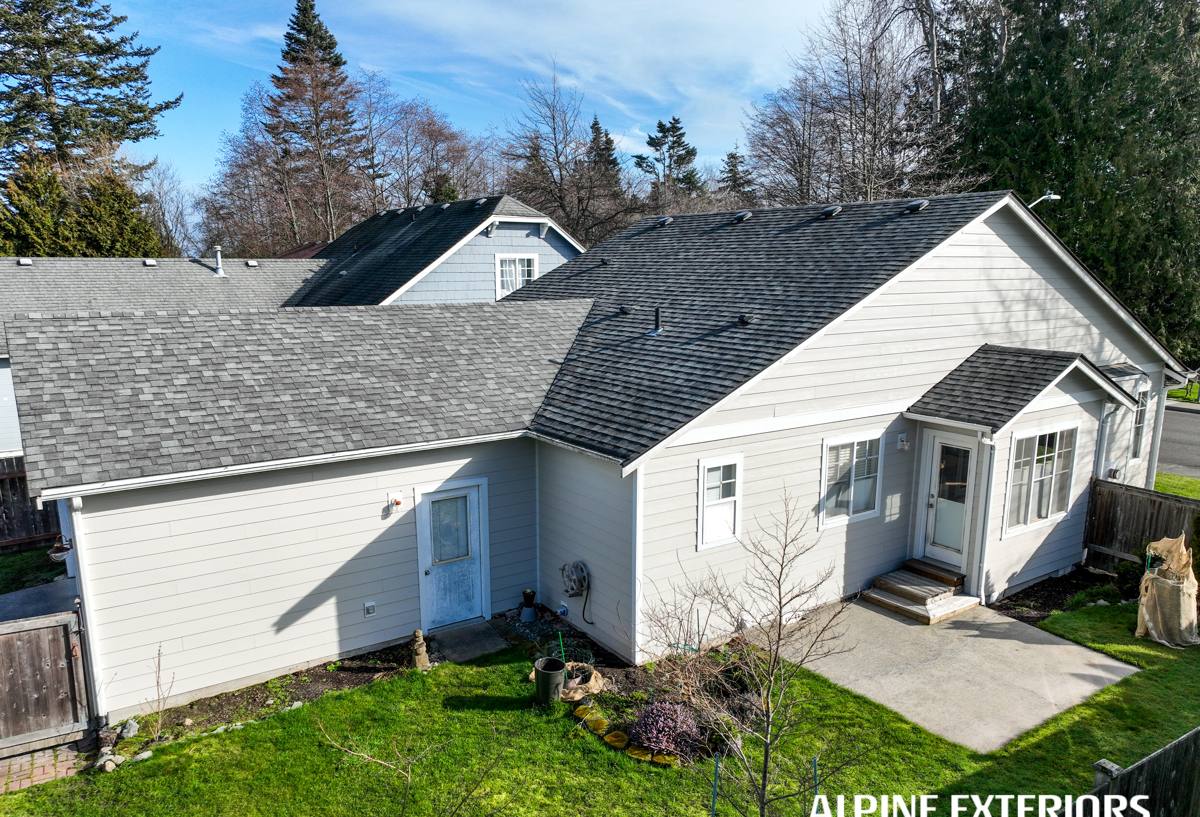
What We See On Ship Harbor Homes
Working this area regularly, a few patterns show up more than they would on a drier, more sheltered lot:
- Moss and algae staining on north- and west-facing walls, especially under eaves with limited sun exposure
- Paint film failure and caulk cracking where wood or engineered wood siding has taken repeated wet-dry cycles
- Corrosion on lower-grade fasteners and trim hardware exposed to salt air
- Soft or delaminating siding at butt joints and corners where water has been finding a way in for years, often unnoticed until a repaint or repair job exposes it
- Wind-driven rain intrusion at panel edges and window trim on the water-facing side of a house
None of that means Ship Harbor is a bad place to own a home — it's a beautiful spot for exactly the reason it's tough on exterior materials: you're close to the water. It just means the siding, roofing, and window details need to be chosen and installed with that exposure in mind, not treated like a standard suburban lot.
Why This Differs From a Sheltered Anacortes Lot
A home tucked into a wooded lot away from the water deals mostly with shade-driven moss growth and general Pacific Northwest rainfall. A Ship Harbor home dealing with direct wind off the strait adds salt exposure and wind-driven rain to that list. The practical result is that materials and details which perform adequately on a sheltered lot can underperform on an exposed one — thinner coatings wear faster, poorly sealed joints let in more water, and softwood substrates absorb more moisture before they ever get a chance to dry out between storms.
Why We Install Only James Hardie Fiber Cement
We made a decision as a company to install one siding system: James Hardie fiber cement. Not because it's the only decent product on the market, but because it's the one we're comfortable standing behind on homes facing this specific climate, year after year, without hedging.
Fiber cement is cement, sand, and cellulose fiber — it doesn't have the organic wood content that gives moisture a food source, and it isn't a petroleum-based product that softens or embrittles under sun and salt exposure the way some engineered and vinyl products can over a long service life. It holds paint and factory finish differently than wood, it doesn't feed rot fungus, and it's non-combustible, which matters increasingly for insurance conversations even in a coastal, high-moisture area where wildfire isn't the first concern that comes to mind.
What "Climate-Engineered" Actually Means
James Hardie makes region-specific product formulations under its HZ5 and HZ10 designations, engineered for different moisture and freeze-thaw conditions across the country. For the Pacific Northwest — Skagit County, Anacortes, and specifically wetter, wind-exposed spots like Ship Harbor — the relevant point isn't a marketing label, it's that the product is formulated and tested for sustained wet climates rather than a generic national spec. Combined with a factory-applied ColorPlus finish (baked on in a controlled environment rather than field-painted), the result is a siding system that's supposed to hold its color and seal without the maintenance repainting cycle wood or thin coatings need.
Comparing What's Actually At Stake
| Factor | Wood / Engineered Wood Siding | Vinyl Siding | James Hardie Fiber Cement |
|---|---|---|---|
| Moisture response in marine climate | Absorbs moisture, can swell or delaminate at joints | Doesn't absorb, but can warp and gap, letting water behind panels | Non-combustible, doesn't rot; engineered for wet climates |
| Salt air / coastal wind exposure | Accelerates paint failure and edge decay | Can become brittle and fade faster near salt spray over time | Factory finish holds color; substrate doesn't feed decay |
| Moss and algae resistance | Textured surfaces and cut edges are common growth points | Smooth surface resists growth but seams trap debris | Smooth factory finish sheds growth better; still needs periodic cleaning |
| Repainting / recoating cycle | Typically every 5-10 years | Doesn't need paint, but can't be effectively repainted if faded | ColorPlus finish rated well beyond typical repaint cycles |
| Fire rating | Combustible | Combustible, can melt/deform near heat sources | Non-combustible |
We don't install LP SmartSide, vinyl, Cemplank, Allura, primed spruce, or cedar — not because every one of those products is poorly made, but because we'd rather commit to one system we can install to spec, warranty properly, and stand behind on every job than split our crews and our expertise across five different materials with five different installation quirks and moisture behaviors.
Roofing, Windows, and Decks in the Same Exposure
Siding doesn't work in isolation. A Ship Harbor home facing wind-driven rain needs the roofing, window flashing, and deck details working together, not fighting each other. A few things we pay particular attention to on homes in this area:
Roofing
Roof edges, valleys, and any transition where the roofline meets a wall are common points where wind-driven rain finds its way behind siding if the flashing isn't detailed correctly. On an exposed lot, we treat that transition as critical, not routine.
Windows
Window flashing integration with the siding water-resistive barrier matters more on a wind-exposed wall than a sheltered one. A window that's "close enough" on a calm inland lot can leak on a wall that regularly takes rain at an angle.
Decks
Ledger board connections and any deck structure tied into the house need the same moisture-conscious detailing as the siding around them — a deck ledger is one of the more common places we find hidden rot on older coastal homes.
What Correct Installation Looks Like
James Hardie siding is only as good as the installation behind it. The product itself won't compensate for shortcuts at the details, and on an exposed lot those shortcuts show up faster.
- Proper water-resistive barrier and flashing integration at every window, door, and penetration
- Correct fastener type and placement per Hardie's published installation specs — not generic trim nails
- Manufacturer-specified clearances at grade, roof lines, and decks so siding isn't sitting in standing moisture
- Caulking and joint treatment matched to Hardie's fastening and finishing guidelines, not a generic caulk-everything approach
- Field-cut edges properly primed and sealed, since factory finish only protects what's finished at the factory
Skipping any one of those isn't usually visible for a year or two. It shows up five or ten years later as staining, soft trim, or a warranty claim that gets denied because the installation didn't meet manufacturer requirements. That's the real argument for a local crew that installs one product system daily and knows its installation spec cold, rather than a crew moving between five different siding types and treating them all the same way.
Why Local Experience Matters Here
A contractor working across Skagit County sees the difference between a sheltered Anacortes lot and an exposed one like Ship Harbor because we're back on these streets repeatedly — not reading a regional climate zone off a chart. That's the difference between a generic installation and one that accounts for which direction a house faces, how much wind it takes off the water, and where moss and moisture actually collect on that specific structure.
James Hardie backs its ColorPlus finish and substrate with a strong transferable warranty when installation meets spec — which is one more reason installation quality isn't optional. A warranty is only worth what it covers, and it only covers what was actually installed correctly.
Get a Straight Answer for Your Home
If you're dealing with moss buildup, failing paint, soft trim, or you're just planning ahead for a home exposed to Ship Harbor's wind and salt air, we're happy to take a look and give you a straightforward assessment — no pressure, no upsell to a product we don't install ourselves. Request a free estimate below and we'll walk the exterior with you and talk through what actually makes sense for your home.