 Anacortes Siding
 Sedro-Woolley Homes Face a Slow, Steady Kind of Weather Damage
Sedro-Woolley sits inland along the Skagit River, tucked between farmland and the first rise of the Cascade foothills. It doesn't take the direct wind-driven surf spray that hits homes right on Puget Sound, but it doesn't escape the region's weather either. Storm systems that move in off the water still push driving rain up the valley, humid air settles and lingers longer here under tree cover and low winter cloud, and the result is a moss season that runs most of the year rather than a few wet months. None of that is dramatic on any single day. It's the accumulation over years that wears down an exterior that wasn't built for it.
We're an Anacortes-based exterior contractor working across Skagit County, and Sedro-Woolley is a regular part of that territory. The pattern we see on service calls here is consistent: siding that looked fine for the first several years, then started showing soft spots, streaking, and paint failure well before it should have. Almost every time, the cause traces back to a material or an installation detail that wasn't matched to what this climate actually does to a wall over a couple of decades.
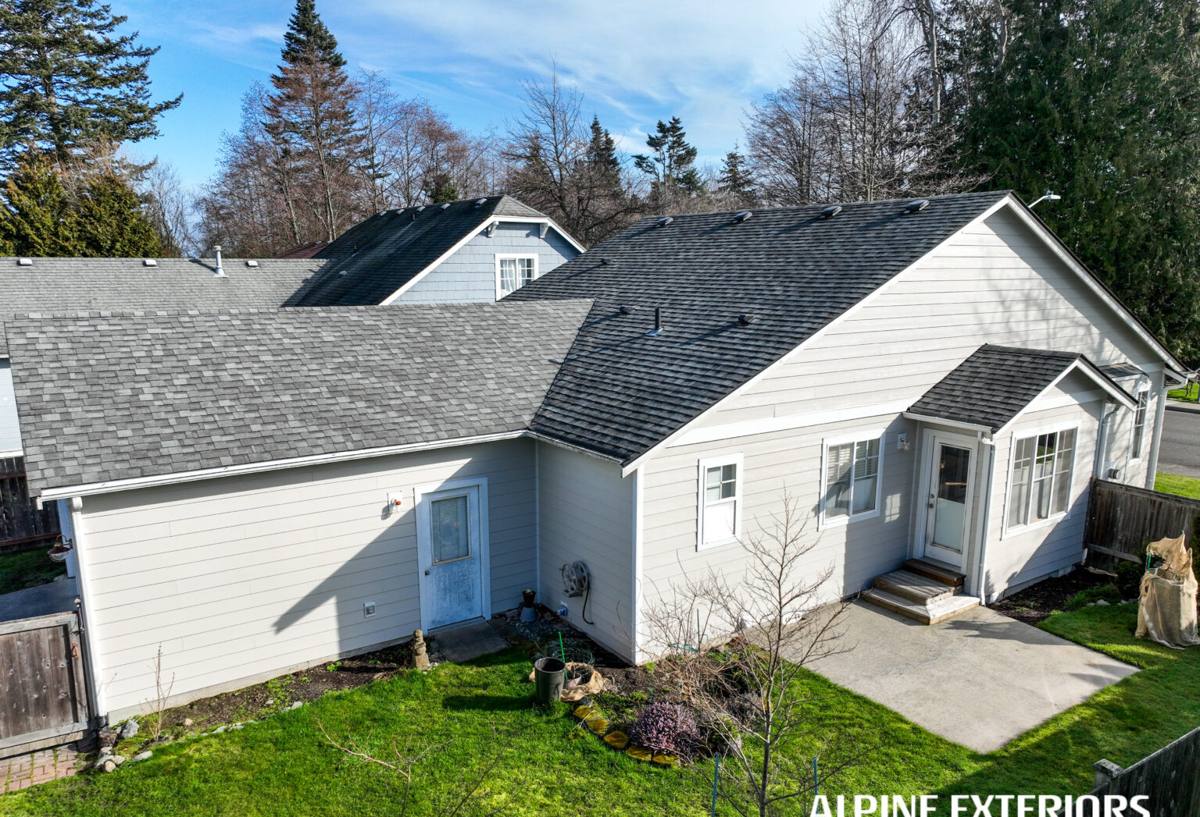
What Salt Air, Rain, and Moss Actually Do Over Time
Moisture That Doesn't Get a Break
Skagit County's marine-influenced air carries a low but steady dose of salt-tinged moisture inland from the Salish Sea, and when that combines with Sedro-Woolley's tree cover and valley humidity, exterior surfaces spend a lot more of the year damp than dry. Materials that absorb water — even a little, at cut edges or seams — stay wet longer here than they would in a drier climate, and that's exactly the condition that accelerates rot, delamination, and finish failure.
A Moss Season That Doesn't Really End
Filtered light from mature trees, mild temperatures, and near-constant humidity make Sedro-Woolley good moss habitat almost year-round. North-facing walls and anywhere airflow is restricted are usually first to show it. Moss doesn't just look bad — it holds moisture directly against the siding surface, which is a slow but real driver of the rot and paint failure we see on older installations.
Driving Rain and Wind-Loaded Seams
Rain in this part of the state rarely just falls straight down. Wind pushes it sideways into laps, corner joints, and trim seams, which is where poorly installed or poorly flashed siding starts to fail first — regardless of what the material itself is rated for.
Freeze-Thaw From the Foothills
Being closer to the Cascade foothills than towns right on the water means Sedro-Woolley sees a few more freeze-thaw cycles each winter. Materials holding moisture that then freeze and expand take on cracking and surface breakdown over time — a damage pattern that's easy to miss until it's already extensive.
Why We Install Only James Hardie Fiber Cement
We used to offer more product options. We narrowed that down after too many service calls where the failure pattern was the same: a product that performs fine in a drier or milder region struggling against Skagit County's rain load and moss season. Here's the reasoning behind our standard:
- Non-combustible fiber cement core — it doesn't add fuel to a fire the way wood-based siding can, which matters for safety and often for insurance.
- Factory-cured ColorPlus finish — cured under controlled conditions rather than brushed on site, so it holds color and resists chipping far longer than field-applied paint exposed to this climate.
- HZ5 climate engineering — Hardie's HZ5 formulation is built for regions with significant moisture and freeze-thaw exposure, a closer match to Skagit County than lines engineered for warmer, drier markets.
- Dimensional stability — fiber cement doesn't swell, cup, or warp the way engineered wood can when it takes on repeated moisture.
- A strong, transferable warranty — backed by manufacturer specification, which matters most when the installation itself is done to spec.
We don't install LP SmartSide, vinyl, Cemplank, Allura, primed spruce, or cedar. Those products aren't without merit, and plenty of homeowners are satisfied with them elsewhere. Our position is narrower than a blanket judgment: given what we've seen this specific climate do to siding over years of service work, we'd rather install one system we can stand behind for decades than offer a menu of options with different maintenance demands and moisture tolerances.
Comparing Siding Options for a Valley Climate
| Product | How It Handles This Climate | Ongoing Maintenance | Typical Lifespan |
|---|---|---|---|
| James Hardie Fiber Cement | Engineered for moisture and freeze-thaw exposure | Low — factory finish holds up with minimal upkeep | 30+ years installed to spec |
| Vinyl | Can trap moisture behind panels; softens and fades in sustained damp conditions | Low cost upfront, but limited lifespan in wet climates | 15-25 years |
| LP SmartSide (engineered wood) | Vulnerable at cut edges and seams if sealing isn't maintained | Moderate — edges and seams need regular attention | 15-30 years, variable |
| Cedar / Primed Spruce | Absorbs and holds moisture; needs airflow to dry | High — regular refinishing and inspection | 10-20 years without diligent upkeep |
These are general industry ranges, not guarantees. Actual performance always depends on installation quality, upkeep, and how exposed a given elevation is to sun, shade, and prevailing wind.
It's Not Just Siding — The Whole Exterior Works Together
A siding system doesn't fail in isolation. It fails because water got somewhere it shouldn't have, and that path usually starts at the roof, a window, or a deck ledger. We handle all four trades so a Sedro-Woolley home gets treated as one connected system rather than four separate jobs.
Roofing
How a roof directs water — at valleys, drip edges, and penetrations — determines how much of that water load the siding underneath has to manage. A roof shedding water in the wrong place will overwhelm even well-installed siding over time.
Windows
Window flashing and how it ties into the siding plane is one of the most common places we find hidden moisture damage during inspections. Problems here stay invisible for years before they show up as soft trim or stained drywall inside.
Decks
Decks take the same rain and moss exposure as siding, plus standing water and ground contact. We build and repair decks with drainage details and materials suited to a climate that stays damp much of the year.
What a Sedro-Woolley Siding Project Actually Involves
Inspection Before Anything Gets Quoted
We walk the exterior first and read what the current siding and trim are telling us — staining patterns, soft spots, failed caulk lines, and gaps at penetrations. On Sedro-Woolley homes, that usually means paying close attention to shaded, tree-adjacent walls where moss and slow-drying moisture problems tend to start.
What's Under the Old Siding Matters More Than the Siding Itself
Once old material comes off, we check the sheathing and framing before anything new goes up. Water-damaged substrate gets repaired, not covered. Skipping this step is the most common shortcut in low-bid siding work, and it's why "new" siding sometimes fails within a handful of years no matter what product was used.
Installation to Manufacturer Specification
Hardie siding is engineered around specific nailing patterns, ground and roofline clearances, and flashing details at every penetration. The material itself rarely fails on its own — installation shortcuts are what cause the early moisture intrusion we get called out to fix on other companies' work.
A Practical Checklist Before You Sign a Siding Contract
- Ask exactly which product line will be installed, and why the contractor recommends it for this climate
- Confirm manufacturer certification for that specific product
- Ask how water-damaged sheathing found during tear-off is handled and priced
- Get clearance and flashing details in writing, not just a verbal assurance
- Verify licensing and insurance directly rather than taking it on faith
- Ask what the warranty actually covers, and whether it's transferable if you sell the home
Signs Your Current Siding Is Losing Ground
- Green or dark staining that returns within months of cleaning
- Soft, spongy spots when pressed near bottom courses or under windows
- Peeling, bubbling, or chalking paint, especially on shaded or north-facing walls
- Visible gaps or separation at seams, corners, or trim joints
- Warping, cupping, or swelling in existing panels or boards
Why It Matters That the Crew Actually Works This Area
A siding job built right for a wind-exposed shoreline property in Skagit County isn't automatically right for a tree-covered valley setting like Sedro-Woolley, and the reverse is just as true. A crew that works this county regularly knows which wall orientations dry out slowest here, where moss takes hold first, and how the rain behaves across a full year rather than on the one day a job gets installed. That's what shapes the flashing choices and clearances that hold up for decades instead of just looking finished at handoff — and it's what gives a homeowner someone to call if a question comes up five years down the road.
If your Sedro-Woolley home's exterior is showing wear, or you'd rather plan ahead than wait for a small problem to become an expensive one, we're happy to take a look and give you a straight, no-pressure assessment of what it actually needs. Use the form below to schedule a free estimate.