 Anacortes Siding
 Why West Anacortes Homes Wear Out Faster Than Inland Homes
West Anacortes sits close to open water on Fidalgo Island, and that proximity shapes almost everything about how a home's exterior ages here. Salt-laden air off Rosario Strait and Guemes Channel doesn't just smell different — it's chemically corrosive to fasteners, coatings, and unprotected wood fiber. Add Skagit County's long wet season, where driving rain off the water comes in sideways more often than straight down, and you have an exterior that's under sustained attack for eight or nine months out of the year.
The fourth factor is moss. West Anacortes gets enough shade from mature evergreens, enough humidity, and enough mild temperature swings that moss and algae don't just grow on roofs — they colonize siding, trim, and anything with a rough or porous surface that stays damp. Once moss gets a foothold on a wall, it holds moisture against the substrate around the clock, which is a slow but reliable way to rot wood-based siding and blister paint.
None of this means West Anacortes homes are doomed to constant repair. It means the exterior materials and installation details matter more here than they would in a drier, inland climate. A siding job that would hold up fine in eastern Washington can fail in half the time a few blocks from the water.
The Three-Part Climate Load
- Salt air: corrodes exposed metal fasteners and accelerates coating breakdown on siding and trim.
- Driving rain: pushed by wind off the strait, finds gaps in flashing and caulk that vertical rain would never reach.
- Moss and algae: long shoulder seasons with high humidity and filtered sun let organic growth establish on siding, not just roofs.
What We Actually See on West Anacortes Siding
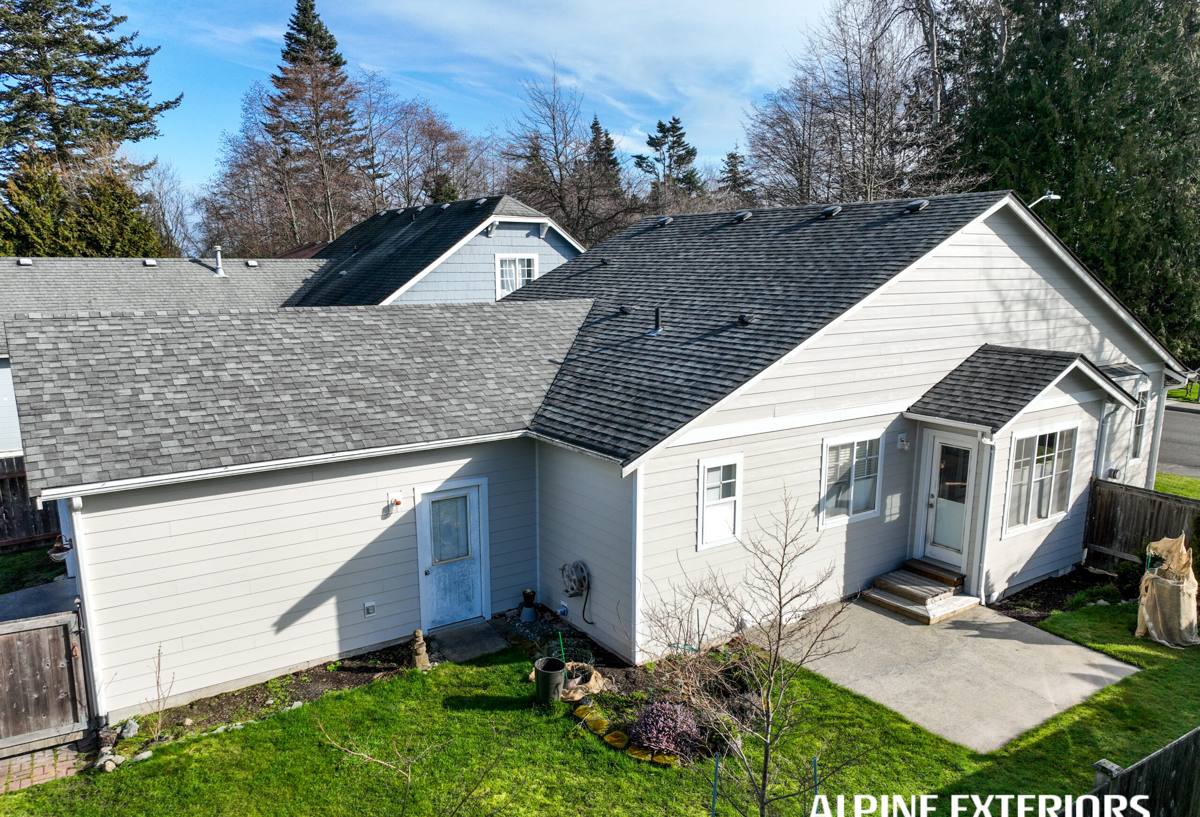
When we walk a property on the west side of town, we're looking for a fairly consistent pattern regardless of the home's age. Lower courses of siding near grade or near sprinkler overspray tend to show the earliest wear — swelling, dark staining, or soft spots if the material is wood-based. North and west-facing walls, which get the least direct sun to dry out after a storm, hold moss and mildew longest. Corner boards, window trim, and anywhere caulk was the only line of defense are usually where we find the first real damage, because caulk is a maintenance item, not a permanent seal.
On older homes with wood or engineered wood siding, we regularly find delamination — the layers of the panel separating — at butt joints and bottom edges where water has had years to wick in. On homes with vinyl, the failure mode is different: cracking and fading from UV and temperature cycling, plus a tendency to rattle or bow in the wind gusts that come through the channel. Neither of these is a defect unique to one bad installer; it's what those materials do over time in this specific climate.
Why We Install Only James Hardie Fiber Cement Siding
We made a decision as a company to stop installing several products that are common elsewhere in the industry — vinyl siding, LP SmartSide, Cemplank, Allura, and primed or raw wood siding — and to install James Hardie fiber cement exclusively. That's not a marketing position; it's a response to what we see failing on West Anacortes homes and what we don't want to be responsible for in ten years.
Fiber cement is made from cement, sand, and cellulose fibers, which makes it non-combustible and dimensionally stable in a way wood-based products can't match. It doesn't expand and contract with moisture the way engineered wood does, and it doesn't degrade under UV exposure the way vinyl does. Hardie's ColorPlus finish is baked on in a factory-controlled process, which gives it far more resistance to fading and chipping than field-applied paint, and it comes with its own multi-year finish warranty separate from the product warranty.
Just as important for this specific area: Hardie engineers its HZ5 product line for climates like ours — regions with sustained moisture exposure — with a formulation and installation spec built around managing that moisture rather than pretending it won't happen. That matters more in West Anacortes than it would forty miles inland.
What We're Not Saying
We're not going to tell you vinyl siding is garbage or that LP SmartSide is a scam — they're legitimate, widely used products, and plenty of companies install them well. Our position is narrower: given what a marine climate like West Anacortes does to a home over 20-plus years, and given that we're the ones putting our name on the installation, fiber cement is the material we're willing to stand behind. Vinyl's seams and flex points give wind-driven rain more opportunities to get behind the cladding. Engineered wood products rely on factory sealing at cut edges staying intact for the life of the product, which is a hard standard to guarantee in a wet climate with normal field cutting and handling. Those are real trade-offs, not defects — but they're trade-offs we'd rather not make on a house that has to survive salt air and Skagit County rain for decades.
How a Siding Project Works in West Anacortes
Every job starts with an actual walk-around, not a drive-by estimate. We're checking the condition of the existing siding, looking for moisture intrusion at penetrations (hose bibs, dryer vents, light fixtures), and checking how the home's roof, gutters, and grading are managing water before it ever reaches the walls. On a house this close to the water, we also look hard at exposure — which elevations take the worst of the wind-driven rain and moss growth, since that can affect flashing and drainage details even if the siding material is the same all the way around.
From there, installation follows Hardie's published fastening, clearance, and flashing specifications closely — this is where a lot of siding problems on the west side of town actually originate, not in the material itself. Correct installation means:
- A minimum clearance between siding and grade, decks, patios, and roof lines so water can't wick up into the bottom edge
- Weather-resistant barrier and properly lapped flashing at every window, door, and penetration
- Correct fastener type and spacing to handle wind load off the strait without over-driving nails that crack the board
- Factory-cut and factory-primed edges kept intact wherever possible, with field cuts sealed per spec
- Rain screen or drainage gap detailing on walls with heavy exposure, so bulk water has somewhere to go besides the wall assembly
We also coordinate trim, caulking joints, and paint lines so the finished wall doesn't have hidden gaps that only show up as a leak two winters later.
Beyond Siding: The Rest of the Envelope
Siding doesn't work in isolation, and on a marine-exposed home in West Anacortes, the roof, windows, and any attached decks are all part of the same water-management system. We handle roofing, window replacement, and deck construction alongside siding for exactly that reason — a new Hardie exterior installed above a failing roof or leaking window flashing will still develop moisture problems, just from a different entry point.
A roof inspection during a siding project often catches moss buildup, damaged flashing, or worn underlayment that's already sending water toward the wall assembly. Aging windows are one of the most common hidden leak sources we find — old flashing tape or caulk-only seals around window frames let wind-driven rain track down inside the wall cavity long before it shows up as a visible stain. And decks that tie directly into the house need flashing details that match the same standard as the siding, or they become a permanent moisture bridge at the exact point where the deck ledger meets the wall.
Cost Factors to Expect
Every home is different, but the variables that move a West Anacortes siding project's cost up or down are fairly consistent. This isn't a price list — it's what to expect a contractor to walk you through before quoting.
| Factor | Why It Matters Here |
|---|---|
| Existing siding removal | Wood or engineered wood with hidden rot often means added sheathing repair once it's exposed |
| Wall exposure | Elevations facing the water or prevailing wind may need extra flashing/drainage detailing |
| Home size and stories | Multi-story homes near the water require more scaffolding and access work |
| Trim and architectural detail | Corner boards, window casings, and custom trim add labor beyond flat panel coverage |
| Moisture damage found mid-project | Rotted sheathing or framing discovered after tear-off should be repaired, not covered up |
| Product line and profile | Hardie offers several plank widths, textures, and the HZ10 line for higher-exposure applications |
What to Look For When Hiring an Exterior Contractor Here
West Anacortes homeowners are often choosing between crews based an hour or more away and a local outfit that actually works this side of the island regularly. A local crew knows which walls take the worst weather, has already seen how moss establishes on north-facing siding in this specific microclimate, and isn't guessing at flashing details for a marine environment for the first time on your house.
- Ask whether the crew is a factory-certified installer for the specific fiber cement product they're proposing
- Ask to see how they handle flashing at windows, doors, and deck ledgers — not just the siding panels themselves
- Confirm what warranty covers labor versus what's covered by the manufacturer's product warranty
- Ask how they handle moisture or rot discovered after tear-off, and get that process in writing before work starts
- Get references or completed local work you can actually go look at, not just photos
Maintaining Your Siding Once It's Installed
Fiber cement is low-maintenance compared to wood or vinyl, but "low-maintenance" doesn't mean "no maintenance," especially this close to salt water. A simple annual routine keeps a Hardie exterior performing the way it's designed to:
- Rinse siding annually to remove salt residue and slow moss/algae establishment, especially on shaded or north-facing walls
- Keep gutters clear so overflow doesn't run down the face of the siding
- Trim back vegetation and tree limbs that keep walls shaded and damp
- Re-caulk joints at trim and penetrations on the manufacturer's recommended schedule, not just when it visibly cracks
- Watch for any staining or soft spots near grade, decks, or roof lines and address them early
If you're weighing a siding, roofing, window, or deck project on the west side of Anacortes, we're happy to walk the property, explain what we're seeing, and put together a straightforward, no-pressure estimate — use the form below to get started.