 Anacortes Siding
 Siding Built for Flounder Bay's Waterfront Conditions
Flounder Bay sits close enough to the water that homes here take on a different kind of weathering than houses a few miles inland in Anacortes. Salt-laden air moves off Rosario Strait and the surrounding waterways, driving rain comes in sideways during fall and winter storms, and the shaded, moisture-heavy stretches of the neighborhood grow moss on anything that holds dampness for too long. Siding in this pocket of Skagit County isn't just a cosmetic layer — it's the first line of defense against three distinct stressors working at the same time, year after year.
We install James Hardie fiber cement siding exclusively, and Flounder Bay is a good example of why. This is not a neighborhood where a marginal siding choice quietly gets away with it. Homes here show the difference between a product engineered for wet, salt-exposed marine climates and one that simply gets painted to look the part.
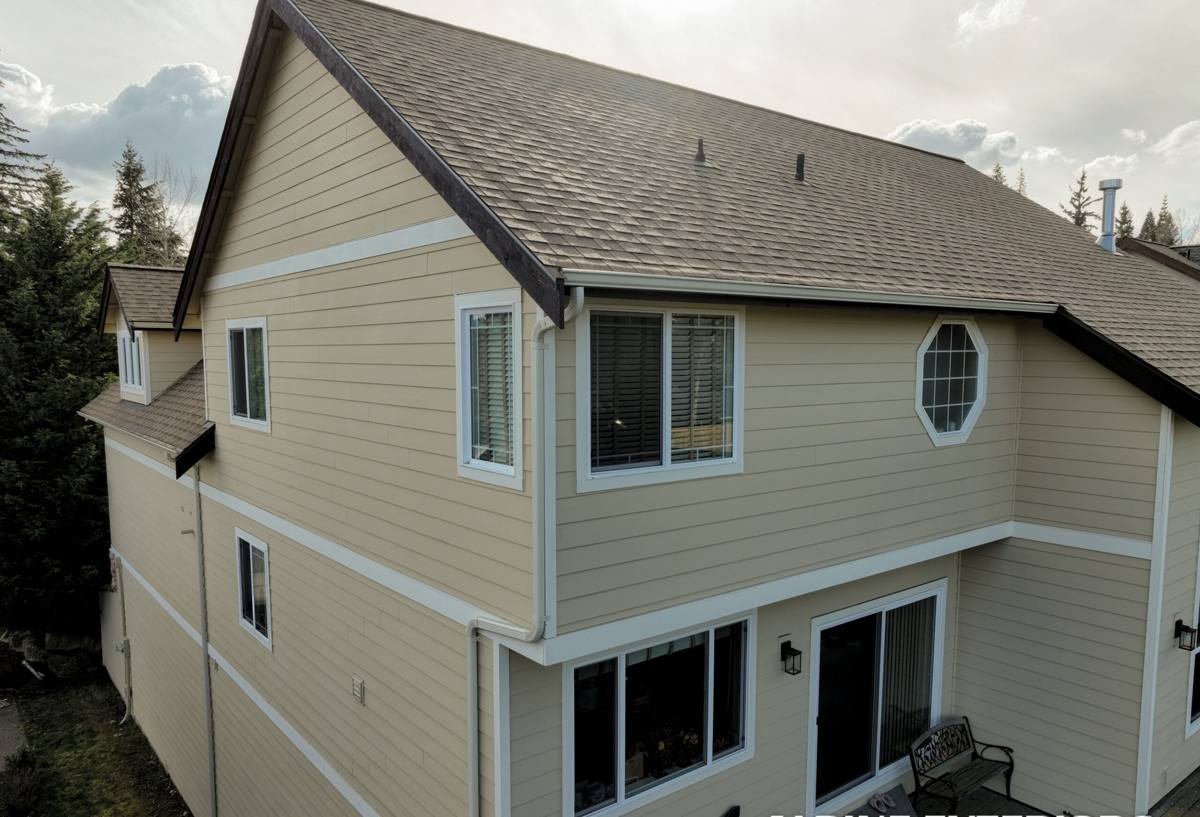
What Flounder Bay's Climate Actually Does to Siding
Salt Air
Airborne salt is corrosive to exposed metal fasteners and hardware, and it accelerates the breakdown of lower-grade paint films and coatings. Over time, salt exposure causes chalking, fading, and premature coating failure on siding materials that weren't formulated to handle it. It also tends to draw moisture — salt is hygroscopic, meaning it pulls humidity out of the air and holds it against the surface it's sitting on, which keeps siding damp longer than a comparable inland location.
Driving Rain
Flounder Bay's exposure to wind off the water means rain doesn't just fall here — it's driven horizontally into wall assemblies during winter storms. That kind of wind-driven rain finds every gap in flashing, every under-caulked seam, and every place where siding boards weren't properly lapped or spaced. Water intrusion at the wall assembly, not the siding material itself, is the single biggest cause of rot and mold behind exterior cladding in this climate.
Moss Season
Western Washington's long, mild, wet stretch from fall through spring is prime moss-growing weather, and Flounder Bay's tree cover and shaded north-facing walls make it worse. Moss and algae hold moisture directly against a wall surface for extended periods. On materials that swell, wick water, or trap it against wood substrates, that's a slow path to decay. On a material that doesn't absorb and swell, it's mostly a cleaning issue rather than a structural one.
Why We Standardized on James Hardie for This Climate
James Hardie fiber cement is engineered from cement, sand, and cellulose fiber — it does not have the moisture-swelling behavior of wood-based siding products, and it's non-combustible, which matters given Skagit County's dry summer wildfire risk alongside its wet winters. Hardie's HZ5 product line is specifically engineered for climates with sustained moisture exposure, freeze-thaw cycling, and coastal conditions — which describes Flounder Bay well. The factory-applied ColorPlus finish is baked on under controlled conditions and backed by its own finish warranty, which matters directly in a salt-air environment where field-applied paint tends to fail faster.
We've explained to homeowners elsewhere why we don't install LP SmartSide, vinyl, Cemplank, Allura, or bare cedar and primed spruce. In short: those products each carry trade-offs — moisture sensitivity, seam and expansion behavior, field-finish maintenance burden, or shorter effective service life — that show up faster and more visibly in a marine, high-rainfall climate like this one than they would somewhere drier and more sheltered. Flounder Bay isn't a forgiving test environment for a mediocre siding choice, and we'd rather stand behind one product system we trust completely than offer several and hope the wrong one doesn't get picked for the wrong house.
What a Correct Installation Looks Like Here
The product is only half the equation. James Hardie's own installation instructions are detailed for a reason — installed wrong, even the best fiber cement siding can trap water behind it. For a Flounder Bay home, we pay particular attention to:
- Weather-resistant barrier and flashing integration — the house wrap, window and door flashing, and siding need to shed water downward and outward, not just sit next to each other
- Rainscreen or proper drainage gap — allowing any incidental moisture behind the siding to drain and dry rather than sit against the wall sheathing
- Fastener selection — corrosion-resistant, hot-dipped galvanized or stainless fasteners, placed per Hardie's fastening schedule, matter more here than in a dry inland climate
- Correct clearances — Hardie specifies minimum clearance from grade, roofing, and decking so the bottom edge of the siding isn't sitting in a moisture trap
- Caulking and sealant discipline — the right joints get sealed, and just as important, the wrong ones (like butt joints designed to move) get left open per spec
- Trim and penetration detailing — every point where siding meets a window, vent, or fixture is a potential entry point for wind-driven rain if it's not detailed correctly
Skipping or rushing any one of these steps doesn't usually show up as a problem in year one. It shows up in year five or eight, as staining, soft trim, or interior moisture issues — well after the installer has moved on.
Our Process for Flounder Bay Homes
1. Assessment
We look at the home's actual exposure — which walls face prevailing wind and rain, how much tree cover and shading affects moss growth, and the condition of the existing siding, sheathing, and any trim or flashing already showing wear.
2. Product and Line Selection
We walk through which Hardie plank profile, panel style, or shingle pattern fits the home and the neighborhood's character, and confirm the right HZ product line and ColorPlus color for the exposure level.
3. Tear-Off and Substrate Check
Old siding comes off and we inspect the sheathing underneath. Any water damage or rot found at this stage gets addressed before new siding goes on — covering a wet or compromised substrate defeats the purpose of upgrading the siding at all.
4. Weather Barrier and Flashing
New house wrap and flashing go in at every window, door, and penetration, integrated to shed water down and out per Hardie's and the local code's requirements.
5. Installation to Spec
Siding goes up following Hardie's fastening, clearance, and joint-treatment specifications — not shortcuts that happen to look right from the ground.
6. Final Walkthrough
We review the finished work with the homeowner, including basic care guidance for a moss- and salt-prone site.
Comparing Approaches: Why Correct Installation Costs What It Costs
| Factor | Cut-Corner Approach | Correct Hardie Installation |
|---|---|---|
| Drainage behind siding | Siding fastened tight to wall wrap, no drainage gap | Rainscreen or drainage gap allows incidental moisture to escape |
| Fasteners | Standard fasteners, not corrosion-rated for salt air | Corrosion-resistant fasteners per Hardie fastening schedule |
| Flashing at openings | Caulk relied on instead of proper flashing | Integrated flashing sheds water; caulk used only where specified |
| Clearance from grade/roof | Siding installed too close to grade or roofline | Manufacturer-specified clearances maintained |
| Visible outcome in year 1 | Looks fine | Looks fine |
| Outcome in year 5-10 | Staining, trim rot, or interior moisture issues possible | Performs as engineered, holds finish, sheds moisture |
The visual difference between a rushed installation and a correct one is close to zero on install day. The performance difference over a decade of Flounder Bay winters is not.
Maintenance in a Salt-Air, Moss-Prone Setting
James Hardie siding doesn't need painting on the same schedule wood-based products do, and it won't swell or rot from moisture exposure the way engineered wood siding can. That said, no siding is maintenance-free in this climate. A homeowner in Flounder Bay should plan on:
- Rinsing salt residue and grime off the siding periodically, especially on wind-facing walls
- Keeping gutters and downspouts clear so water isn't dumping directly onto or behind siding sections
- Trimming back vegetation and tree cover that keeps shaded wall sections damp and moss-prone
- Gently removing moss or algae buildup before it spreads, using a soft wash rather than high-pressure equipment that can force water behind boards or damage the finish
- Doing a yearly visual check of caulked joints and trim for cracking or gaps, particularly after a hard winter
Why Local Experience with Flounder Bay Specifically Matters
A siding crew that mostly works inland jobs doesn't build the same instincts around wind-driven rain detailing, salt-air fastener selection, and moss-season drainage that a crew working Anacortes's waterfront neighborhoods develops over repeated jobs in these exact conditions. Flounder Bay homes face a narrower, more demanding set of conditions than the Skagit County average, and installation decisions that are optional inland — a drainage gap, upgraded fasteners, extra attention to shaded-wall flashing — are not optional here if the goal is siding that still looks and performs well a decade from now.
We also know this stretch of Anacortes well enough to talk through realistic product and color choices that hold up against salt exposure and moss growth, rather than defaulting to a generic recommendation that ignores where the house actually sits.
Getting Started
If you're weighing a siding replacement or repair on a Flounder Bay home, we're happy to take a look, talk through what your home's specific exposure calls for, and give you a straightforward, no-pressure estimate — no inflated claims, no pressure to sign on the spot, just an honest read on what the job actually needs. Fill out the form below to get started.