 Anacortes Siding
 Old Town Anacortes' Climate Problem for Siding
Old Town Anacortes sits close to the water, and that proximity shapes everything about how siding ages here. Salt-laden air drifts off the marine waters surrounding Fidalgo Island and settles on exterior surfaces day after day, working into seams, fasteners, and any gap in a coating system. Add Skagit County's long wet season — steady, driving rain that can last for days rather than hours — and you have a climate that punishes any siding material with a weak point in its moisture defense.
Then there's moss. The combination of shade, moisture, and mild temperatures that makes this part of Washington beautiful also makes it excellent moss and algae habitat. On siding, that shows up as green-black streaking, trapped moisture behind growth, and coatings that break down faster than they would in a drier climate. Homes in established, tree-lined neighborhoods like Old Town tend to see this more than newer subdivisions on open lots, simply because there's more shade and less direct sun to dry surfaces out between storms.
None of this is unusual for the area — it's just the baseline every siding job in Old Town Anacortes has to be built to handle. Products and installation details that would be fine in a drier inland climate aren't automatically fine here.
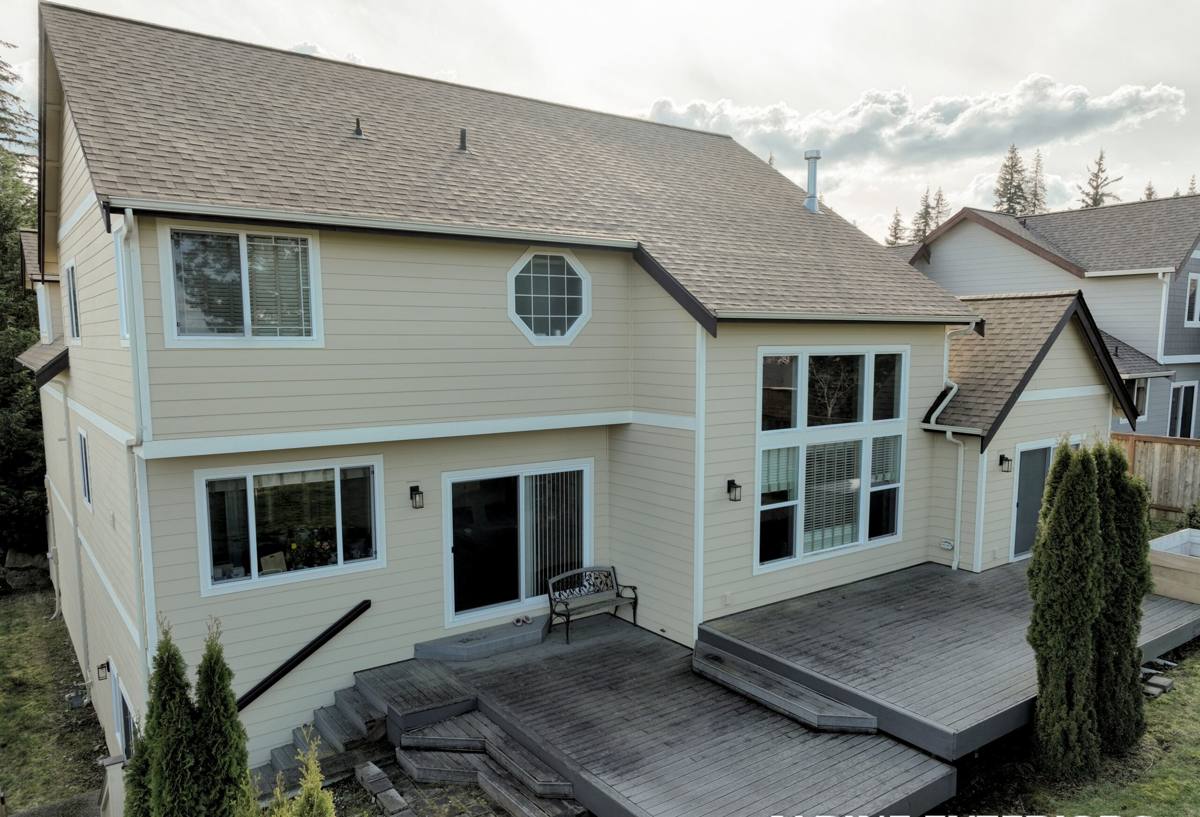
Why James Hardie Fits This Environment
James Hardie fiber cement is engineered from cement, sand, and cellulose fiber — materials that don't rot, don't feed mold or moss the way wood fibers can, and don't absorb water the way some composite sidings do. It's also non-combustible, which matters in a state where wildfire smoke and dry-season fire risk have become a bigger part of the conversation even on the wet side of the Cascades.
The factory-applied ColorPlus finish is the other half of the equation. Instead of relying on a field-applied paint job to hold up against salt air and UV, the color and topcoat are baked on at the factory under controlled conditions, which gives a more consistent, durable bond than most site-applied paint. That matters directly here: a coating that fails early in a salty, wet climate means repainting sooner and moss taking hold in the compromised spots.
This is also the core reason we don't install vinyl, LP SmartSide, Cemplank, Allura, or bare wood siding. Each of those has a place in the industry, but none of them combine non-combustible material, engineered moisture resistance, and a factory finish built for coastal conditions the way Hardie's system does. We'd rather install one product correctly and stand behind it than offer a menu of options with different weak points.
HZ5 Engineering and What It Actually Means Here
James Hardie manufactures its siding in regional formulations called HZ zones, engineered for the climate they'll be installed in. Western Washington, including Skagit County, falls into a wetter, more moisture-exposed category than the dry Southwest or Midwest zones. Practically, that means the board formulation and factory finish supplied for this area are matched to sustained rainfall and higher humidity rather than heat and dryness. It's a detail easy to miss, but it's part of why the same-looking siding can perform differently depending on where it was engineered for.
What a Correct Installation Looks Like
Fiber cement siding is only as good as the installation behind it. Most of the problems we get called out to look at on older homes aren't material failures — they're installation shortcuts that let water in behind a perfectly good product.
Flashing and Water Management
Every window, door, and horizontal trim transition needs proper flashing and a drainable water-resistive barrier behind the siding — not caulk alone. In a climate with this much sustained rain, any point where water can get behind the cladding and not have a way back out becomes a slow rot problem, even with a rot-resistant material like Hardie board protecting the surface.
Fasteners and Clearances
Hardie specifies fastener type, spacing, and penetration depth for a reason — get it wrong and you either crack the board over time or leave a fastener head exposed to corrode and streak. Clearance from grade, roof lines, and decks also matters more here than in a dry climate, since splash-back and standing moisture at the bottom edge of the siding are common failure points.
Caulking and Joints
Panel joints, trim intersections, and penetrations need the right sealant, applied correctly, and inspected as part of the finished job — not treated as an afterthought. In a salt-air, high-rain environment, a joint that was caulked but not backed by proper flashing will eventually leak regardless of how good the sealant is.
How Siding Material Choices Compare in This Climate
Homeowners in Old Town Anacortes often ask us to explain, in plain terms, why material choice matters so much here. This is a general comparison based on how these materials typically perform in a marine, high-moisture climate — not a claim about any specific brand's failure rate.
| Material | Moisture & Rot Resistance | Salt Air Durability | Maintenance Load | Typical Lifespan Fit for This Climate |
|---|---|---|---|---|
| James Hardie fiber cement | High — cement-based, doesn't absorb and rot | Engineered coastal (HZ5) formulation | Low — occasional wash, factory finish holds color | Long, with strong transferable warranty |
| Vinyl | Doesn't rot, but can warp/crack in temperature swings and impacts | Can fade and become brittle over time in UV/salt exposure | Low, but limited repair options if damaged | Moderate |
| LP SmartSide (wood-strand composite) | Wood-based; vulnerable at cut edges and joints if moisture gets in | Sensitive to sustained moisture exposure | Moderate — finish and edge sealing need attention | Moderate, install-sensitive |
| Cedar / primed wood | Natural material; rots and feeds moss/algae without upkeep | Requires regular refinishing in salt air | High — recoating, moss treatment, edge sealing | Shorter without consistent maintenance |
The pattern that matters most for this area: materials that depend on a field-applied finish or that have wood fiber content need more consistent homeowner upkeep to hold up against salt air and moss than a cement-based product with a factory finish.
Colors and Finish for an Established Neighborhood
Old Town is an older, established part of Anacortes, and a lot of the homes have real character worth matching rather than covering up. James Hardie's ColorPlus line offers a range of finishes from classic muted tones to deeper, more saturated colors, along with different plank profiles and textures — traditional lap, shingle-style panels, and board-and-batten among them — so a re-side can respect a home's existing style instead of flattening it into something generic. We'll walk through which profiles and colors make sense for your specific house rather than pushing a one-size-fits-all package.
Our Process for Old Town Anacortes Jobs
Assessment and Tear-Off
We start by looking at what's actually happening behind the existing siding — moisture staining, soft sheathing, and flashing condition all get checked before we quote the job, not after tear-off starts. On older homes, this step often turns up things a homeowner couldn't have seen from outside.
Installation
Water-resistive barrier and flashing go in first, following manufacturer detailing at every window, door, and trim transition. Fasteners, clearances, and joint sealing follow Hardie's published specifications rather than shortcuts that might not show a problem for a few years.
Final Walkthrough
We walk the finished job with the homeowner, checking joints, trim, and clearances up close before calling it done. Cleanup includes job-site debris and fastener/material scraps, not just a quick sweep.
Maintenance Checklist for Homeowners
A correctly installed James Hardie system is low-maintenance, but "low" isn't "none" in a climate like this. A short annual routine keeps moss and salt buildup from becoming a bigger issue:
- Rinse siding down (garden hose pressure, not a pressure washer) once or twice a year, more often on shaded, north-facing walls prone to moss
- Check and clear gutters before the fall rains so overflow doesn't run down the siding face
- Look at ground-level clearance yearly — trim back plantings and check that mulch or soil hasn't crept up against the bottom edge
- Inspect caulking at trim joints and penetrations every year or two, and have any cracked sealant redone before it becomes a leak path
- Address moss or algae staining promptly with a gentle cleaner rather than letting it sit through another wet season
Why a Crew That Already Works This Neighborhood Matters
Old Town Anacortes has a different mix of homes than a lot of newer development elsewhere in Skagit County — older framing, established landscaping, tighter lots, and years of exposure to the same salt air and rain we've been describing. A crew that already works this neighborhood has seen how these specific conditions play out on real houses: where moisture tends to collect, which details on older construction need extra attention during tear-off, and what a home in this setting actually needs versus what a generic spec sheet says.
That familiarity shows up in small decisions throughout a job — how flashing gets detailed around an older window opening, how clearance gets handled on a lot with mature trees, how a color gets chosen to suit a home that's been part of the neighborhood for decades. It's the difference between a crew installing a product and a crew installing the right system, correctly, for this specific place.
If you're weighing a re-side in Old Town Anacortes, we're happy to take a look and talk through what your home actually needs — no pressure, no hard sell. Reach out for a free estimate using the form below.