 Anacortes Siding
 Roofing in Conway: A Different Set of Problems Than Town
Conway sits low in the Skagit River delta, wedged between farmland, sloughs, and the I-5 corridor south of Mount Vernon. It's a different roofing environment than a hillside lot in Anacortes proper. The air here carries more moisture longer into the day — river fog, field mist, and marine air moving up from Skagit Bay all settle into this low ground and don't burn off as fast as they would on higher, more exposed terrain. Add in mature tree cover common around Conway properties, and you get roofs that stay damp, shaded, and slow to dry for a good chunk of the year.
That combination — persistent moisture, limited direct sun, and organic debris from surrounding trees — is exactly what shortens a roof's real service life versus its rated one. A shingle rated for 30 years on a dry, sun-exposed roof in eastern Washington might realistically give you 18-22 good years on a shaded Conway roof with a lot of moss pressure. None of that means Conway homes need exotic solutions. It means the install has to account for drainage, airflow, and moss resistance from day one, not as an afterthought.
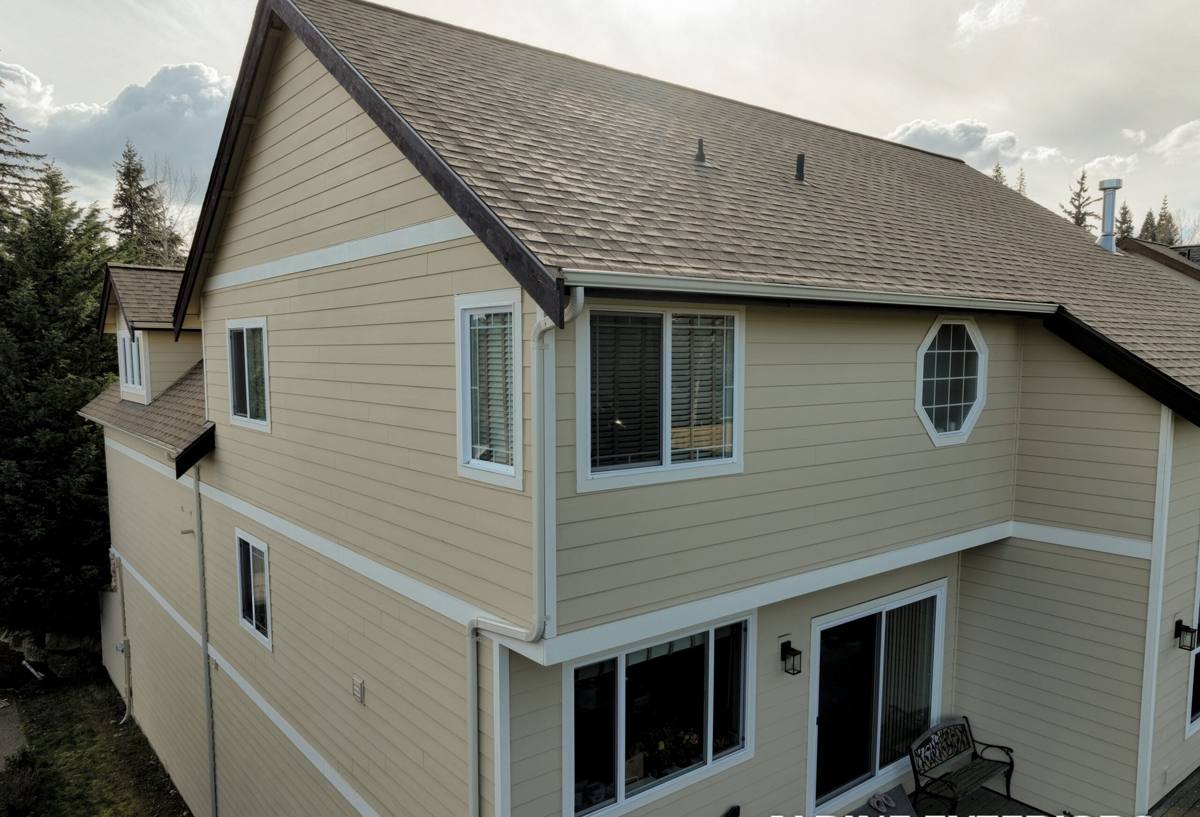
Signs a Conway Roof Is Actually Due for Replacement
Not every roofing issue means a full tear-off. Plenty of problems we see on service calls are legitimately repairable. But there's a point where patching stops making financial sense and a full replacement is the honest recommendation. Here's how we tell the difference.
Repair Territory
- A handful of cracked, curled, or wind-lifted shingles in one localized area
- A single active leak traced to flashing around a chimney, vent, or skylight
- Moss buildup on an otherwise sound roof that's less than 12-15 years old
- Minor granule loss visible in gutters after a normal wind event
Replacement Territory
- Shingles that are brittle or bald across most of the roof, not just one slope
- Multiple leak points, or a leak that keeps returning after repair in a new spot
- Visible sagging in the roof deck, which usually means underlying rot
- Daylight visible through the roof deck from the attic
- A roof already past 20-25 years old with no major work done
If you're not sure which category your roof falls into, that's a reasonable thing to ask us to look at directly rather than guess from the ground. A five-minute attic check often tells us more than what's visible from the yard.
What Moss and Moisture Actually Do to a Roof
Moss gets treated as a cosmetic nuisance, but it's a structural problem in slow motion. Moss holds water against the shingle surface far longer than open air would, and that sustained dampness works underneath shingle tabs and around fasteners. Over a Skagit County winter, that cycle repeats week after week. The result isn't usually a dramatic leak — it's slow granule loss, softened underlayment, and eventually deck rot that you don't see until you're up there replacing it.
Salt-influenced air moving in off the Sound and the bay compounds this by accelerating corrosion on exposed metal — flashing, fasteners, vent boots, and gutter hardware all age faster here than they would inland. A roof replacement done right for Conway accounts for both of these at once: moisture management (ventilation, underlayment, ice-and-water shield at vulnerable points) and metal that's chosen to hold up to a damp, salt-tinged environment rather than standard hardware store stock.
Material Options for a Conway Roof
There's no single "right" material for every house — it depends on your roof's pitch, sun exposure, tree cover, and budget. Here's how the common options actually perform in this specific climate, not in general marketing terms.
| Material | How It Handles Local Moss/Moisture | Typical Lifespan Here | Trade-Offs |
|---|---|---|---|
| Architectural asphalt shingle | Good with proper ventilation and algae-resistant granules; still needs periodic moss treatment | 20-28 years | Best value; wide color range; needs deck ventilation to perform well |
| Standard 3-tab shingle | Fair; thinner profile holds less resistance to sustained moisture | 15-20 years | Lowest upfront cost, shortest realistic lifespan in this climate |
| Metal (standing seam) | Excellent shedding, minimal moss adhesion, but coastal-grade fasteners are a must | 40-50+ years | Higher upfront cost; requires correct fastener spec to avoid premature corrosion |
| Composite/synthetic shake | Good moisture resistance, low moss uptake | 30-40 years | Mid-to-upper cost; fewer installers experienced with correct detailing |
We don't push one material as the universal answer. What we won't do is install a product where the manufacturer's own moisture or ventilation requirements don't match what your specific roof structure can deliver — that's a warranty problem waiting to happen, not a favor to the homeowner. If a material needs airflow your attic doesn't have, we'll tell you that before it becomes your problem in year six.
Our Replacement Process
1. On-Site Assessment
We walk the roof and the attic, not just one or the other. Deck condition, existing ventilation, flashing points, and moss/moisture patterns all get checked before we recommend anything. A roof quote written from the driveway skips the part that actually determines whether the new roof lasts.
2. Tear-Off and Deck Inspection
Old material comes off down to the deck. This is the point where hidden rot or soft spots show up — common on Conway roofs that have carried moss and moisture for years without full ventilation. Any compromised decking gets replaced before anything new goes down; covering rot with new shingles just hides the problem for a while.
3. Underlayment and Flashing
Given the amount of driving rain this area sees, we don't treat underlayment as an afterthought. Ice-and-water shield goes at valleys, eaves, and penetrations — the spots where wind-driven rain actually gets pushed uphill under shingles. Flashing around chimneys, skylights, and vents gets replaced rather than reused wherever it's showing wear, since flashing failure is the single most common cause of "mystery leaks" we get called out for.
4. Ventilation Check
A new roof installed over inadequate attic ventilation will grow moss and shorten its own lifespan almost as fast as the old one did. We check intake and exhaust balance and recommend corrections when the existing setup won't support the new material's warranty terms.
5. Final Walkthrough
We go over the finished roof and the cleanup with you directly — gutters, yard, and any material staging areas — before calling the job done.
Permits and Practical Considerations in Skagit County
Most full roof replacements require a building permit through Skagit County, and we handle that process as part of the job rather than leaving it to the homeowner. Depending on your property's location relative to shoreline or floodplain designations near the Skagit River delta, there can be additional review steps — this is worth confirming early rather than assuming, since Conway's proximity to the river and wetlands means some parcels carry overlays that a hillside Anacortes lot wouldn't have. We flag this during the initial assessment so there are no surprises mid-project.
What to Expect: A Practical Checklist
- A written estimate that breaks out material, labor, and any deck repair contingency
- A realistic timeline — most single-family reroofs take 2-4 days depending on size and weather windows
- Protection for landscaping, siding, and windows during tear-off
- Daily cleanup, including magnetic sweeps for nails
- Documentation of any deck rot found, with photos, before repair — not billed as a surprise afterward
- A final walkthrough before the job is considered complete
Weather is the one variable we can't fully control here. Skagit County's rain patterns mean we plan tear-offs around forecast windows and keep the deck covered if conditions shift mid-job — an open deck sitting exposed overnight isn't something we risk.
Why a Crew That Already Works Conway Matters
Roofing crews unfamiliar with this specific stretch of Skagit County tend to under-spec ventilation and flashing because they're working from generalized regional assumptions rather than what this low, damp, tree-covered ground actually does to a roof year over year. A crew that's replaced roofs in and around Conway has already seen where the moss comes back first, which flashing details fail under driving rain off the delta, and which attic setups chronically underperform. That's not a marketing point — it changes concrete decisions like where ice-and-water shield goes, how much ridge and soffit venting a specific roof needs, and which fastener grade actually holds up to the salt-tinged air moving through this part of the county.
It also matters for permitting and inspection — knowing the local building department's expectations ahead of time keeps a project from stalling mid-tear-off waiting on a correction.
Get a Straight Answer on Your Roof
If you're not sure whether your Conway home needs a repair or a full replacement, the honest move is to have someone look at it before assuming either way. We offer free, no-pressure estimates — walk the roof and attic with us, get a clear breakdown of what we find, and decide from there with real information instead of guesswork. Use the form below to get started.