 Anacortes Siding
 Why Cap Sante's Setting Puts Extra Demands on a Deck
Homes on and around Cap Sante sit close to Anacortes' working waterfront, with clear exposure to marine air coming off the harbor and Fidalgo Bay. That's part of what makes the location desirable, and it's also exactly why decking performs differently here than it would twenty miles inland. Salt-laden air accelerates corrosion in fasteners and hardware, driving rain gets pushed sideways by wind off the water, and the shaded, damp stretches of the year in Skagit County keep moss and algae going almost year-round on any surface that doesn't drain and dry properly.
None of that makes composite decking a bad choice for this area — it's usually a very good one. But it does mean the build has to account for conditions a generic install in a drier, inland climate wouldn't need to worry about. A deck that's "fine" on paper can still fail early here if the framing, fasteners, and drainage details weren't chosen with this specific microclimate in mind.
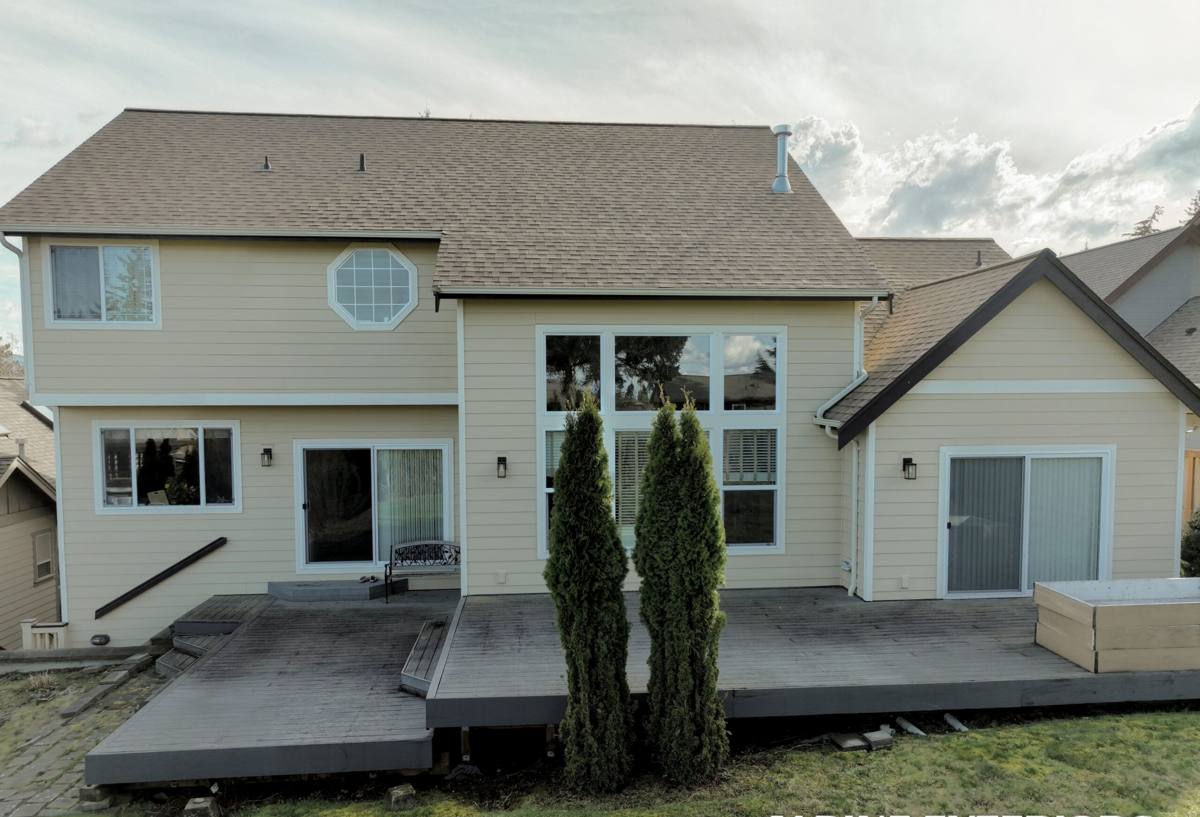
What Correct Composite Deck Construction Involves Here
Substructure and Moisture Protection
Composite boards themselves resist rot, but the framing underneath them is almost always still wood, and that's where a lot of long-term problems start. On a Cap Sante build, we treat the substructure as the part of the job that determines how long the whole deck lasts:
- Ledger boards attached to the house get proper flashing so water is directed out and away from the wall assembly, not trapped behind the ledger.
- Joists get a protective tape or coating over the top edge, since that's where standing moisture does the most damage over time.
- Board spacing and substructure layout allow for real airflow underneath, so the deck can actually dry out between the area's frequent rain events instead of staying damp for days.
- Footings are set to the depth required for this soil and frost exposure, not just "deep enough to hold."
Skip any one of these and the composite decking on top can look perfect while the frame underneath quietly rots or rusts. That mismatch — a good product over a compromised substructure — is one of the most common issues we find when we're called out to look at an existing deck that's failing early.
Fasteners and Hardware for Salt Air
This is the detail that gets skipped most often, and it's the one that matters most this close to the water. Standard galvanized fasteners can start showing corrosion within a few seasons in a salt-air environment; the streaking and staining that shows up on composite boards near coastal hardware is almost always a fastener or bracket issue, not a problem with the decking material itself. We spec stainless steel or marine-rated coated fasteners and structural hardware for Cap Sante installs specifically because of the air quality here, even though it costs more than standard hardware. It's a small line item relative to the whole project and it's the difference between hardware that lasts and hardware that has to be dealt with again in a few years.
Choosing the Right Composite Board
Capped vs. Uncapped Composite
Composite decking is a wood-fiber-and-plastic blend, and it comes in capped and uncapped versions. Capped composite has a shell wrapped around the core that resists moisture absorption, staining, and fading. In a climate with this much rain and this much moss and mildew pressure, we default to capped composite for Cap Sante homes — the uncapped core is more exposed to the moisture the region throws at it year-round, and that shows up as swelling or surface wear sooner. Manufacturers like Trex, TimberTech, and Fiberon all make capped composite lines with different price points and warranty structures, and we'll walk through the real differences between them for your project rather than pushing one brand by default.
Color and Fade Considerations Near the Water
UV exposure combined with salt air can affect how quickly lighter or more saturated composite colors show fading compared to more neutral, muted tones. This isn't a defect in the product — it's just how pigmented materials behave under sustained coastal sun and salt exposure. We'll talk through color options honestly, including which tones tend to hold their look longest in this specific setting, so you're picking a color you'll still like in ten years, not just on install day.
Composite vs. Other Decking Materials for This Microclimate
Every decking material is a set of trade-offs. Here's how the main options actually compare for a home exposed to Anacortes' salt air, rain, and moss season:
| Material | Moisture Behavior | Maintenance Here | Typical Lifespan Locally |
|---|---|---|---|
| Wood (cedar/fir) | Absorbs moisture, needs sealing to resist swelling and rot | Annual cleaning, periodic staining/sealing to fight moss and gray-out | 10–15 years before major repair or replacement, sooner if maintenance lapses |
| Capped composite | Resists moisture absorption; shell limits swelling and staining | Periodic washing to clear moss/pollen film; no staining or sealing | 25+ years with correct framing and fasteners |
| Uncapped composite | More moisture-sensitive core; can absorb water at cut edges over time | More attention to sealing exposed edges; more prone to surface wear | Shorter than capped, especially in wetter exposures |
| PVC decking | Fully moisture-resistant, no wood content | Low maintenance; can look and feel less like natural wood | Long lifespan, higher upfront cost |
For most Cap Sante homeowners, capped composite lands in the sweet spot: it handles the moisture and moss pressure well, doesn't demand a yearly maintenance ritual, and costs less than PVC while outperforming untreated or lightly maintained wood by a wide margin over the life of the deck.
Our Process for a Cap Sante Composite Deck
The steps don't change much from job to job, but the details inside each step are what we adjust for this location:
- Site walk and design. We look at sun exposure, wind direction, drainage slope, and how close the deck sits to salt air and standing moisture, then design the layout and board direction around those realities.
- Permitting. We handle the permit application and inspections through the appropriate local building department so the structure meets current code for footings, framing, and guardrails.
- Framing and flashing. Ledger attachment, joist protection, and footing depth are set up front, since this is the part that's invisible once the decking goes down.
- Fastener and hardware selection. Stainless or marine-rated hardware goes in at this stage, matched to the board system being installed.
- Composite board installation. Boards are laid with correct spacing for drainage and expansion, using hidden fastener systems where the product allows for a clean, screw-free surface.
- Railings and code details. Guardrail height, baluster spacing, and stair details are finished to meet code and to hold up to the wind exposure common on elevated sites near the water.
- Final walkthrough. We go over the deck with you, including basic care specific to this climate, before calling the job done.
Permits, Site Slope, and Other Realities on the Bluff
A lot of Cap Sante properties sit on sloped or elevated lots, which changes the engineering more than a flat backyard build would. Footing depth, beam sizing, and railing height all need to account for the actual grade and drop-off, not just a standard flat-lot assumption. Deck permitting in Anacortes and Skagit County covers structural elements like footings, framing, and guardrails, and we pull the appropriate permits and schedule inspections as part of the job rather than treating that as optional. If your lot has view considerations, wind exposure, or drainage that flows toward the house, those get addressed in the design stage — it's much cheaper to solve on paper than after the frame is built.
Living With a Composite Deck Through Moss Season
Composite decking cuts down maintenance dramatically compared to wood, but "low maintenance" isn't "no maintenance" in a climate this damp. A short seasonal routine keeps a composite deck looking and draining the way it should:
- Sweep off fir needles, leaves, and debris regularly so moisture and organic matter don't sit against the boards.
- Rinse or lightly wash the deck a few times a year to clear the thin film of pollen, algae, and moss spores that builds up in the wetter months.
- Keep gutters and downspouts near the deck clear so runoff isn't dumping directly onto the surface or substructure.
- Check railings and stair connections periodically, especially after a hard windstorm off the water.
- Trim back overhanging vegetation that keeps sections of the deck shaded and slow to dry — that's where moss takes hold first.
None of this is heavy work, but skipping it entirely is how a low-maintenance deck starts looking neglected faster than it should.
Why Hiring a Crew That Already Works Cap Sante Matters
A lot of the decisions above — fastener grade, flashing detail, footing depth, board coating — aren't things you can eyeball after the fact. They're either built in correctly from the start or they become a problem years down the road, usually right around the time a standard warranty stops covering it. A crew that works this area regularly already knows how the wind, rain, and salt air behave on an exposed or elevated Cap Sante lot, and builds to that reality by default instead of treating it as a special case. That's the difference between a deck that needs real attention at year eight and one that's still solid at year twenty-five.
If you're planning a new composite deck or replacing an aging one on your Cap Sante property, we're happy to walk the site with you and talk through what your specific lot needs. Reach out for a free, no-pressure estimate using the form below.