 Anacortes Siding
 Building a Deck That Holds Up in Flounder Bay
Flounder Bay sits close enough to the water that every deck out there deals with conditions a lot of composite decking never has to face inland: salt-laden air, wind-driven rain coming off the water, and a moss season that can run from October clear through April. A composite deck built the same way you'd build one in a dry inland subdivision won't hold up the same way here. The materials, the fasteners, and the framing details all need to account for what this specific stretch of Anacortes throws at a structure year after year.
We've built and repaired decks all over Skagit County's waterfront and near-waterfront neighborhoods, and Flounder Bay has its own personality. The lot orientation relative to the water, the amount of shade from surrounding trees, and how exposed a deck is to prevailing wind all change what "correct" looks like for a given house. This page covers what we've learned building composite decks specifically for homes in this area.
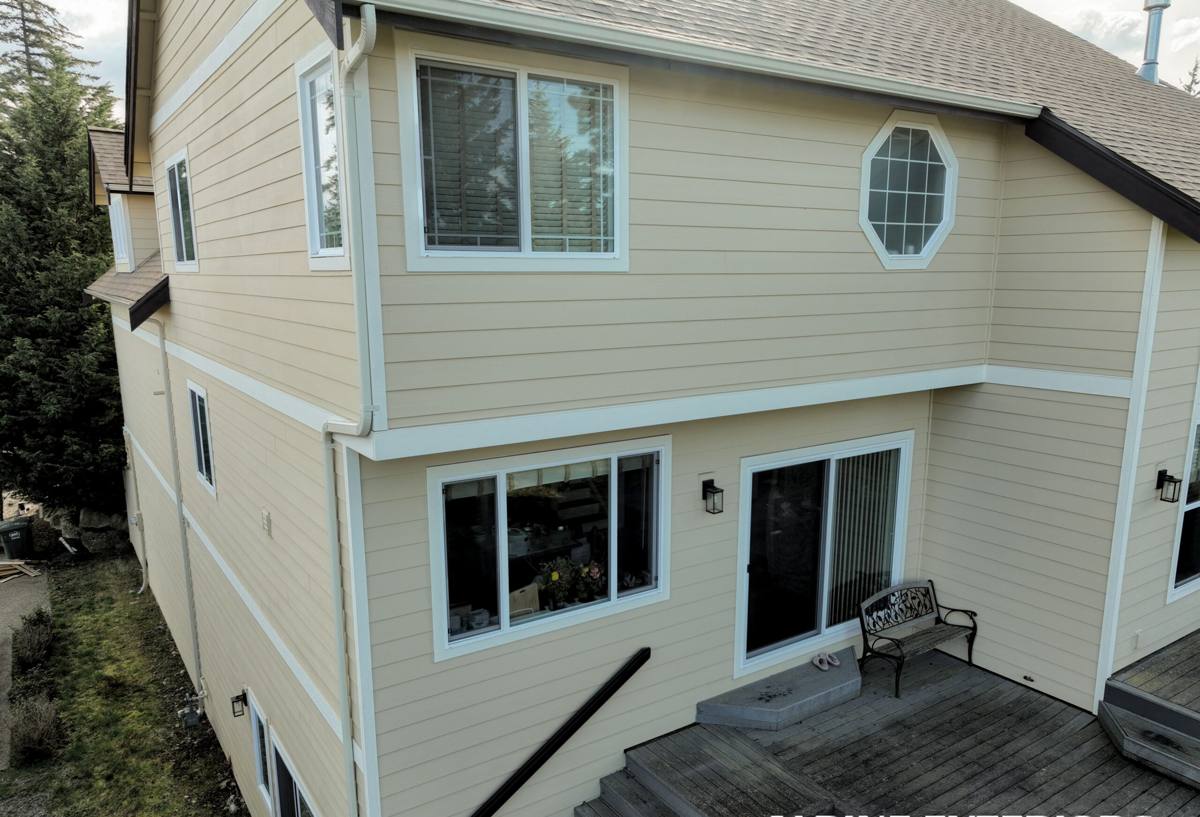
Why This Climate Is Hard on Decking
Three things stack up against outdoor structures in Flounder Bay, and they don't act alone — they compound each other.
Salt Air
Airborne salt from the bay settles on every exposed surface, including metal. Fasteners, brackets, and hardware that would last decades in a dry climate can start showing corrosion within a few years if they're not rated for a marine environment. This is one of the most common causes of premature deck failure we see near the water — not the decking boards themselves, but the hardware holding everything together underneath.
Driving Rain
Storms coming off the water don't just fall straight down — wind pushes rain sideways, into ledger connections, under railing posts, and into any gap in the flashing. A deck built without real attention to water management will eventually let moisture into the house framing at the ledger board, which is where the expensive damage happens.
A Long Moss Season
Skagit County's wet, mild winters give moss and algae months of ideal growing conditions. Anywhere a deck stays shaded and damp — under trees, on the north side of a house, or wherever boards don't drain and dry quickly — green growth takes hold. It's not just cosmetic; a mossy deck surface gets slick and dangerous, especially on stairs.
What a Correctly Built Composite Deck Needs Here
Substructure and Framing
The framing underneath a composite deck matters as much as the boards on top, arguably more in this climate. We build on pressure-treated lumber rated for ground contact where it's near soil, and we pay close attention to joist spacing — tighter spacing than the manufacturer's bare minimum gives the deck more stiffness and reduces long-term sagging in a climate where wood framing stays damp more months of the year than it dries out.
Fasteners That Won't Rust Out
For anything on or near the water, we use stainless steel or coated fasteners rated for coastal exposure — not standard galvanized hardware. This applies to structural connectors, ledger bolts, and the hidden fastener systems used with most composite board profiles. Cutting corners on hardware is invisible on installation day and expensive five years later.
Flashing at the Ledger
Where a deck attaches to the house, we install proper flashing that directs water away from the rim joist rather than relying on caulk alone. Caulk fails over time; flashing is a physical barrier that keeps working. This one detail is behind most of the rot damage we find when we're called out to repair an older deck near the water.
Choosing a Composite Board for a Waterfront-Adjacent Property
Capped vs. Uncapped Composite
Composite decking comes in capped and uncapped versions. Capped boards have a protective outer shell wrapped around the composite core, which resists moisture absorption, staining, and fading far better than uncapped material. In a salt-air, high-rainfall environment like Flounder Bay, we recommend capped composite as our standard — the extra upfront cost is worth it for a material that's going to sit outside in wet conditions most of the year.
Color and Heat
Darker composite boards absorb more heat and can feel hot underfoot on a sunny afternoon, but they also tend to show less algae staining than very light colors, which matters when a deck stays damp for long stretches. Mid-tone woodgrain colors are a common practical choice for this climate — light enough to stay comfortable, dark enough not to show every water spot.
Board Spacing and Drainage
Composite boards need consistent gapping between them so water can drain through rather than pooling on the surface. Too tight, and you get standing water and faster moss growth; too wide, and small debris collects underneath. We set gapping to the manufacturer's spec and adjust slightly tighter or wider depending on how much sun and airflow a given deck actually gets.
Moss, Algae, and the Long Wet Season
No decking material is completely immune to moss and algae in a climate this wet, but the design of the deck has a lot of influence over how bad it gets. Decks with good airflow underneath, minimal shade, and proper drainage stay noticeably cleaner than decks tucked under trees with poor ventilation below.
A few things we build in specifically for this climate:
- Joist tape over framing to keep the substructure drier and slow rot at the fastener points
- Adequate ventilation gaps under low decks so air can move and surfaces dry between rain events
- Grading and drainage below the deck so water doesn't pool against posts and footings
- Board selection and color choices that make algae staining less visible and easier to clean
Even with all of that, plan on an annual cleaning as routine maintenance, not a sign something went wrong — see the maintenance checklist further down this page.
Composite vs. Wood vs. PVC: What Actually Fits This Climate
Homeowners in Flounder Bay often ask us to weigh composite against pressure-treated wood or PVC decking. Here's how they compare for a wet, salt-air environment specifically — not in general terms, but for conditions like this one.
| Factor | Pressure-Treated Wood | Composite | PVC |
|---|---|---|---|
| Upfront cost | Lowest | Mid-range | Highest |
| Moisture tolerance | Fair — needs regular sealing | Good, especially capped boards | Excellent |
| Moss/algae resistance | Poor without upkeep | Good with proper design | Very good |
| Ongoing maintenance | Annual sealing/staining | Periodic cleaning | Minimal cleaning |
| Expected lifespan here | 10–15 years with upkeep | 20–30 years | 25–30+ years |
| Fastener sensitivity | Moderate | Higher — hardware quality matters | Higher — hardware quality matters |
Composite tends to be the sweet spot for most Flounder Bay homeowners: better moisture and moss resistance than wood without the top-end cost of PVC, and a wide range of colors and profiles to match different house styles. That said, for very high-exposure decks right on the water, some homeowners choose to spend up for PVC. We'll walk through the real trade-offs for your specific site rather than push one product across the board.
Our Process for a Flounder Bay Composite Deck Project
We keep the process straightforward and try to catch issues before they become surprises mid-build.
- Site visit — we look at sun exposure, wind direction, drainage patterns, existing structure (if replacing a deck), and how close the site is to salt spray or standing moisture.
- Design and material selection — board profile, color, railing style, and layout, matched to your house and budget, with honest input on what will actually perform well at this location.
- Permitting — most attached decks in the City of Anacortes require a building permit. We handle that paperwork and coordinate inspections so you don't have to chase it down yourself.
- Demo and framing — removal of any old structure, then framing with pressure-treated lumber, proper ledger flashing, and coastal-rated fasteners throughout.
- Decking and railing installation — boards set with correct gapping and hidden fastener systems, railing installed to code for height and baluster spacing.
- Final walkthrough — we go over the finished deck with you, including what maintenance to expect given the local climate.
Maintenance Checklist for Your New Composite Deck
Composite decking is lower-maintenance than wood, but "low-maintenance" isn't "no-maintenance," especially in a climate this wet. Here's what we recommend for a Flounder Bay composite deck:
- Sweep debris off regularly, especially fallen leaves and needles that trap moisture against the boards
- Rinse the deck surface and clean underneath gaps once or twice a year to prevent buildup
- Use a soft-bristle brush and a composite-safe cleaner for moss or algae spots — avoid pressure washing at close range, which can damage the surface finish
- Check railing posts and stair connections annually for any looseness
- Inspect fastener heads and hardware periodically for early signs of corrosion, particularly on decks closest to the water
- Keep gutters and downspouts nearby clear so runoff isn't dumping extra water onto or under the deck
Why Hiring a Crew That Already Works Flounder Bay Matters
A lot of what separates a composite deck that looks great for 25 years from one that needs hardware repairs in five isn't the decking brand — it's the details underneath that nobody sees on installation day: the flashing, the fastener grade, the framing spacing, the drainage. Those decisions get made correctly by a crew that already understands how this specific stretch of coastline behaves, rather than one applying a generic build spec to a job that isn't generic.
We've worked on homes throughout Anacortes and the surrounding Skagit County waterfront, and we bring that site-specific judgment to every composite deck we build in Flounder Bay — from how much airflow a shaded deck needs to which hardware grade actually holds up this close to salt water.
If you're considering a new composite deck or replacing an aging one, we're happy to take a look and give you a straightforward, no-pressure estimate. Use the form below to get started.