 Anacortes Siding
 Decks Near Ship Harbor Take a Different Kind of Beating
Ship Harbor sits close enough to the water that salt-laden air is part of daily life, not an occasional event. Add Anacortes' long wet season, heavy tree cover on many Fidalgo Island lots, and the shade that keeps moisture sitting on wood and composite surfaces for days at a time, and you get a climate that ages an outdoor deck faster than most homeowners expect. A deck built to a generic spec — the kind that might hold up fine in a drier inland town — often shows real trouble here inside ten to fifteen years instead of twenty or more.
Salt air accelerates corrosion on fasteners and hardware. Driving rain off the Sound finds every gap in flashing and end-grain that isn't properly sealed. And moss doesn't just grow on roofs around here — it colonizes shaded deck boards, railings, and stair treads, holding moisture against the wood and turning surfaces slick and dangerous underfoot. A deck replacement in Ship Harbor needs to be planned around these three things specifically, not treated as a generic build.
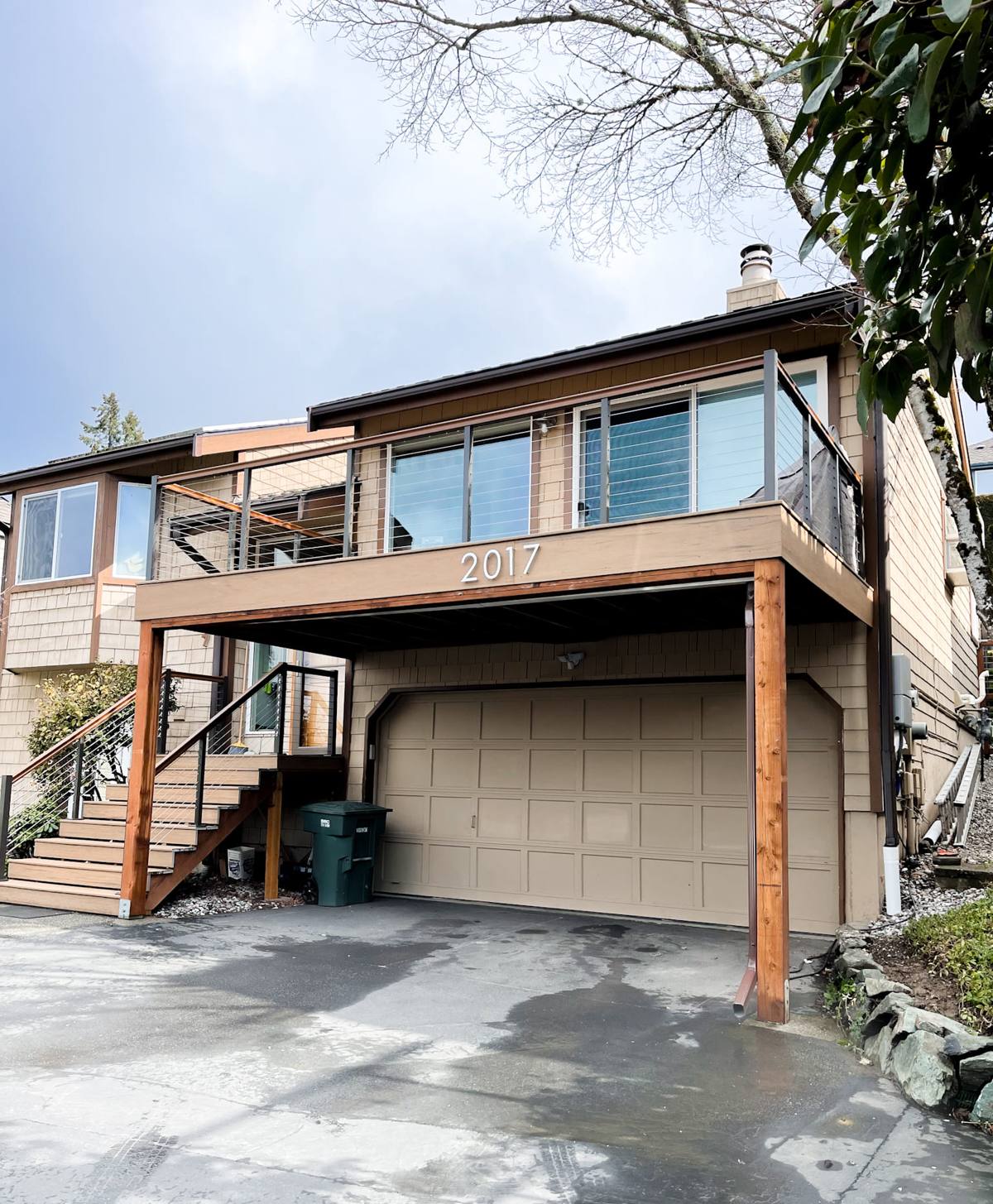
Signs a Ship Harbor Deck Needs Replacement, Not Just Repair
Not every tired-looking deck needs to come out. But there's a point where patching boards and re-staining stops being cost-effective and starts being a way to delay an inevitable, more expensive fix. We look for a few specific things when we're deciding whether repair or full replacement makes sense:
- Soft or spongy spots in decking boards, especially near the house where rain runoff collects
- Rust streaking or corrosion visible around fasteners, post bases, or joist hangers
- A ledger board (where the deck attaches to the house) that shows staining, gaps, or soft wood — this is the single most common failure point we find and the most serious
- Persistent green or black growth on the deck surface that returns within weeks of cleaning
- Railings or stair stringers that flex or feel loose, which usually points to compromised framing underneath, not just a loose bolt
- A deck more than 15–20 years old built to older code, especially if it predates current guardrail and attachment standards
If the framing and ledger are sound and it's just surface boards showing wear, repair or a board-and-rail refresh can make sense. Once the structure itself is in question, replacement is almost always the more honest answer — and the safer one.
Why the Ledger Board Matters So Much Here
The ledger is the board that bolts the deck to the house framing, and it's the connection point where most deck failures actually start — nationally and locally. In a climate with this much sustained moisture, a poorly flashed ledger traps water against the house rim joist year-round. We see this most often on decks that were built without proper flashing tape or with flashing that was installed but never lapped correctly with the house's water-resistive barrier. A correct replacement fixes this connection properly, every time — it's not optional scope, it's the part of the job that protects the house itself, not just the deck.
What a Correct Deck Replacement Actually Involves
A full deck replacement is more than pulling up old boards and screwing down new ones. Done right, it addresses the structure from the ground up:
- Demolition and inspection. We remove the old decking, railings, and where needed, the framing, so we can actually see the condition of posts, footings, and the ledger connection — problems hidden under old boards are common and change the scope.
- Footings and posts. Undersized or frost-heaved footings get corrected. On sites with drainage issues, this is where a lot of long-term deck problems start if it's skipped.
- Ledger flashing. Proper flashing tape and metal flashing, correctly lapped with the house's existing water barrier, so water sheds away from the house rather than behind the ledger.
- Framing and joist hardware. Joist hangers, structural screws, and post connectors sized and rated for the load, in corrosion-resistant material appropriate for a marine-influenced climate.
- Decking installation. Proper board spacing for drainage and seasonal movement, correct fastening method for the material chosen, and attention to end-grain sealing at cuts.
- Railings and stairs. Built to current guardrail height and baluster spacing requirements, which older decks frequently do not meet.
- Final grading and drainage check. Making sure water moves away from posts and footings rather than pooling against them.
Skipping steps in the middle of that list is how a deck looks fine for a few years and then fails from the inside out. It's also the difference between a deck that needs real work again in a decade and one that doesn't.
Choosing Decking Material for a Ship Harbor Property
There's no single "best" decking material for every home — it depends on budget, how much upkeep you want to do, and how much sun or shade the deck actually gets. What we won't do is put a moisture-sensitive product in a heavily shaded, salt-exposed spot and call it a permanent fix. Here's how the common options actually perform in this specific climate:
| Material | Moisture & Salt Air Behavior | Moss/Algae Resistance | Maintenance | Realistic Lifespan Here |
|---|---|---|---|---|
| Pressure-treated wood | Good if properly sealed and re-sealed; end grain and cut edges are the weak point | Low — needs regular cleaning in shaded areas | Annual cleaning and re-sealing recommended | 10–15 years before major work |
| Cedar | Naturally moisture-resistant but still needs sealing to hold color and resist checking | Moderate | Regular sealing; more sensitive to prolonged shade/moisture than treated lumber | 12–18 years |
| Capped composite | Very good — the cap layer resists moisture intrusion into the core | Good, though surface film can still develop in deep shade | Periodic washing; no sealing or staining | 20–25+ years |
| PVC decking | Excellent — essentially immune to moisture absorption | Good with occasional cleaning | Lowest maintenance of the group | 25+ years |
For homes with heavy tree cover or a north-facing deck that rarely dries out, we generally steer clients toward capped composite or PVC — not because wood is a bad product, but because a shaded, damp deck asks a lot of any wood species and the maintenance burden to keep it looking good in that spot is real. For decks that get good sun exposure and where the homeowner is comfortable with an annual maintenance routine, cedar or treated wood remains a solid, less expensive option.
How We Approach a Ship Harbor Deck Replacement
Every deck replacement starts with an honest look at what's actually there, not an assumption based on the age of the house.
1. On-Site Evaluation
We walk the existing deck, check the ledger connection, probe framing and posts for soft spots, and look at drainage and grading around the footings. This tells us whether we're dealing with a straightforward like-for-like replacement or a deck that needs a redesign — for example, if railings don't meet current code or footings were undersized to begin with.
2. A Written Scope and Estimate
You get a clear breakdown of what's being replaced, what material is being used, and why — not a vague lump sum. If we find something once demo starts that changes the scope, we tell you before we proceed, not after.
3. Demo, Structural Work, and Flashing
This is where the job is actually won or lost. We don't rush the ledger flashing or framing connections to get to the visible decking faster — those hidden steps are what determine whether this deck holds up through another decade of Anacortes winters.
4. Decking, Railings, and Finish Work
Boards, railings, and stairs go in to spec, with attention to fastening patterns and spacing that account for our wet-dry seasonal swings and material movement.
5. Final Walkthrough
We walk the finished deck with you, cover basic care for whatever material you chose, and make sure everything meets code before we call it done.
Permits and Code Considerations Around Anacortes
Deck replacements in the City of Anacortes and unincorporated Skagit County typically require a building permit, particularly for any work involving footings, framing, or a deck attached to the house structure. Properties near the shoreline can also fall under additional shoreline management review depending on proximity to the water and the scope of work. Requirements vary by exact location and project scope, so we handle the permit determination and application as part of the job rather than leaving homeowners to sort out which rules apply to their specific lot.
Current guardrail height, baluster spacing, and stair rise/run requirements have also tightened over the years compared to older code cycles. A straight rebuild of a deck built decades ago usually needs to be updated to meet today's standards — this is normal and expected, not a sign something was done wrong originally.
What Drives the Cost of a Deck Replacement
Pricing for a full deck replacement depends on several factors that vary quite a bit from one Ship Harbor property to the next:
- Deck size and layout — square footage, plus complexity like multiple levels, angles, or built-in seating
- Material choice — treated wood costs less upfront than composite or PVC, but the lifetime cost picture can look different once maintenance is factored in
- Structural condition — whether footings, posts, and the ledger connection can be reused or need to be rebuilt
- Height and access — a deck built high off a sloped lot involves more structural work than a low, level ground-level deck
- Railing and stair scope — length of railing runs and number of stairs both add material and labor
- Site access — tight side-yard access or limited equipment access can add time to demo and material staging
We'd rather walk your specific deck and give you real numbers than quote a broad range that doesn't mean much for your project — but as a general rule, structural condition and material choice move the price more than almost anything else.
Why It Matters to Hire a Crew That Already Works This Area
A deck replacement done right in Ship Harbor isn't the same job as one done in a drier, inland part of Skagit County. A crew that regularly works properties this close to the water already knows to flash the ledger for sustained moisture exposure, to use fasteners and hardware rated for salt-air corrosion, and to account for the shade and moss patterns that show up on tree-covered, north-facing lots around here. That's not something you have to explain on-site — it's baseline knowledge for the crew before the first board comes off.
It also means we're familiar with how Anacortes and Skagit County permitting works for this kind of project, so there are fewer surprises and delays once work is scheduled. A local crew has a reputation to maintain on the same streets year after year — that's a real incentive to build something that's still solid the next time we're back in the neighborhood.
Caring for Your New Deck After Installation
Whatever material you choose, a little seasonal attention keeps it performing the way it should:
- Sweep debris and standing leaves off the deck regularly, especially in fall — trapped organic material holds moisture and feeds moss growth
- Rinse or wash the surface periodically in shaded areas prone to green film or algae
- For wood decks, plan on resealing on a regular cycle rather than waiting until it visibly needs it
- Keep gutters and downspouts near the deck clear so runoff isn't dumping extra water onto or under the structure
- Have fastener and railing connections checked periodically, since corrosion in a marine-influenced climate can start before it's visible on the surface
If you're weighing a repair versus a full replacement, or you just want an honest read on the condition of your current deck, we're glad to come take a look. The estimate is free, there's no pressure attached to it, and you'll get a straight answer about what your deck actually needs — just fill out the form below to get started.