 Anacortes Siding
 Conway sits low in the Skagit River delta, roughly between Mount Vernon and Anacortes, on flat, open ground with little to slow down wind coming off Skagit Bay and the Sound. It's close enough to saltwater that airborne salt still works on roofing hardware even for homes that never see the water from their yard. When a windstorm or heavy rain event moves through, a Conway roof often takes a harder hit than a roof tucked into a more sheltered inland town a few miles away. This page covers what storm damage actually looks like on a roof out here, what a correct repair involves, and how our process works from the first call to the final walkthrough.
Why Storm Damage Hits Conway Roofs Harder
Open Wind Exposure
Conway's flat, low-lying position in the delta means there's little terrain or tree cover to break up wind before it reaches a roof. A gust that gets knocked down by hills or dense forest in other parts of Skagit County often arrives here at close to full strength. That's a big part of why the same storm can leave one Conway roof with lifted shingle tabs, torn ridge cap, or a missing section, while a roof a few miles inland only rattles a few windows.
Driving Rain
Wind and rain tend to arrive together in this part of the county, and wind-driven rain finds weaknesses that straight-down rain never would — a lifted shingle edge, an aging flashing seam, a nail that's backed out a fraction of an inch. A roof that's stayed watertight through ordinary rain for years can suddenly leak during a storm simply because the rain is being pushed sideways into laps and joints it was never really tested against.
Moss and Saturated Debris
Long stretches of damp weather here support a real moss season on shaded and north-facing slopes. Moss holds water against the roof surface, and a moss mat that's already saturated adds weight right at the moment wind is trying to peel shingles loose. Storm damage and moss damage often show up in the same spot — the storm usually isn't creating a new weak point so much as finishing off one that a season of moss has already been working on.
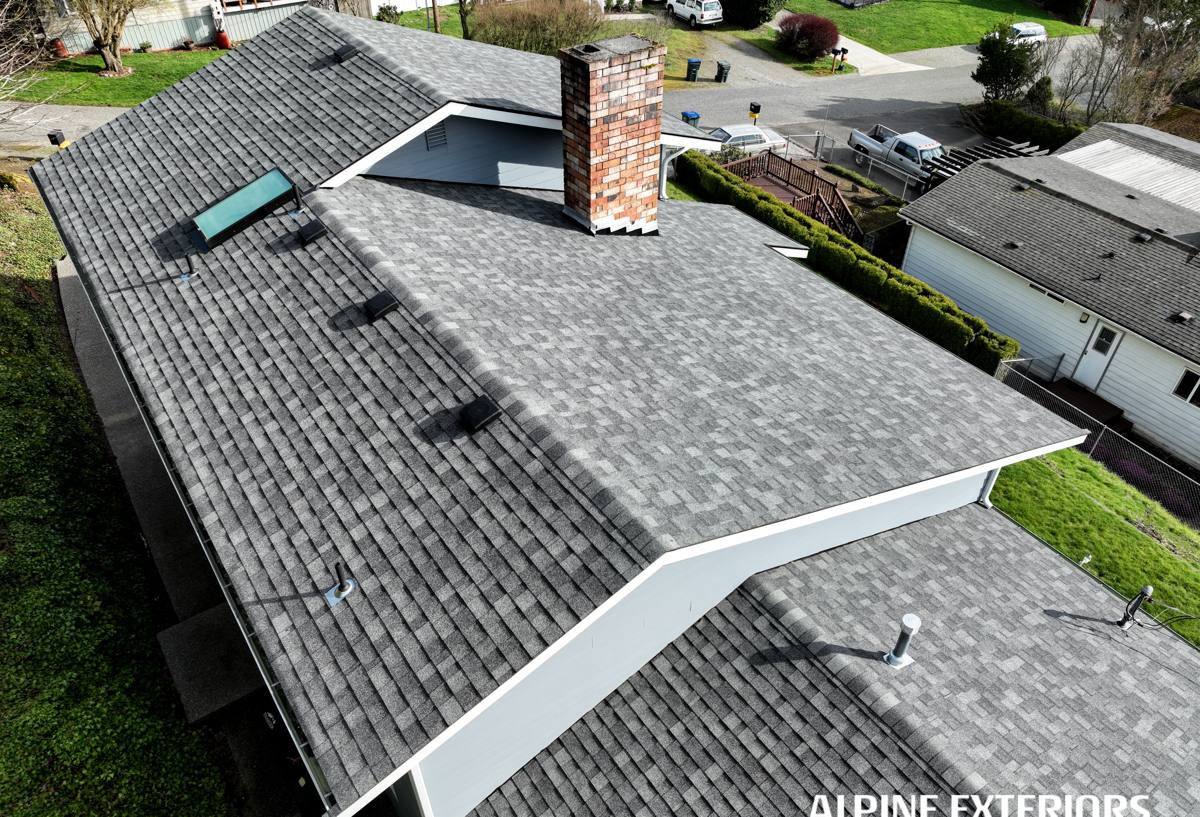
What Actually Counts as Storm Damage
Not every problem after a storm is obvious from the ground. Some of the most common damage is easy to walk right past:
- Shingle tabs lifted, cracked, or torn loose, especially on the windward slope
- Missing shingles or shingle pieces found in the yard or gutters after a storm
- Bent, lifted, or missing ridge cap or hip cap pieces
- Flashing pulled loose or bent at chimneys, vents, skylights, or roof-to-wall transitions
- Dents or punctures from wind-driven branches or blowing debris
- New water stains or leaks on ceilings that appear during or right after a storm
- An unusually large amount of granules washed into gutters or downspouts
- Soft spots or sagging in the roof deck that weren't there before the storm
What to Do Right After a Storm
Safety comes first — a roof that's just been through a windstorm isn't the place for a homeowner to be climbing around, especially if it's still wet or if there's visible structural movement. From the ground, take photos of any damage you can see: shingles in the yard, dented gutters, visible gaps on the roofline. If there's an active leak, a temporary interior catch and a call for an inspection matter more than trying to diagnose the roof yourself. A small amount of storm damage left exposed to the next rain event is what turns a simple shingle repair into a ceiling repair, so the priority after any storm is getting eyes on the roof before the next system moves through, not waiting to see if it gets worse.
Patch, Partial Repair, or Full Replacement
Not every storm-damaged roof needs the same fix. The right approach depends on how much of the roof was affected and what condition it was in before the storm hit.
| Approach | When It Fits | What It Doesn't Fix |
|---|---|---|
| Spot patch or targeted repair | Isolated damage — a handful of shingles, one flashing point, a small puncture — on an otherwise sound, reasonably young roof | Won't address underlying wear elsewhere on a roof that's already close to the end of its service life |
| Partial re-roof (one slope or section) | Damage concentrated on the windward slope of a roof that's otherwise in good shape, or where material availability makes a close match possible | Can leave a visible seam between old and new material if colors have weathered unevenly |
| Full roof replacement | Widespread damage, an older roof nearing the end of its life, or damage combined with existing moss or moisture problems found during inspection | Bigger up-front cost, though it resets the whole roof's service life instead of extending an aging one |
We'll give a straight answer on which category a given roof falls into during the inspection, rather than defaulting to the most expensive option or trying to stretch a patch over damage that's really telling you the roof is done.
What a Correct Storm Repair Actually Involves
Full Inspection Before Any Work
Storm damage is rarely limited to the spot that's visible from the ground. We check the full roof — not just the obviously damaged area — since wind that tore loose one section often stressed shingles and flashing nearby that haven't failed yet but are no longer sealed the way they should be.
Matching Materials
Shingle color and profile shift with age and sun exposure, so a repair using brand-new shingles next to a ten-year-old roof won't always disappear the way a homeowner hopes. We're upfront about what kind of match is realistic before work starts, rather than promising an invisible repair and delivering a visible one.
Flashing and Underlayment Reset
Wind that lifts shingles often disturbs the flashing and underlayment underneath them too, even where it isn't obvious. A repair that just replaces the visible shingles without checking what's underneath is a repair that's likely to leak again in the next driving rain event.
Ventilation Check
While we're on the roof for a storm repair, we also check that intake and exhaust ventilation are working the way they should. Poor ventilation contributes to the moss and moisture problems that make storm damage worse in the first place, and it's a lot cheaper to correct during a repair than as its own separate job later.
Working With Insurance on a Storm Claim
Many storm repairs go through a homeowner's insurance, and our job is to document the damage honestly — clear photos, a written scope, and a straightforward explanation of what happened and why. We won't inflate a claim to pad a job, and we also won't downplay real damage to make a repair look smaller than it is. If an adjuster's drive-by assessment doesn't match what we find up close, we'll walk a homeowner through the discrepancy so they can decide how to proceed, rather than just taking the lower number at face value.
Our Storm Repair Process
- Emergency contact. If there's active leaking or exposed roof deck, we prioritize getting a temporary cover in place to stop further damage.
- On-site inspection. We assess the full roof, not just the visibly damaged section, and document everything with photos.
- Honest recommendation. We explain whether a patch, partial repair, or full replacement fits the damage, with the reasoning behind it.
- Insurance coordination. If a claim is involved, we provide documentation the homeowner can use with their adjuster.
- Repair work. We complete the agreed-upon repair, checking flashing, underlayment, and ventilation along the way.
- Final walkthrough. We confirm the repair holds up to inspection before considering the job done.
Cost Factors After Storm Damage
| Factor | Why It Matters |
|---|---|
| Extent of damage | A few missing shingles costs far less to address than damage spread across multiple slopes |
| Roof age and condition | An older roof found to be near the end of its life during inspection may point toward replacement instead of repair |
| Material matching | Discontinued shingle lines or heavily weathered existing roofs can limit how closely a patch will match, sometimes pushing toward a larger repair |
| Access and pitch | Steep or hard-to-access roof sections take longer and require more safety setup, which affects labor cost |
| Underlying deck condition | Rot or soft sheathing found once shingles are pulled back adds repair scope that wasn't visible from the outside |
| Insurance timing | Getting an inspection soon after a storm gives clearer documentation for a claim than waiting weeks after the damage has been rained on repeatedly |
Why Hire a Crew That Already Works Conway
After any significant windstorm in Skagit County, it's common for out-of-area crews to show up going door-to-door offering fast repairs. Some of that work is fine, but a lot of it isn't — a contractor who won't be around in three years isn't the one you want to call if that quick repair leaks again. A crew that already works in Conway knows how this roofline sits relative to the wind coming off the delta, what flashing and fastening choices actually hold up here, and is still a local business to call if something needs a second look after the job is done.
There's also a simple accountability piece: a local contractor has a reputation in Skagit County to maintain, licensing tied to this state, and no reason to disappear once the check clears. That matters more after a storm than almost any other time, since storm damage is exactly the situation where rushed, corner-cutting repairs are most tempting to sell and hardest for a homeowner to catch before it's too late.
If your roof took a hit in a recent storm, or you're not sure whether what you're seeing is storm damage or ordinary wear, we're glad to take a look. Reach out for a free, no-pressure estimate using the form below.