 Anacortes Siding
 Building Decks for Mount Vernon's Skagit County Climate
Mount Vernon sits inland along the Skagit River, so it doesn't take the direct salt spray that waterfront Anacortes properties deal with. But it shares the same marine-driven weather system that defines this whole corner of Washington: long stretches of driving rain, heavy humidity, and a moss season that can run eight or nine months out of the year. A deck built here has to shed water fast, resist rot in shaded and low-airflow spots, and hold up under freeze-thaw cycles that show up more often in the valley than they do right on the water.
We work as an Anacortes-based crew, and Mount Vernon is regularly on our schedule. That matters because decking failures in Skagit County rarely come from bad materials alone — they come from details that get skipped when a crew isn't used to building for this specific mix of rain volume, drainage patterns, and moss growth. This page covers what a Mount Vernon deck actually needs, what correct construction looks like, and how we approach the job from first call to final walkthrough.
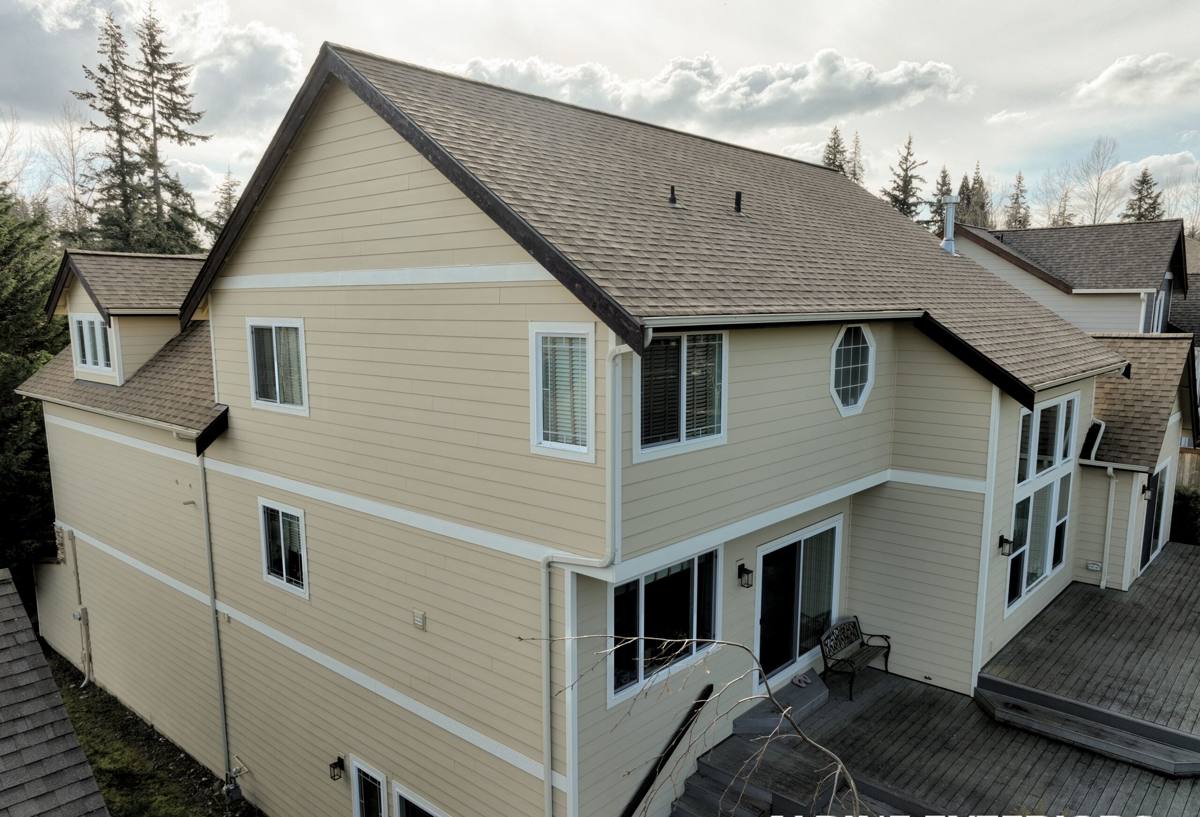
What Local Weather Does to an Improperly Built Deck
Skagit County gets a lot of rain, but it's the combination of moisture and time that does the real damage. A deck that looks fine in July can be hiding problems that only show up after a full wet season.
The failure points we see most often
- Ledger boards attached to the house without proper flashing, letting water track behind the siding and into the rim joist
- Joists and beams spaced or sized for a drier climate, sagging or checking after repeated wet-dry cycles
- Deck boards installed tight together with no gap for drainage, trapping moisture and growing moss between planks
- Fasteners that aren't rated for treated lumber, corroding and staining the wood within a few seasons
- Footings poured too shallow, shifting as the ground freezes and thaws through winter
- Shaded, low-airflow areas under and around the deck where moss and algae get a foothold and never fully dry out
None of these are dramatic failures on day one. They're slow ones — a soft spot here, a stain there, a railing post that's started to wobble. By the time a homeowner notices, the fix is usually bigger than it would have been if the deck had been built correctly from the start.
Choosing Decking Material for Mount Vernon's Conditions
There's no single "best" decking material — it's a trade-off between upfront cost, maintenance, and how the material behaves in a wet, moss-prone climate. Here's how the common options actually compare for a Skagit County deck.
| Material | Upfront Cost | Maintenance | How It Handles Local Moisture |
|---|---|---|---|
| Pressure-treated pine | Lowest | Annual cleaning, periodic sealing | Needs consistent upkeep or it grays, checks, and grows moss in shaded spots |
| Cedar | Moderate | Sealing every 1-2 years to hold color and resist rot | Naturally rot-resistant but still needs maintenance in constant damp; untreated cedar left bare will silver and soften over time |
| Composite decking | Higher | Occasional washing, no sealing or staining | Resists rot and doesn't absorb water like wood, but can still grow surface moss if airflow underneath is poor |
| PVC/capped composite | Highest | Minimal — washing only | Best moisture resistance of the group; won't swell, rot, or hold water the way wood-based products can |
We don't push one product over another as a rule — we walk through the trade-offs with the homeowner. A deck that gets full sun and good airflow can do fine with a well-maintained wood deck. A deck tucked under trees or against a north-facing wall, where moisture sits longer, is usually a better fit for composite or capped material. Either way, correct installation matters more than the material choice — a poorly built composite deck will still trap water and grow moss if the framing and drainage details are wrong.
Where we're honest about limitations
Some lower-grade composite products don't hold up well to years of constant damp shade — moisture can work into the core over time if the capping isn't fully sealed on cut edges. That's not a defect claim against any specific brand; it's a reason we pay close attention to edge sealing, fastener placement, and manufacturer install specs on every composite deck we build, and why we're upfront with homeowners about which products have a track record we trust for this climate.
What a Correctly Built Deck Requires in This Climate
A deck built to last in Mount Vernon isn't fundamentally different in design from a deck anywhere else — it's the execution that changes. Here's what we treat as non-negotiable.
Structural basics
- Footings poured below the local frost depth and sized to the deck's load, not just the minimum code allows
- Ledger boards flashed properly where they meet the house, with the flashing lapped correctly to shed water away from the structure — not into it
- Joist spacing and beam sizing calculated for the actual span and load, not just "what's always worked"
- Stainless or hot-dip galvanized fasteners rated for treated lumber, to avoid the corrosion and black staining that cheaper fasteners cause
Drainage and airflow
This is where a lot of decks in wetter climates actually fail. Deck boards need a consistent gap for water to drain through rather than pool. The space underneath needs enough clearance and airflow to dry out between rain events — a deck built low to the ground with no ventilation underneath is a moss and rot problem waiting to happen, no matter how good the decking material is.
Railings and hardware
Railing posts need to be through-bolted to the framing, not just screwed to the rim joist — undersized railing attachment is one of the more common safety issues we find on older decks during inspections. Hardware exposed to weather should match the corrosion resistance of the fasteners used in the framing.
Our Process From First Call to Finished Deck
We keep the process straightforward because homeowners deserve to know what's happening at each step, not just a start date and an invoice.
- On-site walkthrough. We look at the site — sun exposure, drainage direction, shade patterns, existing structure if it's a rebuild — and talk through what the homeowner actually wants to use the deck for.
- Material and design discussion. We go over decking material options, railing style, size, and layout, with honest input on what holds up best given the specific spot on the property.
- Written estimate. A clear scope and price before any work starts, no vague allowances that turn into surprise add-ons later.
- Permitting. We handle the permit process for the jurisdiction the project falls under, since deck permit requirements vary by size, height, and attachment method.
- Framing and inspection. Footings, framing, and ledger attachment get built to spec and are ready for inspection before decking goes down — this is the stage that determines how the deck performs for the next twenty years, not just how it looks.
- Decking, railing, and finish work. Boards, railings, stairs, and any trim or lighting get installed and squared away.
- Final walkthrough. We go over the finished deck with the homeowner, including basic care and what to watch for in the first year.
Maintaining a Deck Through Skagit County's Moss Season
Even a well-built deck needs some seasonal attention in a climate this wet. The good news is that the maintenance is simple if it's kept up with, and a lot less work than dealing with rot or moss buildup that's been left alone for a few years.
- Sweep leaves and debris off the deck regularly in fall — trapped organic matter holds moisture and feeds moss growth
- Wash the deck surface at least once a year, more often in shaded areas, to knock back moss and algae before it gets established
- Check gaps between boards periodically to make sure debris hasn't built up and blocked drainage
- Inspect railing posts and stair stringers annually for movement or soft spots
- For wood decks, reseal on the manufacturer's recommended schedule — skipping a season in this climate shows up faster than it would somewhere drier
- Keep the area underneath the deck clear of stored materials that block airflow
Permits and Local Considerations
Deck projects in Skagit County typically require a permit once they exceed a certain height or size, and the specifics depend on the jurisdiction the property falls under. Ground-level decks and attached decks are often treated differently, and attachment to an existing structure can trigger additional review of the ledger connection. We handle the permit application and inspection scheduling as part of the project rather than leaving it to the homeowner to sort out, since getting this step wrong can delay a project or require rework later.
Why Hiring a Crew That Already Works Mount Vernon Matters
A deck built by a crew unfamiliar with this specific climate often looks fine at handoff and starts showing problems within a few wet seasons — moss in the gaps, staining at the fasteners, soft spots where drainage wasn't accounted for. We work throughout Anacortes and the surrounding Skagit County communities, including Mount Vernon, so the framing details, fastener choices, and drainage planning on every deck we build already account for what this region's rain and moss season actually do to a structure over time. That's not a marketing point — it's the difference between a deck that needs major repair in year six and one that just needs an annual wash.
We're also a local, accountable crew — if something needs attention after the project is done, we're not a company that packed up and left the area. That matters for a build that has to perform outdoors, year-round, in this climate for decades.
Get a Free Estimate for Your Mount Vernon Deck Project
If you're planning a new deck or need to replace one that hasn't held up to Skagit County weather, we're happy to come take a look and walk through your options — no pressure, no obligation. Use the form below to request a free estimate and we'll get back to you to schedule a time to visit the property.