 Anacortes Siding
 Old Town Anacortes is one of the older, closer-to-the-water pockets of the city, and decks here take on a different kind of wear than decks a few miles inland. Salt-laden air off the water, driving rain that comes in sideways more often than you'd like, and a moss season that can stretch across most of the year all work against wood decking in particular. We build composite decks in this neighborhood regularly, and we've learned which details actually matter here versus which ones are just building-code minimums. This page walks through what a correctly built composite deck involves in Old Town Anacortes, and why the material and the install both matter as much as each other.
What Old Town Anacortes Decks Are Up Against
Being close to the water in Skagit County means a home's exterior — deck included — deals with a heavier moisture load than a comparable structure sitting further inland or sheltered by terrain. Salt air accelerates corrosion on fasteners and hardware that aren't rated for it, driving rain finds its way into ledger connections and framing joints that weren't detailed carefully, and shaded or north-facing sections of a deck can stay damp for days after a storm passes. Add in mature tree cover common to older Anacortes lots, and you've got conditions that are close to ideal for moss and algae to take hold.
Older homes in Old Town Anacortes also tend to have decks that were built or rebuilt at different points over the decades, often to whatever standard was common at the time rather than to what actually holds up in a marine climate. When we're called out to look at an aging deck in this part of town, it's rarely the decking boards themselves that failed first — it's almost always the framing, the ledger attachment, or the fasteners underneath.
Common Problems We See on Old Town Anacortes Decks
- Moss and algae buildup on shaded boards and in the gaps between them, especially on north-facing or tree-covered decks
- Soft or discolored framing near the ledger board, where water has been tracking behind the house rather than draining away from it
- Corroded fasteners and joist hangers on older decks that weren't built with coastal-rated hardware
- Cupped, splintering, or graying wood boards that were never sealed on a consistent enough schedule to keep up with the wet season
- Standing water or slow drainage under the deck from grading or ventilation that was never addressed at construction
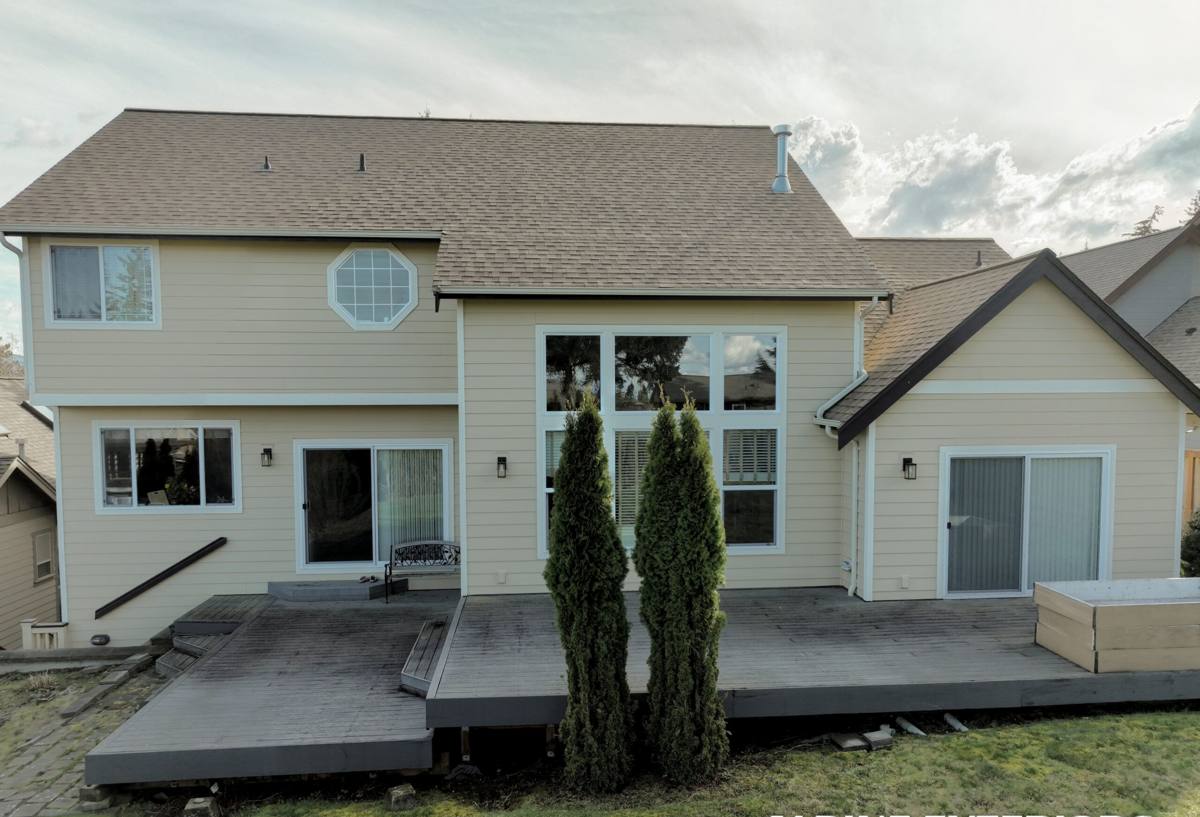
Why Composite Decking Fits This Climate
Composite decking doesn't solve every problem a wet, salty climate throws at a deck, but it removes a big one: wood's dependence on a strict maintenance schedule to avoid rot, splintering, and graying. Modern capped composite boards are made from a wood-plastic core with a protective polymer shell, which means the board itself doesn't absorb water the way solid wood does, doesn't need annual staining or sealing, and holds its color and surface texture through repeated wet-dry cycling far better than untreated or even pressure-treated lumber.
That doesn't mean composite decking is maintenance-free — moss, pollen, and algae will still settle on the surface here the same as they would on any other exterior material, and boards still need periodic cleaning to stay looking good. But the difference is that composite doesn't rot from the inside if that maintenance slips for a season, which matters in a climate where it's easy for a busy homeowner to fall behind on deck upkeep between October and April.
What a Correctly Built Composite Deck Involves
Substructure and Framing
The framing underneath a composite deck matters as much as the boards on top, arguably more. We use pressure-treated or coated framing lumber sized and spaced to the decking manufacturer's specification — composite boards often require tighter joist spacing than solid wood, especially when installed at an angle or with hidden fastener systems, and skipping that spec is one of the more common shortcuts that leads to bounce or sagging down the road.
Ledger Attachment and Flashing
Where the deck attaches to the house is the single most important water-management detail on the whole structure. We install proper ledger flashing that directs water away from the band joist and wall assembly rather than letting it pool or wick into the framing — a detail that's easy to get wrong and hard to inspect once the decking is down, which is exactly why we don't cut corners here. In a climate with as much sustained rain as Skagit County gets, a poorly flashed ledger is often the first place a deck fails, years before the decking material itself would ever need replacing.
Fasteners, Hardware, and Ventilation
All structural hardware — joist hangers, screws, and connectors — should be rated for treated lumber and coastal exposure; standard uncoated hardware corrodes faster near salt air and eventually loses its holding strength. We also pay attention to airflow underneath the deck, since a structure that can't breathe traps moisture in the framing longer after every rain, which shortens the life of everything above it even if the decking boards themselves never rot.
Composite vs. Wood vs. PVC Decking — What Actually Fits Old Town Anacortes
| Material | Upfront Cost | Maintenance | Fit for This Neighborhood |
|---|---|---|---|
| Pressure-treated wood | Lowest | Annual sealing/staining to prevent rot and graying | Workable if the upkeep schedule is kept up with; struggles if it isn't, especially in shaded spots |
| Cedar | Mid | Regular sealing/staining to prevent graying and splitting | Attractive but demanding in sustained wet conditions near the water |
| Capped composite | Higher | Periodic washing, no staining or sealing | Strong fit — resists moisture absorption and holds up to repeated wet-dry cycling |
| PVC (cellular) | Highest | Periodic washing, no staining or sealing | Fully synthetic, very moisture-resistant, but a different look and feel underfoot than capped composite |
There's no single "right" answer for every property — a shaded, heavily wet lot right off the water leans harder toward composite or PVC, while a sunnier, more sheltered yard can make wood a reasonable option if the owner is committed to the maintenance. We'll walk through what your specific lot is dealing with before recommending one over another.
Choosing a Composite Board
Composite decking isn't one product — boards vary by manufacturer in core composition, cap thickness, color-fastness, and fastening system. Well-known manufacturers like Trex, TimberTech, and Fiberon each offer multiple product tiers, from entry-level boards to premium lines with deeper wood-grain texture and stronger fade warranties. We can walk through options across brands and price points based on your budget, the look you want, and how the deck's orientation and sun exposure will affect color retention over time — a south-facing deck and a shaded north-facing one don't always call for the same board.
Our Process
- On-site evaluation — we look at the existing deck or build site, note sun exposure, drainage, tree cover, and proximity to the water, and check the condition of any structure we'd be attaching to
- Structural assessment — for a rebuild, we determine whether the existing framing and ledger connection can be reused or need to be replaced; for new construction, we design the substructure to the decking manufacturer's spec
- Material selection — we go over composite board options, colors, and fastening systems (hidden clips versus face screws) based on your budget and preferences
- Build — framing, ledger flashing, and structural work first, then decking installation, railing, and any stairs or lighting
- Final walkthrough — we go over the finished deck with you, including what routine maintenance actually looks like for the specific board you chose
Keeping a Composite Deck Looking Good in This Climate
- Sweep off leaves, needles, and debris regularly, especially in fall — trapped organic matter is what feeds moss and algae growth on any surface, composite included
- Wash the deck surface a couple of times a year with a soft-bristle brush and mild soap and water; avoid pressure washing directly into board grooves, which can force water and debris into fastener channels
- Check that gaps between boards stay clear so water can drain through rather than pooling on the surface
- Keep gutters and downspouts near the deck clear so runoff isn't dumping extra water onto or under the structure
- Periodically check railing posts and stair connections for movement, since hardware and connection points are still the parts of a composite deck most likely to need attention over time
- Trim back overhanging branches where practical to cut down on shade and debris that encourage moss
Why a Crew That Works Old Town Anacortes Regularly Matters
Old Town Anacortes isn't uniform — lot elevation, tree cover, and distance from the water vary block to block, and that changes how much exposure a given deck actually sees. Working in this neighborhood repeatedly means we already have a sense of where drainage tends to be a problem, where moss comes back no matter what, and which older homes are likely to need extra attention to the ledger and framing before a new deck ever gets attached. That's the kind of thing you learn from doing the work here, not from a spec sheet, and it shapes how we scope a job before we ever start cutting lumber.
It also means fewer surprises during the build — we're familiar with the permitting process for this part of the city and with the practical realities of older lots, like tighter access or established landscaping that needs to be worked around during construction.
If you're planning a new composite deck or replacing an aging one in Old Town Anacortes, we're glad to take a look and give you a straight read on what your property needs. Reach out for a free, no-pressure estimate — there's a form right below this page.