 Anacortes Siding
 Oak Harbor Siding Takes a Different Kind of Beating
Homes in the Oak Harbor area sit close enough to open water that siding has to deal with more than the average Northwest storm cycle. Salt-laden air moves across the water and settles on exterior walls, where it accelerates corrosion on fasteners and trim, and quietly breaks down finishes that were never engineered for a marine environment. Add driving, wind-blown rain that hits walls at an angle instead of falling straight down, and a moss season that can stretch from fall through spring, and you have a set of conditions that punishes siding faster than most manufacturers' glossy brochures ever admit.
We work this stretch of the Skagit County coastline regularly, and the repair calls we get from the Oak Harbor area follow a pattern: damage that started small, in one corner or one water-exposed elevation, and spread because it wasn't caught early or wasn't fixed correctly the first time. Siding repair here isn't just patching a hole — it's understanding why that spot failed and making sure the fix doesn't fail the same way in eighteen months.
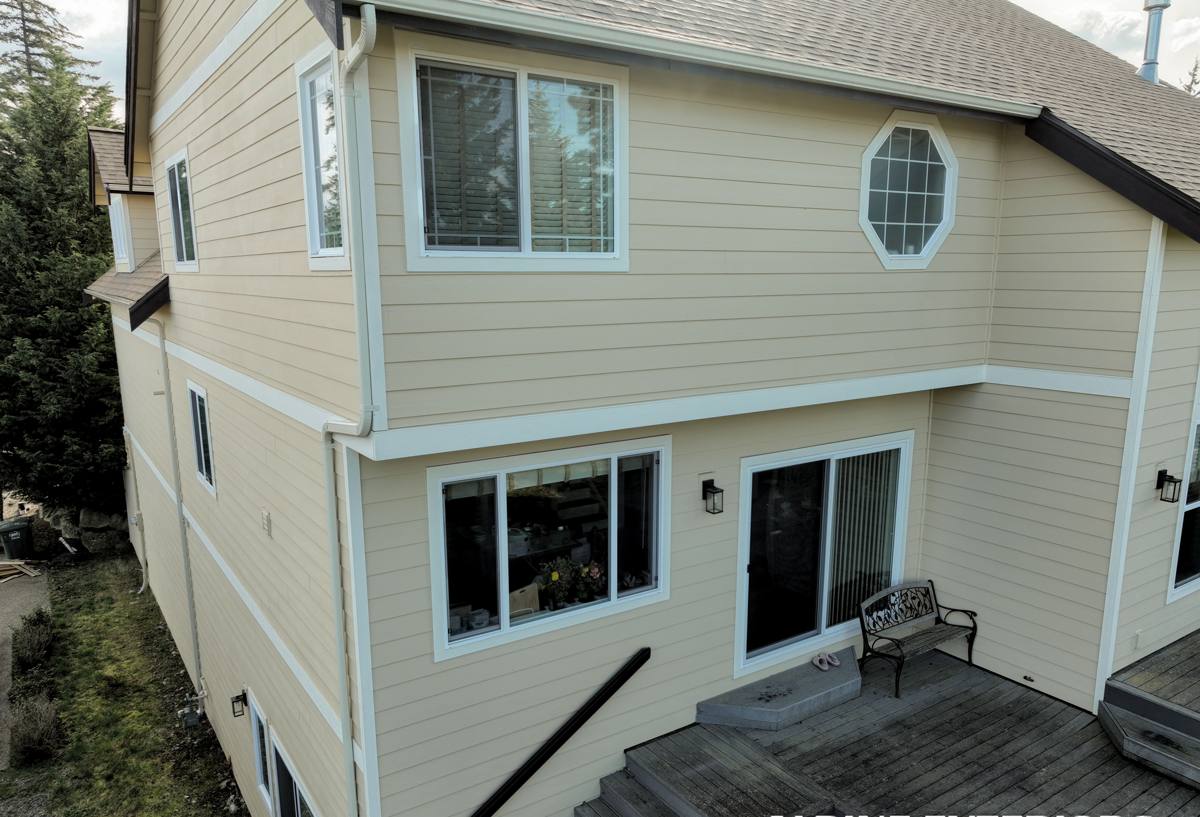
What Local Weather Actually Does to Siding
Salt Air and Metal Fasteners
Nails, screws, and metal flashing corrode faster near the water. Once fasteners weaken or flashing rusts through, water finds a path behind the siding — and by the time you see a stain or a soft spot on the surface, the damage underneath is usually already established.
Driving Rain and Wind-Driven Water
Wind off the water pushes rain sideways into wall assemblies, which puts far more stress on laps, seams, and butt joints than a calm vertical rain ever would. Any gap, any failed caulk joint, any spot where two pieces of siding don't overlap correctly becomes an entry point.
Moss and Sustained Moisture
A long moss season means shaded, north-facing, and tree-covered walls stay damp for extended stretches. Moss and algae hold moisture against the siding surface far longer than open air would, which is exactly the condition that lets rot take hold in wood-based products and lets water tracking find its way into seams on any material.
Signs Your Oak Harbor Home Needs Siding Repair
Most siding failures give warning signs well before they become structural problems. Homeowners in this area should walk the exterior at least once or twice a year and look for:
- Soft, spongy, or bubbling spots when you press on the siding, especially near the bottom edge of walls
- Visible cracking, splitting, or buckling in individual boards or panels
- Peeling or bubbling paint, or chalky discoloration that wipes off on your hand
- Dark streaking, staining, or a persistent musty smell near exterior walls or interior corners
- Gaps opening up at seams, corners, or around window and door trim
- Moss or algae buildup that keeps returning to the same section of wall
- Rust streaks running down from nail heads or metal trim
- Warping or separation where siding meets flashing, especially over windows and at roof lines
Any one of these on its own might be minor. Several appearing together, or appearing on the same elevation repeatedly, usually means water has been getting behind the siding for a while.
What a Correct Repair Actually Involves
Diagnosing Before Cutting
The most important part of a repair happens before any siding comes off. We check how far moisture has traveled — into sheathing, framing, or insulation — because replacing the visible damaged board and leaving wet material behind it just guarantees a repeat call. A repair that only addresses what's visible on the surface is not a repair, it's a delay.
Matching Water Management, Not Just Material
Every repair has to restore the drainage plane behind the siding — proper flashing, correct overlaps, and house wrap that directs water out and away from the wall rather than trapping it. This matters more here than in drier inland climates, because a repair that looks right but doesn't manage water correctly will fail again during the next wind-driven storm.
Matching Appearance
Patched sections need to match existing coloring, profile, and reveal lines closely enough that the repair doesn't stand out. On older siding with faded or discontinued colors, this sometimes means a broader repair scope than a homeowner initially expects, and we'll always explain that trade-off honestly before starting work.
Fastening and Sealing for the Environment
Given the corrosion risk from salt air, fastener choice and sealant selection matter more here than they would twenty miles inland. Cutting corners on either is exactly how a repair calls us back in a year or two.
Repair or Replace? How We Help You Decide
Not every damaged section justifies a full re-side, but not every "small patch" request is actually a good candidate for a spot repair either. Here's how we generally think about it:
| Situation | Repair Usually Makes Sense | Replacement Usually Makes Sense |
|---|---|---|
| Damage location | Isolated to one section or elevation | Spread across multiple walls or the whole house |
| Underlying moisture | Sheathing and framing test dry once siding is removed | Rot or moisture is found in sheathing/framing |
| Age of existing siding | Siding is relatively young and otherwise sound | Siding is near or past its expected service life |
| Material match | Matching material/color is available or close enough | Discontinued profile or color makes patching obvious |
| Root cause | A one-time or localized failure (flashing, impact damage) | A systemic issue (product-wide moisture behavior, failed original install) |
We'll always tell you honestly which category your home falls into, even when a smaller repair means a smaller job for us.
Our Repair Process
- On-site inspection — we look at the damaged area, the surrounding siding, and check for hidden moisture, not just the obvious spot
- Honest scope — you get a clear explanation of what's causing the damage and whether a repair or a larger fix is the right call
- Correct removal — damaged material and any compromised underlayment or flashing come out, not just the visible board
- Rebuild the water management — flashing, house wrap, and drainage details get restored to spec before new siding goes back on
- Match and install — new material is fastened and finished to blend with the surrounding siding as closely as possible
- Final walk-through — we show you what was found, what was fixed, and what to watch going forward
Why We Repair With James Hardie Fiber Cement
When a repair calls for new material — whether it's a patched section or a full elevation — we use James Hardie fiber cement, and we don't install vinyl, LP SmartSide, Cemplank, Allura, primed spruce, or cedar as a substitute. That's a deliberate standard, not a default. Fiber cement is non-combustible, holds up to moisture without the swelling and rot risk that wood-based products carry, and Hardie's ColorPlus factory finish resists fading and chipping far better than field-applied paint — which matters directly in an environment where salt air and UV both work against a painted surface. Hardie's HZ5 product line is engineered specifically for climates with more moisture and freeze-thaw exposure, which fits this coastal stretch of Washington better than a one-size-fits-all product.
Repairing with a different material than what's already on the house is sometimes unavoidable — for instance, if the existing siding is a product we don't install and full replacement isn't in scope yet. In those cases we'll tell you plainly what your options are and what the long-term trade-offs look like, rather than quietly matching a product we wouldn't put on a house ourselves.
Why Hiring a Crew That Already Works Oak Harbor Matters
A siding repair done by someone unfamiliar with this coastline often misses the actual cause of failure — treating a salt-air corrosion problem like a generic maintenance issue, or patching over a moss-related moisture problem without addressing the shading or drainage that caused it. A crew that regularly works Oak Harbor and the surrounding Skagit County coastal area already knows which elevations tend to take the worst weather, which fastener and flashing choices hold up here, and what a repair actually needs to survive more than one wet season. That local pattern-recognition is the difference between a repair that lasts and one that's a temporary patch.
After the Repair: Keeping Oak Harbor Siding Ahead of the Weather
A good repair buys you time, but this climate rewards a little ongoing attention. We recommend:
- A visual walk-around each fall before the wet season and again in spring
- Keeping gutters and downspouts clear so water discharges away from walls, not down them
- Trimming back vegetation and tree cover on shaded walls to reduce moss growth and let siding dry out between storms
- Gently removing moss and algae buildup before it spreads, rather than letting it sit through another wet season
- Watching caulked joints and trim intersections for cracking, since these are usually the first place wind-driven rain gets in
If you're seeing early warning signs on your Oak Harbor home, or you just want an honest read on whether a section needs a repair or something more, we're happy to take a look. Fill out the form below for a free, no-pressure estimate — we'll give you a straight answer about what your siding actually needs.