 Anacortes Siding
 Why Guemes Island Roofs Take a Different Kind of Beating
Guemes Island sits just across the channel from Anacortes, and that short stretch of water changes the math on roof maintenance. Homes here get more direct exposure to salt-laden air, more wind-driven rain off the Salish Sea, and — thanks to heavy tree cover on much of the island — a moss season that runs longer than it does on more open, sun-exposed lots. None of this means Guemes Island roofs are doomed to fail early. It means repair work has to account for the environment, not follow a generic patch job borrowed from a mainland subdivision.
Salt Air and What It Does to Fasteners and Flashing
Salt in the air settles on every exposed surface of a roof, and over years it speeds up corrosion on anything metal — nails, screws, flashing, drip edge, even the coating on some metal roofing panels. A fastener that's corroding loses its grip on the material it's holding down. A flashing seam that's pitted and thinning is a much easier path for water to find its way under the roofing and into the sheathing below. On Guemes Island, we pay closer attention to fastener and flashing material selection than we would on a job further inland, because the environment is actively working against cheap hardware from day one.
Moss Season and Shaded Rooflines
Skagit County's wet, mild winters are moss-friendly everywhere, but Guemes Island's mix of mature evergreens and slower-drying, shaded roof sections gives moss an especially long runway. Moss isn't just cosmetic. It holds moisture against the roofing material, works its way under shingle edges and shake courses, and lifts materials just enough to let wind-driven rain get underneath. A roof that looks "mossy but fine" from the ground can already have soft, saturated decking underneath by the time a leak shows up inside the house.
What a Correct Roof Repair Actually Involves
A lot of roof "repairs" are really just a patch over a symptom — a dab of sealant over a stain, a single shingle swapped out without checking what's underneath it. On Guemes Island, where the underlying causes are usually salt exposure, trapped moisture, or both, that approach tends to fail again within a season or two.
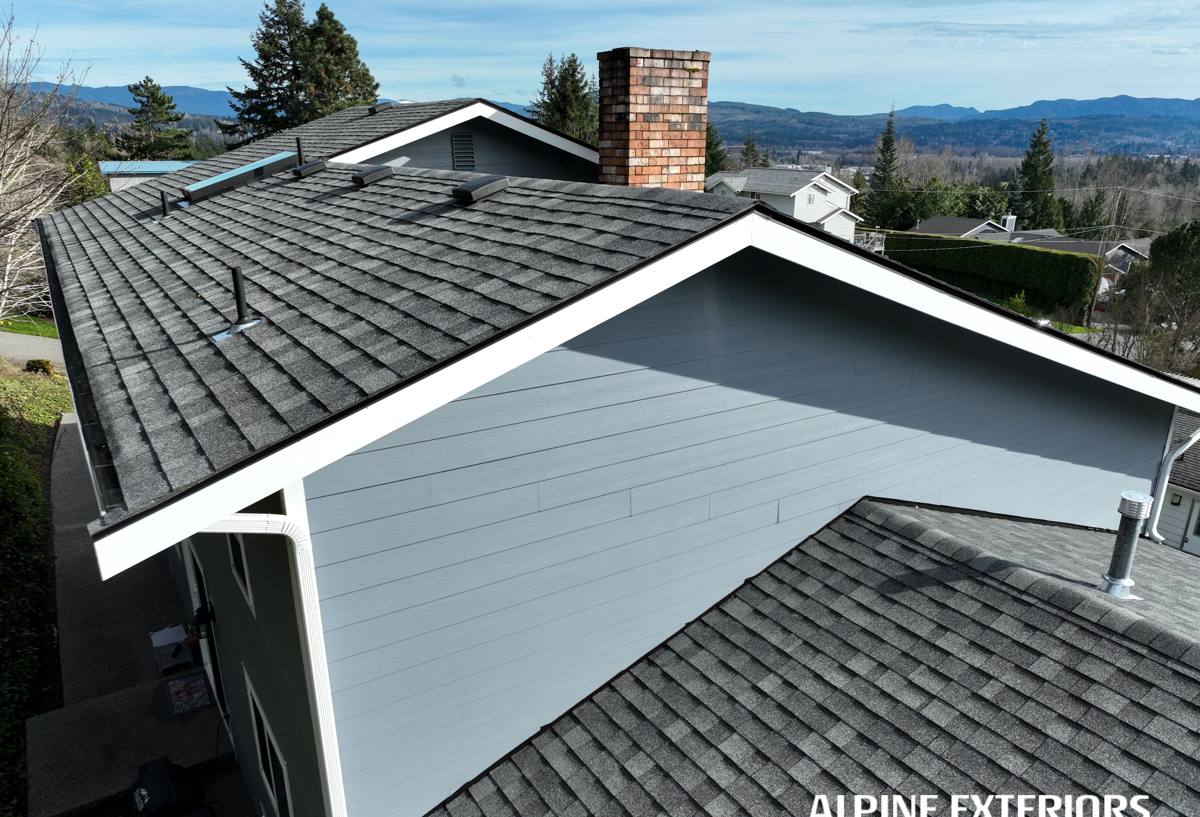
A correct repair starts with figuring out why the roof failed in that spot, not just where it's leaking. That usually means pulling back roofing material around the problem area, checking the condition of the underlayment and decking, and inspecting nearby flashing. Valleys, chimney or vent penetrations, and roof-to-wall transitions are the most common failure points we find on island homes, and a repair that ignores one of these while fixing another rarely holds.
Common Failure Points We Find
- Flashing at penetrations — pipe boots, chimneys, and skylights where corrosion or old sealant has failed
- Valleys — where two roof planes meet and water volume concentrates, especially under moss buildup
- Eaves and low-slope sections — where driving rain can push water uphill under the roofing during storms
- Roof-to-wall transitions — a frequent weak point on additions, porches, and dormers
- Shaded, north-facing slopes — where moss and lichen establish first and hold moisture longest
Materials That Hold Up Out Here
We don't push one roofing material as the answer for every home — the right choice depends on the existing roof system, the home's age, and the budget. But for repair hardware and flashing specifically, we favor corrosion-resistant metals and fastener types suited to marine-influenced air over the cheapest option on the shelf. It costs a little more up front and saves a callback in a few years, which matters more on a job that requires a ferry crossing to get back out to.
The Ferry Factor: Why Access Logistics Actually Matter
Roof repair on Guemes Island isn't just a technical job — it's a logistics job. Every crossing on the ferry is a scheduling decision: how much crew, how much material, and how much equipment can make the trip in one load. A contractor who treats the island like any other stop on the route ends up making extra crossings, and that either shows up in the price or in delays.
Scheduling Around the Crossing
We plan island repair days around the ferry rather than around our own convenience, loading the truck with everything a job is likely to need — materials, underlayment, flashing stock, tools — so the crew isn't stuck waiting on a second crossing mid-repair. For weather-sensitive work, that planning matters even more, since a rain system rolling in off the water can turn a same-day repair into a multi-day one if we're not set up to move fast the first time.
Staging Materials and Equipment On-Island
Many Guemes Island properties are on well water, septic systems, and gravel or unpaved access roads, which changes how we stage a job compared to a typical in-town Anacortes address. We look at driveway access, turnaround space, and safe material staging as part of the estimate itself, not as a surprise on repair day.
Repair Options at a Glance
Not every leak or moss patch calls for the same fix. The table below covers the repairs we're called out for most often on the island, roughly in order of scope.
| Repair Type | Typical Cause on Guemes Island | What's Involved |
|---|---|---|
| Moss removal & treatment | Shaded, slow-drying roof sections under tree cover | Careful manual removal, gentle low-pressure treatment, gutter and valley clearing |
| Flashing repair or replacement | Salt-air corrosion at valleys, vents, and chimneys | Removing affected roofing, installing corrosion-resistant flashing, resealing penetrations |
| Localized shingle or shake replacement | Wind-driven rain lifting edges, storm damage | Matching existing material where possible, checking underlayment condition below |
| Decking repair | Long-term moisture intrusion from moss or failed flashing | Cutting out and replacing soft or rotted sheathing before re-covering the section |
| Full section re-roof | Repair area too large or too degraded to patch reliably | Stripping to deck, new underlayment, new roofing material on the affected slope |
Our Process for a Guemes Island Repair Call
Every roof and every access situation on the island is a little different, but the steps stay consistent:
- Phone or photo assessment — if you can send photos of the problem area ahead of time, it helps us plan the visit and materials before we make the crossing.
- On-site inspection — we look at the roof from the ground and, where safe, up close, checking the reported problem area and the roof as a whole for related issues like moss buildup or aging flashing.
- Written estimate — a clear explanation of what we found, what we recommend, and why, including an honest answer on whether a repair is the right call or the area has moved past what a repair can reliably fix.
- Scheduled repair — timed around ferry logistics and weather windows so the work gets done efficiently in as few crossings as possible.
- Follow-up — for absentee or seasonal owners, we can document completed work with photos since not everyone is on the island to see it done in person.
Signs Your Roof Needs Attention Before the Next Storm Season
Skagit County's wet season doesn't leave much room for procrastination. A small, inexpensive repair in summer is often a much bigger job by the time winter storms off the Salish Sea have had a few months to work on an existing weak spot. Watch for:
- Visible moss or dark streaking on shaded roof slopes
- Granules collecting in gutters or at downspout outlets
- Soft or bouncy spots noticed when a roof surface is walked (have a professional check this rather than testing it yourself)
- Rust staining below metal flashing or fasteners
- Daylight, damp insulation, or water stains visible from inside the attic
- Lifted or curling shingle edges, especially near eaves and valleys
- A ceiling stain that only appears during or right after heavy, wind-driven rain
Why Hiring a Crew That Already Works the Island Matters
There's a real difference between a contractor who occasionally takes an island job and one who already knows the ferry schedule, the typical access challenges, and how island homes in this climate actually fail. That familiarity shows up as fewer surprise costs, fewer wasted crossings, and repair recommendations based on what actually happens to roofs out here — not a generic checklist written for a mainland subdivision.
It also matters for accountability. Skagit County's unincorporated areas, including Guemes Island, fall under county rather than city jurisdiction for permitting on larger roofing work. A contractor who regularly works the island already understands that distinction and handles it correctly instead of treating every job as if it were inside Anacortes city limits.
Maintenance That Extends the Life of a Repair
A good repair buys time, but a little maintenance buys a lot more of it in this climate. Clearing gutters and valleys of moss and debris before the wet season, keeping overhanging branches trimmed back to reduce shade and debris drop, and having a roof looked at every year or two rather than only after a leak shows up all go a long way toward protecting the work that's been done. None of this is complicated, but on an island where a contractor visit takes more planning than a quick drive across town, it's worth staying ahead of small problems instead of waiting for them to turn urgent.
If you're dealing with a leak, moss buildup, or storm damage on a Guemes Island roof, we're happy to take a look and give you a straightforward, no-pressure estimate — including an honest answer on whether a repair makes sense or a larger fix is the better long-term move. Use the form below to get started.