 Anacortes Siding
 Roofing in Sedro-Woolley: A Different Set of Problems Than a Roof in Town
Sedro-Woolley sits inland from Anacortes along the Skagit River, tucked against forested foothills that climb toward the Cascades. That location changes what a roof deals with day to day. You're not getting the direct salt spray of a waterfront lot, but you are getting the same rain systems that soak the whole county, plus heavy tree cover, more shade, and slower-drying humidity than homes out in the open. On an asphalt shingle roof, shade and moisture that lingers is what actually shortens a roof's life — more than any single storm.
We work roofs across Skagit County, from the marine-exposed edges near Anacortes to inland towns like Sedro-Woolley, and the difference shows up in the same places every time: north-facing slopes that never fully dry out, valleys that collect needles and debris, and gutters that back up faster under a tree canopy than they would on an open lot. A shingle roof built and maintained with that in mind will comfortably outlast one that wasn't, on the exact same house.
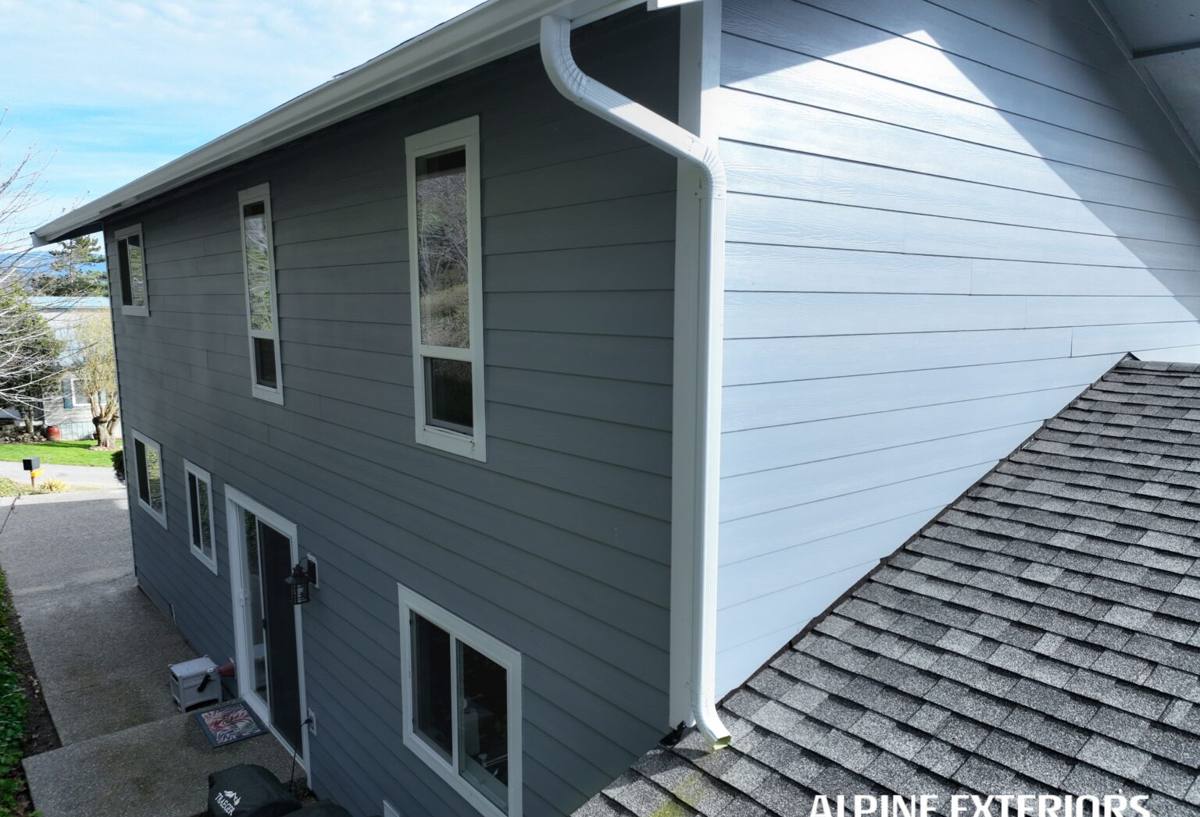
What Local Conditions Actually Do to a Shingle Roof
Moss and Organic Growth
This is the single biggest maintenance issue for asphalt shingle roofs in and around Sedro-Woolley. Shade from surrounding trees, combined with a long wet season, gives moss and algae exactly the conditions they need. Moss doesn't just sit on top of shingles — it works its rhizoids under the shingle edges and granule surface, lifting tabs and holding moisture against the mat underneath. Left long enough, that moisture retention is what leads to premature granule loss and soft spots, not the moss itself.
Sustained Rain and Slow Drying
Skagit County gets a long stretch of the year where roofs simply don't get a real chance to dry between rain events. On an open, sun-exposed roof that's a minor inconvenience. On a shaded, tree-lined lot like a lot of Sedro-Woolley properties, it means certain slopes can stay damp for days. That's a direct input into how fast moss colonizes and how fast the roof deck underneath can pick up moisture if the underlayment or flashing details aren't done right.
Wind-Driven Rain and Debris
Storms moving through this part of Washington regularly bring rain sideways, not just straight down. That matters for anything with seams or laps — ridge caps, valleys, and flashing around chimneys, skylights, and roof-to-wall transitions. A shingle roof that was installed to spec handles that fine. One where flashing was cut corners on or underlayment coverage was thin is where you start seeing leaks that seem to appear "out of nowhere" during a windy storm.
Choosing an Asphalt Shingle for This Climate
Not every asphalt shingle product is built the same, and in a moss-prone, high-moisture area the differences matter more than they would somewhere dry.
| Feature | Why It Matters Here |
|---|---|
| Algae-resistant (AR) granules | Copper or zinc-infused granules slow blue-green algae and moss growth — standard on most quality shingles now, and worth confirming on any bid |
| Architectural (laminated) profile | Thicker, heavier mat sheds water faster and resists wind uplift better than a flat 3-tab shingle |
| High wind rating | Matters for exposed ridgelines and open lots more than deep-shade lots, but still worth having given seasonal windstorms |
| Manufacturer warranty structure | Look closely at what's prorated after the first years and what's excluded for algae/moss staining — this varies by brand |
We install quality architectural shingles with algae-resistant granules as our standard for this region, not as an upsell. On a shaded, moisture-heavy lot, the small cost difference over a basic 3-tab shingle is easy to justify over the life of the roof.
What a Correct Installation Actually Involves
The shingles themselves get most of the attention, but on a roof in this climate the layers underneath and the details around penetrations are what actually determine whether it stays watertight.
- Deck inspection and repair — any soft, delaminated, or water-stained sheathing gets replaced before anything new goes down, not covered up
- Ice and water shield at eaves, valleys, and around penetrations, where wind-driven rain and ice damming (on the colder, higher-elevation edges of the service area) are most likely to force water backward under the shingles
- Synthetic underlayment across the full deck as a second line of defense, not just felt paper alone
- Proper flashing at chimneys, skylights, sidewalls, and any roof-to-wall transition — step flashing and counter-flashing installed correctly, not just caulked over
- Correct nailing pattern per manufacturer spec, since under- or over-driven nails are one of the more common causes of early shingle failure and voided warranties
- Ridge and hip caps matched to the shingle line, with proper overlap for wind resistance
- Balanced ventilation — intake at the eaves, exhaust at the ridge — sized to the attic, not guessed at
Every one of those steps is invisible once the roof is finished. That's exactly why it's worth asking a contractor to walk through their process before they start, not just after.
Ventilation and Moisture: The Part Homeowners Rarely See
A shingle roof isn't just a surface — it's the top of a ventilation system for the whole attic. In a wet, shaded climate like Sedro-Woolley's, poor attic ventilation traps warm, moist air against the underside of the roof deck. Over time that moisture works against the deck from below at the same time rain and moss pressure work against the shingles from above. The result is a roof that fails from the inside out, often well before the shingles themselves would have worn out on their own.
Correct ventilation means intake vents low (usually at the soffit) and exhaust vents high (ridge or roof vents), sized to move enough air for the attic's square footage, with nothing blocking the path in between — insulation stuffed into soffit vents is a common and completely avoidable mistake we run into on older homes. Getting this right during a re-roof is one of the cheapest, highest-value things a contractor can do for the long-term health of the roof.
Our Process for a Sedro-Woolley Roofing Job
- On-site inspection — we look at the existing roof, deck condition, attic ventilation, and any moss, staining, or soft spots, and take note of shade patterns and drainage on the specific lot
- Honest scope and estimate — what needs full replacement versus what's a repair, explained in plain terms, with the reasoning behind each recommendation
- Material selection — matched to the home's exposure, shade, and the homeowner's budget and preferences, not a single default product
- Tear-off and deck prep — full removal of old material, deck inspected board by board, any damaged sheathing replaced
- Underlayment, flashing, and shingle installation — done to manufacturer spec so the warranty actually holds if it's ever needed
- Ventilation check — intake and exhaust confirmed or corrected as part of the job, not left as-is by default
- Cleanup and walkthrough — site cleared of debris and old material, magnetic sweep for nails, and a final walkthrough so you know exactly what was done
What Affects the Cost of a Shingle Roof Here
| Factor | How It Moves the Price |
|---|---|
| Roof size and pitch | Steeper roofs take longer and require more safety setup, which adds labor cost |
| Number of layers to remove | Tear-off of an existing layer (or two) adds disposal and labor time versus a bare deck |
| Deck repair needed | Rotted or soft sheathing found during tear-off is priced as it's found — this is the most common source of a change in scope |
| Roof complexity | Valleys, dormers, skylights, and multiple roof planes all add flashing work and time |
| Shingle tier chosen | Basic 3-tab versus architectural versus premium algae-resistant lines carries a real material cost difference |
| Ventilation upgrades | Adding or correcting intake/exhaust venting is inexpensive relative to the roof but adds to the line-item total |
We give straightforward, itemized estimates so you can see where the cost comes from rather than a single lump number. If deck repair turns out to be needed once tear-off starts, we stop and talk it through with you before proceeding — no surprise charges buried in a final invoice.
Keeping a Shingle Roof Healthy Between Services
A well-installed roof still needs basic seasonal attention in a climate like this one. Most of it is simple and prevents expensive problems later.
- Keep gutters clear of needles and leaf debris — clogged gutters push water back under the shingle edge at the eaves
- Have moss removed before it spreads across a full slope, using methods that don't scrape or damage the granule surface
- Trim back overhanging branches where practical to reduce shade and speed up drying time on affected slopes
- Watch for granules collecting in gutters or downspouts, which can signal accelerated shingle wear
- Check attic ventilation isn't blocked by added insulation, especially after any insulation work
- Have flashing around chimneys, skylights, and vent pipes inspected periodically — sealant and flashing wear out well before shingles typically do
Why It Matters That We Already Work This Area
A roofing crew that mostly works drier, more open parts of Washington won't naturally think about shade patterns, moss cycles, and slow-drying valleys the way a crew that works Skagit County day in and day out does. Knowing which slopes on a Sedro-Woolley property are going to hold moisture, which roof lines tend to collect debris under the tree canopy, and how the local rain systems tend to drive water sideways at flashing points isn't something you learn from a manual — it's something you learn from doing this work here, repeatedly, on homes like yours.
That local knowledge shows up in small decisions during the job: where we pay extra attention to underlayment coverage, which shingle lines we steer people toward for shaded lots, and how we size ventilation for the moisture load this area actually sees. None of it is dramatic, but it's the difference between a roof that needs moss treatment and gutter attention every year or two and one that quietly does its job for its full expected life.
Get a Straightforward Estimate
If you're dealing with moss buildup, granule loss, a leak you can't pin down, or you're just planning ahead for a roof that's getting up in years, we're happy to come take a look. The estimate is free, there's no pressure attached to it, and you'll get a plain-English explanation of what we see and what your real options are. Fill out the form below to get started.