 Anacortes Siding
 Siding Built for Flounder Bay's Waterfront Exposure
Flounder Bay sits on the west side of Fidalgo Island, close enough to the water that salt air, wind-driven rain, and shade-grown moss are simply part of owning a home there. Siding installed here does more work than siding on a home a few miles inland in Anacortes. It absorbs salt-laden wind off the water, sheds rain that comes in sideways during winter storms, and has to resist moisture sitting in shaded, tree-lined lots for weeks at a time. A siding job that isn't specifically built for that combination will show it within a few years — soft spots, peeling paint, streaking, and swelling at the seams.
We install siding in this neighborhood regularly, and the lessons learned here shape how we approach every job: material choice, flashing detail, and fastening pattern all have to account for what this particular stretch of Skagit County throws at a house.
What Flounder Bay's Climate Actually Does to Siding
Salt Air
Airborne salt from the marine environment accelerates corrosion on fasteners, trim, and any exposed metal, and it degrades cheap paint films faster than inland exposure does. Over time, salt residue also holds moisture against a wall surface longer after a storm, which matters more than most homeowners expect.
Driving Rain
Storms coming off the water don't fall straight down — they hit siding at an angle, working into laps, seams, and any gap around trim or penetrations. A siding system that relies on caulk or paint alone to keep water out will eventually fail here. The install itself, not just the material, has to manage water.
Moss and Prolonged Dampness
Anacortes gets a long wet season, and shaded lots near the water stay damp longer than open, sunny sites. Moss and algae take hold on any surface that doesn't dry out quickly, and once established, they hold moisture against the siding continuously. On absorbent or poorly finished materials, that leads to soft board edges, paint failure, and eventually rot.
Why We Install Only James Hardie Fiber Cement Here
We don't install vinyl, LP SmartSide, cedar, primed spruce, or composite panel products like Cemplank or Allura. That's not a marketing position — it's a standard we hold because of what we've seen these products do (and not do) in exactly this kind of coastal, moss-prone environment.
- Vinyl expands and contracts significantly with temperature swings, can warp or buckle in direct sun exposure, and its seams and J-channels give wind-driven rain more places to work its way behind the panel.
- Wood-based products (cedar, primed spruce, engineered wood) are organic material at their core — even with good coatings, sustained dampness and moss growth are exactly the conditions that lead to swelling, delamination, and rot.
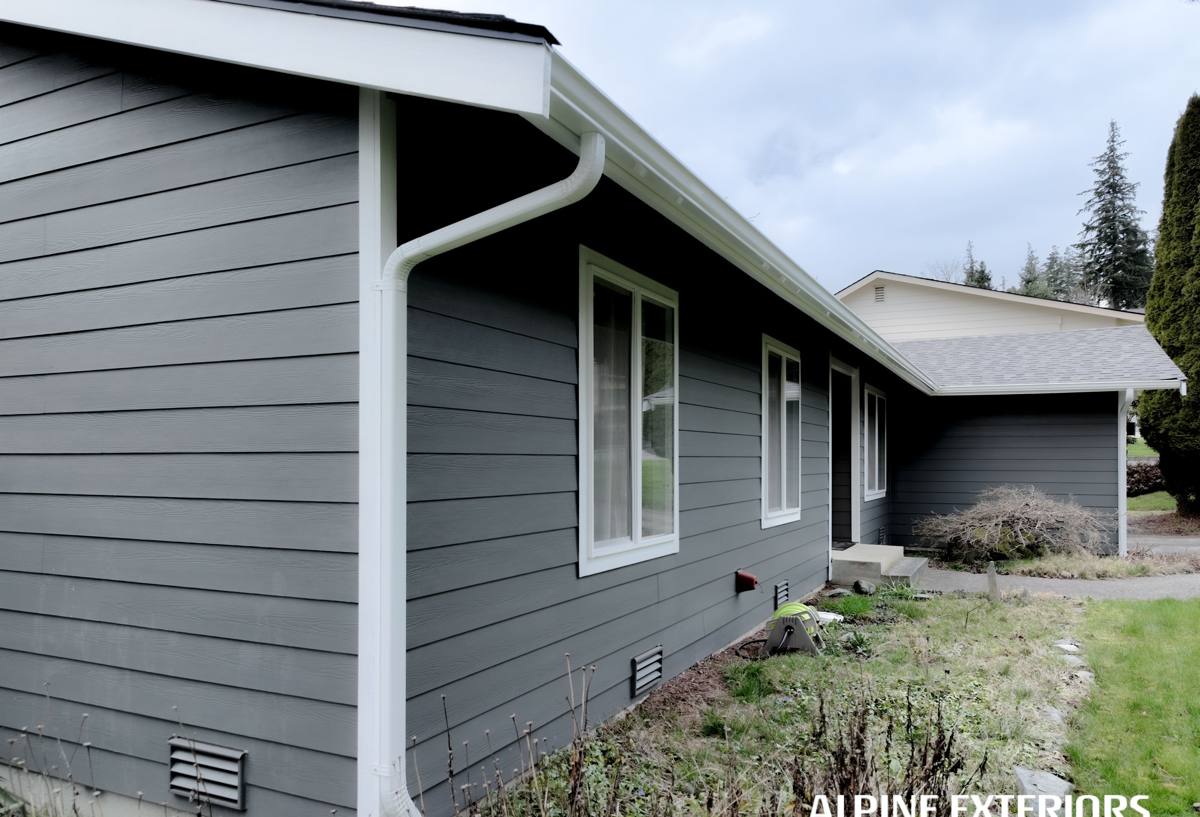
- James Hardie fiber cement is non-combustible, dimensionally stable, and doesn't feed moss or absorb water the way wood-based products do. Its factory-applied ColorPlus finish is baked on under controlled conditions, which holds up to salt air and UV far longer than a field-applied paint job.
Hardie isn't immune to moisture — no siding is — but the material itself doesn't rot, and a correctly installed Hardie system sheds and manages water instead of absorbing it. That combination is why it's the only product we put on homes in this area.
What a Correct Installation Involves in This Environment
The siding panel is only one part of the system. In a location like Flounder Bay, the details around it matter as much as the material itself.
Water-Resistive Barrier and Drainage Plane
A properly lapped weather-resistive barrier behind the siding, paired with a drainage gap, gives any water that does get past the siding a way out instead of a place to sit against the sheathing. This matters more here than in drier, inland parts of the county.
Flashing at Every Penetration
Windows, doors, hose bibs, vents, and deck ledgers all need properly integrated flashing — not just caulk. Caulk is a maintenance item that fails over time; flashing is a permanent water management detail. In a driving-rain environment, skipped or shortcut flashing is the single most common cause of hidden rot behind otherwise good-looking siding.
Fastening and Clearances
James Hardie specifies fastener type, spacing, and embedment depth for good reason — under-driven or overdriven nails, or fasteners that miss framing, create weak points where water can wick in. We also hold the manufacturer's minimum clearances above grade, roofing, and decking so the bottom edge of the siding never sits in standing water or splash-back, which is a common issue on waterfront lots with variable grading.
Caulking and Joint Treatment
Butt joints, trim seams, and terminations get treated with the sealant and technique Hardie specifies — not skipped to save time. In salt air, the wrong sealant degrades faster and needs earlier attention.
How We Approach a Flounder Bay Project
- On-site assessment — we look at sun and wind exposure, existing moisture damage, grading and drainage around the foundation, and how the current siding has actually performed on that specific lot.
- Tear-off and sheathing inspection — once the old siding is off, we check the sheathing for hidden rot, especially around windows and low corners, which is common in older coastal homes that were sided without proper flashing.
- Barrier and flashing installation — weather-resistive barrier, flashing at every penetration, and drainage details go in before a single piece of Hardie touches the wall.
- Hardie installation to spec — correct fastening, clearances, and joint treatment, following manufacturer installation requirements rather than shortcuts.
- Final walkthrough — we inspect seams, trim, and caulking with the homeowner before calling the job done.
Choosing the Right Hardie Line for This Exposure
James Hardie's HZ5 product line is engineered for the kind of freeze-thaw and moisture cycling common in the Pacific Northwest, and it's what we spec for most homes in the Anacortes area, including Flounder Bay. Beyond the base product, color and texture choices also matter here: darker ColorPlus finishes hold up well against salt exposure, and a smooth or lightly textured lap profile sheds surface moisture more readily than deep textures that trap standing water in shaded conditions.
Cost Factors for a Flounder Bay Siding Project
| Factor | Why It Affects Cost |
|---|---|
| Existing sheathing condition | Hidden rot from a prior siding system's water intrusion may require sheathing repair before install |
| Home size and wall complexity | More corners, gables, and trim detail mean more labor and material |
| Siding profile and color | Factory ColorPlus finishes and specialty profiles cost more than standard primed panel |
| Access and site conditions | Waterfront lots with limited access, slopes, or landscaping can add setup time |
| Trim and flashing scope | Full trim replacement and proper flashing at every penetration adds labor but is not optional for a correct job |
Why It Matters to Hire a Crew That Already Works This Neighborhood
Siding installation isn't uniform across Anacortes. A crew that mostly works drier, inland neighborhoods can still do competent work, but they may not default to the extra flashing detail, drainage planning, and clearance discipline that a marine-exposed lot in Flounder Bay actually requires. A crew that's worked this area repeatedly has already seen where water finds its way in on homes like these, and builds the job around avoiding those specific failure points from the start — rather than learning it after a callback.
Local familiarity also helps with practical planning: knowing which lots tend to hold moisture longer, how prevailing wind and rain direction affects a given elevation, and what grading or drainage issues are common on waterfront property in this part of Skagit County.
Caring for Hardie Siding in a Marine Environment
Correctly installed Hardie siding is low-maintenance, not no-maintenance. A few habits extend its life significantly in a salt-air, high-moisture setting like Flounder Bay:
- Rinse salt residue and grime off the siding once or twice a year, especially on wind-facing elevations
- Keep gutters clear so water doesn't overflow and run down the siding face
- Trim back vegetation that shades the wall and keeps it damp, which encourages moss and algae growth
- Check caulking at trim joints and penetrations periodically and re-caulk before gaps open up
- Address any paint chipping or exposed edges promptly so moisture can't get behind the finish
If you're planning a siding project in Flounder Bay, we're happy to walk the property, look at what your current siding is telling you, and put together a clear, honest estimate — no pressure, no obligation.