 Anacortes Siding
 Cap Sante's Exposure Is Different From the Rest of Anacortes
Cap Sante sits up on the bluff overlooking the marina, which means homes here catch wind and salt-laden air coming straight off Fidalgo Bay and the surrounding waterways in a way that inland Anacortes properties simply don't. That elevated, exposed position is part of what makes the neighborhood desirable — and part of what makes siding here fail faster than the manufacturer's brochure suggests it should.
Salt air is corrosive to fasteners and hard on any siding material that depends on paint film integrity to keep water out. Add Skagit County's driving rain — the kind that comes in sideways off the water rather than straight down — and you get moisture intrusion at laps, butt joints, and trim intersections that a fair-weather installation never gets tested against. Then there's the moss. Northwest Washington's damp season runs long, and anything on a shaded wall or under a fir canopy will grow moss and algae if the siding holds moisture at the surface instead of shedding it.
None of this means Cap Sante homes need something exotic. It means they need siding that's rated for the exposure, installed with real attention to water management, by a crew that has actually stood on ladders in this neighborhood and seen what the bay air does to a wall over ten or fifteen years.
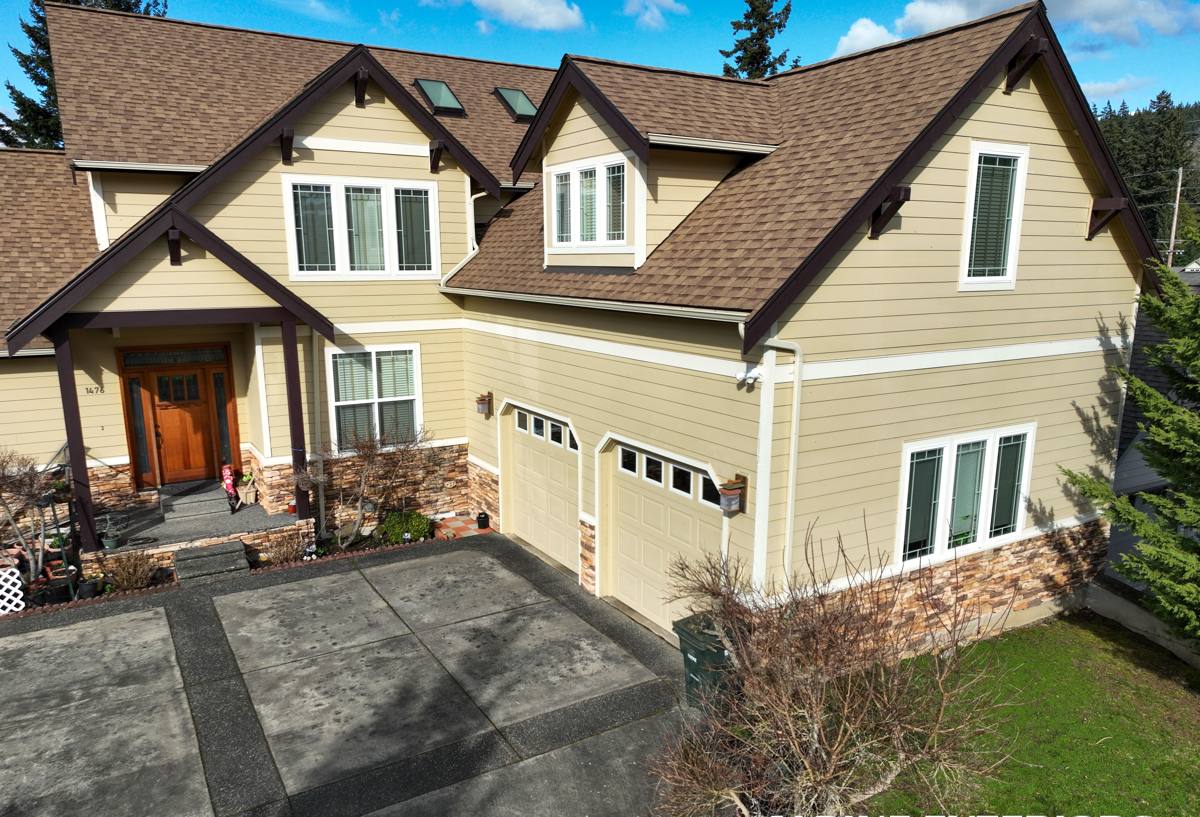
What "Correct" Siding Replacement Actually Involves
Siding replacement is not just pulling old boards or panels off and nailing new ones on. On a coastal, high-moisture site like Cap Sante, the work that happens underneath the new siding matters more than the siding itself.
Tear-off and inspection
Full removal of the old siding lets us see the sheathing underneath — which is the only way to find rot, soft spots, or prior water damage that's been hiding behind the existing cladding. This is especially important on older Cap Sante homes where a previous siding job may have been installed over a compromised wall to save time.
Water-resistive barrier and flashing
A new weather-resistive barrier goes on the sheathing before anything else, with flashing integrated at every window, door, and penetration so water that gets behind the cladding has a path back out instead of a place to pool. On a wind-driven-rain site like this bluff, flashing details at the top and bottom of window openings are where sloppy work shows up first — usually two or three winters later, as stains or soft trim.
Correct fastening and clearances
Fiber cement siding has specific nailing patterns, fastener spacing, and minimum clearances from grade, decks, and roof lines. Skipping these to save labor is exactly how a ten-year problem starts. We follow manufacturer installation specs because they're what keeps the warranty valid and the wall dry.
Why We Install Only James Hardie Fiber Cement
We made a decision as a company to install James Hardie fiber cement siding exclusively — not vinyl, not LP SmartSide, not cedar, not primed spruce. That's a narrower stance than most siding contractors take, and it's worth explaining rather than just stating.
Fiber cement is non-combustible, which matters on the drier side of a Pacific Northwest year, and it doesn't rely on a paint film alone to stay dimensionally stable the way vinyl and some engineered wood products do. James Hardie's ColorPlus factory finish is baked on under controlled conditions, which gives more consistent, longer-lasting color than field-applied paint — a real advantage in a salt-air environment where paint failure is one of the most common callbacks we see on other products. Hardie also engineers different formulations for different climates (their HZ5 and HZ10 product lines), so the material specified for a marine, high-moisture region like Skagit County is not the same formulation used in a dry inland climate.
We're not going to tell you vinyl or engineered wood siding is junk — plenty of it is installed and performs adequately in the right conditions. What we will say is that after years of doing this work, we don't think those products hold up as well on an exposed, salt-air, high-rainfall site like Cap Sante, and we'd rather stand behind one system we trust completely than offer several and let a homeowner guess.
How the Main Siding Options Compare on a Site Like This
| Material | Moisture behavior in marine climate | Maintenance burden | Fire rating | Typical finish longevity |
|---|---|---|---|---|
| Vinyl siding | Sheds water but can warp/buckle with heat and doesn't manage trapped moisture behind it well | Low, but cracks and fades over time, especially in salt air and UV | Combustible | Color is molded in, but fades; can't be effectively repainted long-term |
| Cedar / primed spruce | Absorbs moisture; needs sound paint film and ventilation to avoid rot | High — regular repainting and moisture monitoring | Combustible | Paint film typically 5-8 years before touch-up needed |
| LP SmartSide (engineered wood) | Treated to resist moisture but edge-sealing and caulking must stay intact | Moderate — dependent on maintaining seals at cuts and joints | Combustible | Factory finish generally holds well if installed and maintained per spec |
| James Hardie fiber cement | Dimensionally stable, engineered HZ formulations for marine/high-moisture climates | Low — occasional wash, no repainting cycle required for ColorPlus finish | Non-combustible | ColorPlus factory finish backed by a long manufacturer finish warranty |
Our Siding Replacement Process
- On-site assessment — we walk the exterior, check the current siding and trim condition, and look at exposure: which walls take the worst of the wind and rain off the bay, where moss and algae are already showing, and where prior water damage is likely.
- Written scope and product selection — we specify the Hardie product line, profile, and color, and lay out exactly what's included: tear-off, sheathing repair allowance, house wrap, flashing, and trim.
- Tear-off and sheathing repair — old siding comes off, damaged sheathing is identified and replaced, and the wall is dried in before anything new goes up.
- Weather barrier and flashing installation — house wrap and flashing go in at every penetration, following manufacturer and code-required overlap and integration details.
- Hardie siding installation — installed to manufacturer nailing, fastening, and clearance specifications, which is also what keeps the product warranty intact.
- Trim, caulking, and final inspection — trim work is completed, joints are sealed appropriately, and we walk the finished job with the homeowner.
Choosing the Right Hardie Line for a Cap Sante Home
James Hardie makes several siding profiles — lap siding, shingle-style panels, and vertical board-and-batten among them — and the right choice depends on your home's architecture as much as the climate. For Cap Sante specifically, we pay close attention to two things beyond style:
- Climate-engineered formulation — Hardie's HZ5 product line is engineered for cold, wet, humid climates like ours, as opposed to formulations built for hot-dry regions.
- ColorPlus finish selection — a factory-applied finish reduces the risk of early color fade and chalking that comes from marine UV and salt exposure, and it removes repainting from your maintenance list.
We'll walk you through profile and color options during the estimate, but the underlying material and finish system isn't something we vary — it's the one part of the job we don't compromise on regardless of budget, because it's what determines how the siding performs in year eight and year eighteen, not just year one.
Signs Your Cap Sante Home May Need Siding Replacement Now
- Visible moss or algae growth that returns within weeks of cleaning
- Paint that's peeling, bubbling, or chalking heavily, especially on walls facing the water or prevailing wind
- Soft or spongy spots when you press on siding or trim, particularly near the bottom of walls or below windows
- Persistent musty smell or visible staining on interior walls that back up to exterior siding
- Warped, cracked, or buckled panels, especially on sun- and wind-exposed elevations
- Rising energy bills that suggest the wall assembly is no longer keeping conditioned air in
- Siding that's more than 20-25 years old and has never been fully inspected behind the cladding
Any one of these on its own might just need a repair. Several together, especially on an older home, usually point to a wall assembly that's been taking on moisture for a while and is due for a full look, not another patch.
Why It Matters That We Already Work Cap Sante and Anacortes
A siding crew that's worked this specific stretch of Skagit County knows which elevations of a Cap Sante home take the worst of the weather off the bay, how far moss and algae growth can get before it's actually a moisture problem versus a cosmetic one, and what flashing details actually hold up against wind-driven rain here versus what looks fine on paper. That local track record matters more on an exposed bluff site than it does on a sheltered inland lot, where mistakes take longer to show themselves.
It also means we're not guessing at permitting requirements or working around unfamiliar site conditions for the first time on your house. We know this neighborhood's exposure, we know how James Hardie's products perform in it, and we install that one system correctly rather than offering a menu of products and hoping one works out.
If your Cap Sante home is showing any of the signs above, or you're just planning ahead for a siding project, we're happy to come take a look. The estimate is free, there's no pressure, and you'll get a straight answer about what your home actually needs.