 Anacortes Siding
 Why Similk Beach Sits in a Tougher Siding Environment
Similk Beach sits close enough to the water that its siding lives a harder life than siding a few miles inland. Homes here take on a steady mix of salt-laden air off the bay, wind-driven rain that comes in sideways during winter storms, and the kind of shaded, damp microclimate that keeps moss and algae growing on north- and west-facing walls long after the rest of Skagit County has dried out. None of that is dramatic on any single day. It's the accumulation — years of salt film, years of moisture cycling in and out of the wall assembly, years of green growth holding dampness against the surface — that separates siding that looks good at year fifteen from siding that's chalking, swelling, or rotting by year eight.
That's the backdrop for every siding decision on a Similk Beach home, and it's why we treat this as a different job than a re-side in a dry, inland neighborhood. The material has to tolerate the exposure, and the installation has to manage moisture correctly from the first course to the last.
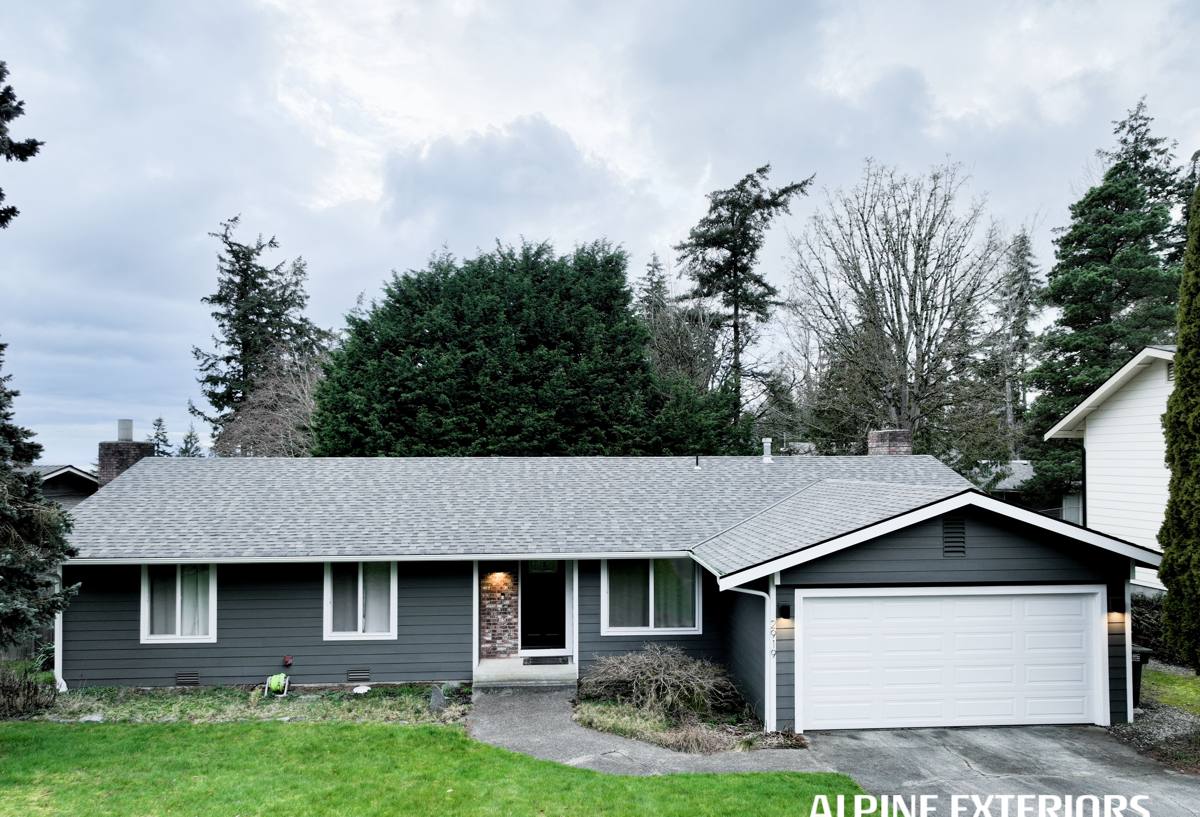
What James Hardie Brings to This Kind of Exposure
We install James Hardie fiber cement siding exclusively — not as one option among several, but as the only product we put our name behind. For a location like Similk Beach, the reasons are practical, not marketing talk.
Fiber Cement Doesn't Feed Moisture the Way Wood-Based Products Do
Fiber cement is made from cement, sand, and cellulose fibers, cured into a rigid, dense board. It doesn't absorb and release water the way wood, wood composite, or wood-fiber siding does, so it isn't prone to the swelling, delamination, and rot that salt-air moisture cycling causes in those materials over time. It also won't feed the kind of surface fungus and moss growth that thrives on organic, moisture-retentive surfaces.
Non-Combustible Construction
James Hardie siding is non-combustible fiber cement. That's not a Similk Beach-specific climate benefit, but it's part of why we standardized on the product across every job we take, coastal or not — it's simply a stronger material to put on a home.
ColorPlus Factory Finish
Salt air is hard on paint. A field-applied paint job on any siding material starts breaking down faster near the water, and repainting a full elevation every few years is a real, recurring cost. James Hardie's ColorPlus finish is baked on at the factory in a controlled process, with a UV-cured clear coat over it, and it carries its own finish warranty separate from the substrate warranty. It holds color and resists the chalking and fading that salt exposure accelerates on site-painted surfaces.
Climate-Engineered HZ Product Lines
James Hardie makes region-specific formulations under its HZ system, engineered for the moisture and freeze-thaw conditions of the area they're sold into. Products sold for the Pacific Northwest are formulated for a wet, moderate-freeze marine climate — which is exactly the environment Similk Beach sits in. This isn't a generic siding pulled off a national shelf; it's a formulation matched to the region.
What a Correct Installation Involves Near the Water
Fiber cement siding is only as good as the installation behind it. A near-water location makes every one of the following details matter more, not less.
Clearance and Drainage
James Hardie specifies minimum clearances from grade, roof lines, decks, and horizontal surfaces so water has somewhere to go instead of wicking up into the bottom edge of the board. On a home exposed to more wind-driven rain than average, we hold those clearances carefully rather than treating them as a suggestion.
Flashing and Water Management
Every window, door, and horizontal trim transition is a place water can get behind the siding if it isn't flashed correctly. We install house wrap and flashing so that water draining down the wall is directed back out, not trapped against the sheathing — this is the single biggest factor in whether a siding job lasts twenty-plus years or develops hidden rot behind a wall that looks fine from the street.
A Drainage Plane Behind the Siding
Especially on a wall that takes direct weather off the water, giving moisture a path to drain and dry between the siding and the sheathing matters. We build that into the assembly rather than relying on the siding alone to keep every drop of water out — no exterior cladding is a perfect water barrier, and the wall behind it needs to be able to dry.
Fastening to Spec
James Hardie has specific fastener types, spacing, and placement requirements. Under-fastened or improperly placed fasteners are one of the more common causes of premature siding failure — panels working loose, gaps opening at seams — and it's a detail that's invisible until it isn't.
James Hardie Against the Other Options Homeowners Consider
We only install James Hardie, but we're regularly asked how it stacks up against the alternatives homeowners see advertised or already have on their homes. Here's an honest comparison focused on how each performs in a salt-air, high-moisture setting like Similk Beach.
| Material | Moisture / Salt Air Behavior | Maintenance Over Time | Fire Behavior |
|---|---|---|---|
| James Hardie fiber cement | Doesn't absorb and swell; resists moisture-driven rot | Factory finish holds color; no repainting cycle in most cases | Non-combustible |
| Vinyl siding | Doesn't rot, but can warp or crack under temperature swings and impact | Low maintenance, but color fades and can't be repainted easily | Combustible, can melt/deform near heat sources |
| LP SmartSide / wood composite | Wood-based; moisture cycling and edge swelling are known failure points | Needs sealed edges and field paint maintenance | Combustible |
| Cedar / primed spruce | Absorbs moisture readily; prone to rot, cupping, and insect issues near water | Highest maintenance — regular staining, sealing, and spot repair | Combustible |
Every product on that list has a place in the market. Our decision to install only James Hardie comes down to wanting to stand behind a job we won't get called back to fix in five years — especially on a wall that faces this much weather.
How We Approach a Similk Beach Job
The process is the same discipline we apply everywhere, with more attention paid to the details that matter most in this location.
- On-site assessment. We walk the exterior, check the existing siding and trim for signs of moisture intrusion, and look closely at north- and water-facing walls where moss and staining tend to show up first.
- Sheathing and framing check during tear-off. Once the old siding is off, we inspect the sheathing underneath. Any soft or water-damaged sheathing gets repaired before anything new goes on — covering a compromised wall with new siding just hides the problem.
- House wrap and flashing installed to spec. This is the water-management layer that does the real work over the life of the siding.
- James Hardie panels or lap siding installed per manufacturer fastening and clearance requirements. Corners, trim, and penetrations get detailed carefully rather than rushed.
- Final walkthrough. We check caulking, trim lines, and clearances before calling the job finished.
Why a Crew That Already Works This Area Matters
Siding installation isn't fundamentally different from one Anacortes neighborhood to the next, but exposure varies a lot across Skagit County — a home tucked inland behind a windbreak deals with a lot less than a home with a clear line to the water. A crew that's already worked Similk Beach and similar waterfront-adjacent parts of Fidalgo Island has a feel for which elevations take the worst weather, where moss tends to establish first, and how much margin to build into flashing and clearance details rather than installing to the bare minimum spec and hoping the weather cooperates. That's judgment built from doing the work here repeatedly, not something you get from a general read of the installation manual.
Maintenance After Installation
James Hardie siding installed correctly is low-maintenance, not no-maintenance. In a salt-air, moss-prone location like Similk Beach, a little seasonal attention keeps it looking right for the long run.
- Rinse the exterior periodically to clear salt film and airborne debris, especially on walls facing the water
- Keep gutters clear so overflow doesn't run down the siding face or pool at the base
- Trim back vegetation and tree cover that keeps a wall shaded and damp, which encourages moss growth
- Check caulking at trim joints and penetrations every year or two and re-caulk where it's cracked or pulled away
- Address any moss or algae on the surface early with a gentle wash rather than letting it establish and hold moisture against the board
- Watch for any staining or soft spots at the base of walls near grade, decks, or downspouts — early signs of a drainage issue, not a siding defect
What Affects Cost on a Job Like This
Every Similk Beach home is different, so we won't quote a number without seeing the house, but these are the factors that move the price up or down.
| Factor | Why It Matters |
|---|---|
| Condition of existing sheathing | Water-damaged sheathing found during tear-off needs repair before new siding goes on |
| Home size and wall complexity | More corners, dormers, and trim detail means more labor and material |
| Siding profile chosen | Lap siding, shingle-style panels, and trim boards carry different material costs |
| Number of stories and access | Second-story and hard-to-access walls take more time and equipment |
| Existing exterior condition | Removal of old siding, trim, or damaged elements adds scope beyond the new material itself |
If you own a home in Similk Beach and your siding is showing salt staining, moss buildup, soft spots, or paint that just won't hold anymore, we'd be glad to take a look. We offer a free, no-pressure estimate — walk the exterior with us, ask what we find, and decide from there. There's a contact form below to get started.