 Anacortes Siding
 West Anacortes homes take a different beating than houses a few miles inland. Closer to the water, exposed to wind off the channel and strait, and shaded by the tree cover that makes this part of Fidalgo Island so pleasant to live on — these lots put more stress on siding than most homeowners realize until they start seeing the results. We install fiber cement siding on homes throughout this part of Anacortes, and we've built our process around exactly the conditions this neighborhood deals with: salt-laden air, rain that comes in sideways more often than straight down, and a moss season that can stretch across most of the year.
What West Anacortes Exposure Actually Does to Siding
Every siding material eventually shows wear, but the pattern and speed of that wear depends heavily on where the house sits. West-facing and water-facing walls in this part of town take direct wind and rain off the water for a large share of the year, and that changes what "normal wear" looks like on a 10- or 15-year-old house.
Salt Air and Fasteners
Airborne salt doesn't just sit on a surface — it works into seams, fastener heads, and any exposed metal, accelerating corrosion faster than it would happen a few miles inland. On siding jobs, this shows up first at nail heads, flashing, and trim fasteners that weren't rated or protected for a marine environment. Once corrosion starts at a fastener, it creates a path for water to follow, and the damage compounds from there.
Driving Rain and Wind-Driven Water
Rain that falls straight down is easy for siding to shed. Rain that's being pushed sideways by wind off the water is a different problem — it gets forced up under laps, into butt joints, and behind trim in ways that gravity-only drainage assumptions don't account for. Homes on more exposed West Anacortes lots see this kind of wind-driven rain regularly, which is why flashing and lap detailing matter more here than they would on a sheltered inland lot.
Moss and Algae Season
Shaded, damp conditions in this part of Skagit County support moss and algae growth for much of the year, especially on north-facing walls and anywhere tree cover keeps siding from drying out between rain events. Moss holds moisture against a surface long after the rain has stopped, which is a much bigger problem for materials that absorb water than for ones that don't.
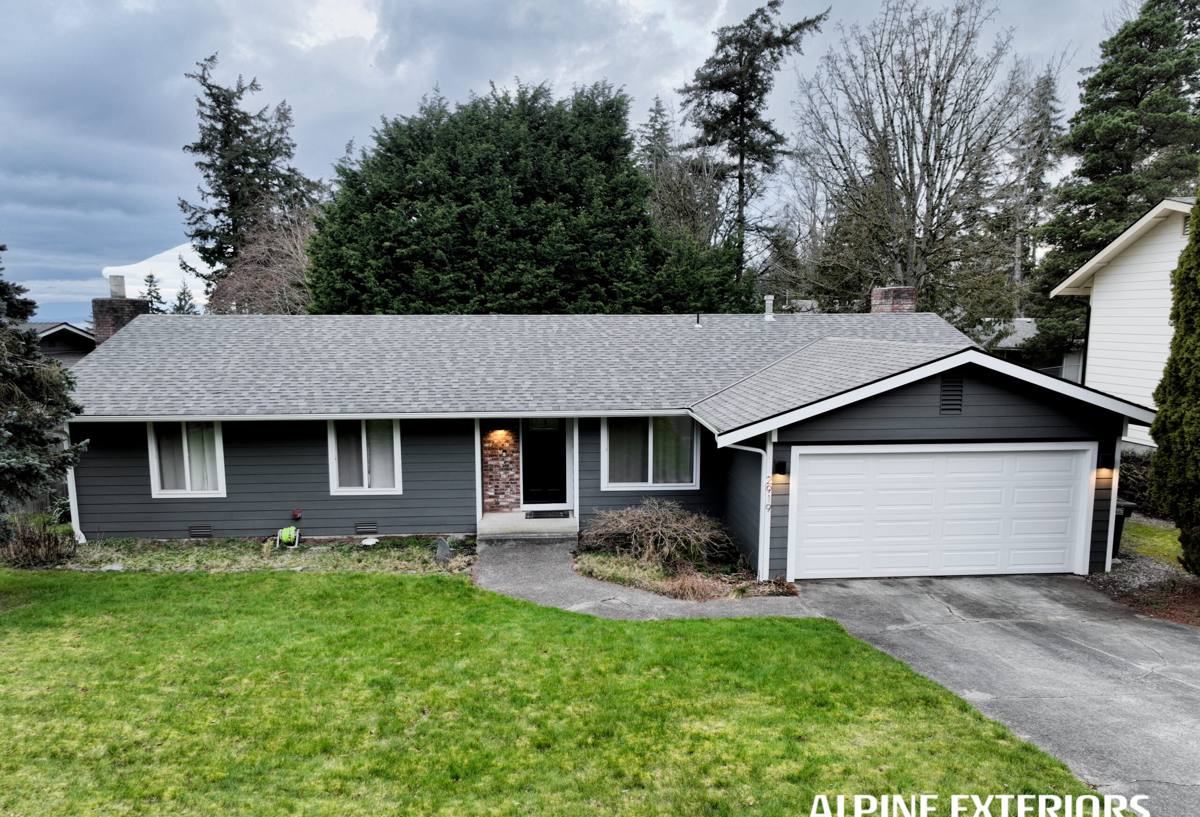
Why Fiber Cement Is Built for This
Fiber cement is a mix of cement, sand, and cellulose fiber, cured into a dense, dimensionally stable board. That composition matters directly for West Anacortes conditions:
- It doesn't absorb and swell with moisture the way wood or wood-composite siding can, which means less risk of rot at butt joints and bottom edges where moss and standing water tend to collect.
- It's dimensionally stable across temperature swings, so it doesn't expand and contract enough to work fasteners loose or open up gaps at seams over time the way some plastic and wood products do.
- It's non-combustible, which matters anywhere in Western Washington given wildfire smoke seasons and general fire-risk awareness, even in a coastal town.
- A factory-applied finish (on the lines we install) cures harder than field-applied paint and resists dirt, algae staining, and UV fading better over time.
Why We Only Install James Hardie
We install James Hardie fiber cement siding exclusively — not LP SmartSide, not vinyl, not unfinished wood products. That's a deliberate standard, not a sales pitch. Hardie's HZ5 product line is engineered specifically for climates like ours: wetter, milder, with more moisture-cycling than the drier regions some fiber cement lines are formulated for. Standardizing on one manufacturer's climate-specific product also means we know exactly how the boards behave, what clearances and fastening patterns the warranty requires, and how the ColorPlus factory finish holds up over years of Puget Sound weather — instead of juggling installation specs across several different products.
What a Correct Installation Involves
Fiber cement siding is only as good as the water management behind it. A house can have the right product on the wall and still fail early if the details underneath weren't done correctly — and in a marine climate, sloppy details show up faster.
Water-Resistive Barrier and Flashing
Every installation starts with a continuous water-resistive barrier over the sheathing, lapped correctly so water sheds downward and outward rather than working its way behind the barrier. Flashing goes in at every horizontal transition — window and door heads, roof-to-wall intersections, deck ledgers — because these are the points where wind-driven rain finds its way in first. On more exposed West Anacortes elevations, we pay particular attention to head flashing and kick-out flashing at roof lines, since those details take the most direct hit from sideways rain.
Gaps, Fastening, and Caulking
Hardie's installation spec calls for specific gaps at butt joints, trim, and penetrations to allow the board to breathe and drain rather than trap water. We follow those clearances exactly, use corrosion-resistant fasteners rated for coastal exposure, and caulk only where the manufacturer's spec calls for it — over-caulking every seam actually traps moisture rather than keeping it out, which is a common mistake on rushed jobs.
What Drives Cost on a West Anacortes Project
Every siding job is priced around the specifics of the house, but a few factors come up consistently on homes in this part of Anacortes:
| Cost Factor | Why It Matters Here |
|---|---|
| Existing siding removal | Tear-off cost and disposal vary by material — removing old wood or vinyl is usually faster than removing a second layer of siding some homes have accumulated over time. |
| Sheathing condition | Water-exposed walls near the shoreline are more likely to need sheathing repair once old siding comes off, especially around old flashing points that failed slowly. |
| Wall exposure and orientation | West- and water-facing walls often get upgraded detailing (heavier flashing, tighter clearances) that inland-facing walls on the same house may not need. |
| Trim and fascia scope | Homes with a lot of trim detail, dormers, or multiple rooflines take longer to flash and finish correctly than a simple rectangular elevation. |
| Product line and profile | HardiePlank lap siding, HardiePanel, and shingle-style profiles have different material and labor costs, and mixing profiles on one house adds detail work at transitions. |
| Site access | Sloped lots, limited driveway access, and close-set neighboring homes — common on tighter West Anacortes lots — can affect staging and labor time. |
How the Job Runs, Start to Finish
- Walkthrough and estimate. We inspect the current siding, check for signs of trapped moisture or existing damage, and note exposure conditions specific to your lot before quoting the job.
- Tear-off and sheathing check. Old siding comes off and we inspect the sheathing underneath. Any water damage gets addressed before anything new goes up — covering over a problem doesn't solve it.
- Water-resistive barrier and flashing. This is the layer that does the real work of keeping water out, and it happens before a single piece of siding is installed.
- Siding installation. Boards go up to Hardie's fastening and clearance spec, with extra attention to head flashing, butt joint placement, and corner details on exposed elevations.
- Trim, caulk, and finish work. Trim gets installed and sealed per spec, touch-up paint is applied at cut edges, and everything gets a final check for gaps or missed fasteners.
- Final walkthrough. We go over the finished work with you before calling the job done.
Living With Fiber Cement in a Marine Climate
Fiber cement is genuinely low-maintenance compared to wood, but "low-maintenance" isn't the same as "no maintenance," especially with West Anacortes moss and salt exposure. A little seasonal attention goes a long way toward protecting the investment:
- Rinse siding down once or twice a year to clear salt residue and airborne grime before it builds up, especially on water-facing walls.
- Keep an eye on shaded, north-facing sections for early moss or algae growth and address it before it spreads.
- Trim back vegetation and tree limbs that keep siding damp and shaded longer than necessary.
- Check caulking at trim and penetrations every couple of years — caulk is a maintenance item even when the siding underneath isn't.
- Watch gutters and downspouts near siding; overflow or misdirected water is one of the most common causes of localized siding damage, regardless of material.
Why a Local Crew Matters for This Job
A crew that already works in West Anacortes has seen how this specific stretch of the island behaves — which walls take the worst of the wind-driven rain, how fast moss establishes on shaded lots here compared to elsewhere in Skagit County, and which flashing details actually hold up over years of this exposure rather than just looking right on installation day. That's not something you get from a general how-to guide or a crew that mostly works inland. It shows up in the small decisions — where to add extra flashing, how tight to run clearances, which corners of a house need the most attention — that separate a siding job that lasts from one that needs early repairs.
If you're planning a siding project on a West Anacortes home, we're happy to walk the property, look at what your current siding is telling us about moisture and exposure, and put together a straightforward estimate — no pressure, no upsell, just a clear look at what the job actually involves.