 Anacortes Siding
 Conway sits low in the Skagit River delta, where farmland gives way to tidal flats and the river widens out toward Skagit Bay. That flat, low-lying geography sets Conway apart from higher ground elsewhere in Skagit County: homes here absorb salt-tinged marine air, wind-driven rain that rarely falls straight down, and a moss season that can run most months of the year on shaded walls. We're based out of Anacortes, but we've replaced enough siding on Conway homes to know this stretch of the valley asks more of an exterior wall than drier ground a few miles inland does. This page covers what a proper siding replacement involves for a Conway home, and why it has to be approached differently here.
Why Conway's Delta Location Puts Extra Load on Siding
Conway doesn't have much elevation working in its favor. The land is flat, the river and bay are close, and open farmland surrounds much of the community instead of hills or dense tree cover that would otherwise break up wind and help moisture evaporate faster. That combination means water — whether it's rain, fog, or humid air off the delta — tends to linger against a house longer here than it would on a home sitting higher and drier elsewhere in the county.
Salt Air Moving in Off the Bay
Even homes set back from the water get a steady dose of salt-tinged marine air moving up the delta from Skagit Bay. Salt accelerates corrosion in exposed fasteners, flashing, and trim, and it breaks down lower-grade finishes faster than a purely inland climate would. Siding and hardware chosen without that in mind tend to show their age early.
Driving Rain Across Open, Flat Ground
With little to break the wind on open, flat delta terrain, rain here often moves sideways into a wall rather than falling straight down onto a roof. That's a different, more demanding load than an annual rainfall number suggests, and it finds its way into any joint, seam, or flashing detail that wasn't sealed correctly the first time.
A Moss Season That Barely Breaks
Shaded walls, damp farmland air, and long gray stretches without real drying time add up to a moss and algae season that runs longer here than in sunnier parts of the region. Moss holds moisture against a wall surface well after a storm has passed, keeping that section of siding wet far longer than an exposed, sun-facing wall ever gets.
What We Find on Conway Tear-Offs — And Why Patch Jobs Don't Hold
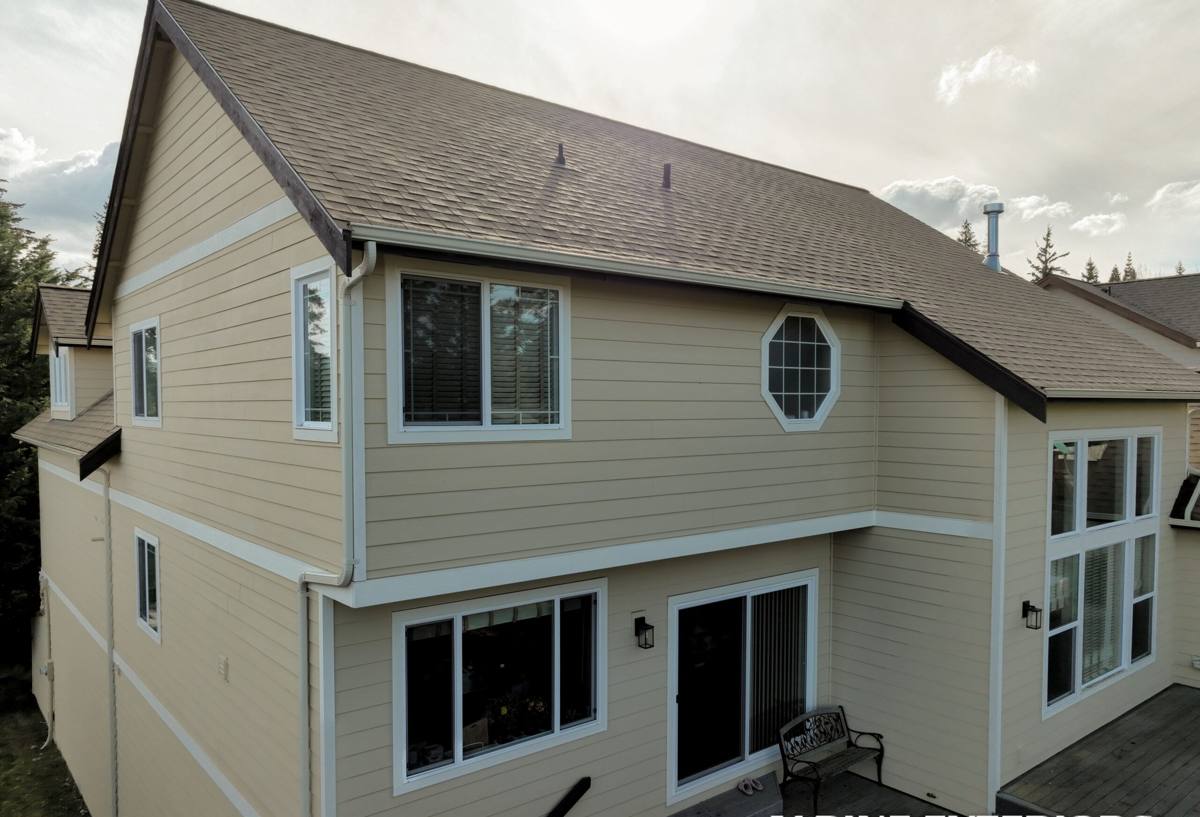
When we pull old siding off a Conway home, the pattern is fairly consistent: swelling and delamination at butt joints and lower courses near grade, moss and dark staining on shaded faces, corroded or popped fasteners, and caulk that's cracked or pulled away at trim and penetrations. Behind the siding, it's common to find sheathing that's stayed damp for years without anyone knowing, because the outward signs were subtle until the siding itself started to fail.
That's also why we don't recommend overlaying new siding on top of an old, compromised wall in this area. A recover job can look fine for a season or two, but it buries whatever moisture problem already exists behind it instead of fixing it — and in a delta climate that doesn't dry out quickly, a buried problem gets worse, not better. A proper siding replacement means removing the old material down to the sheathing, seeing exactly what condition the wall is actually in, and correcting it before anything new goes back on.
What Correct Siding Replacement Involves on a Conway Home
Full Tear-Off and Sheathing Inspection
Every job starts with removing the existing siding completely, not just the visibly damaged sections. That's the only way to actually see the sheathing underneath and catch rot or soft spots before they're covered up again for another twenty years.
Weather-Resistive Barrier and Flashing
A correctly lapped weather-resistive barrier, installed shingle-style so water sheds downward and outward, is what keeps incidental moisture from ever reaching the sheathing in the first place. Flashing at every window, door, and roof-wall intersection has to integrate with that barrier rather than just get caulked over it after the fact — caulk is a backup, not a strategy.
Fastening and Clearance
Fastener pattern and spacing need to match the specific siding product and the wind exposure of an open delta lot, and the bottom edge of the siding needs proper clearance from grade, decks, and hardscape so it isn't sitting in standing moisture after every rain.
Factory Finish vs. Field-Applied Paint
A factory-cured finish holds up more consistently than paint applied on-site in a climate that doesn't offer many reliable dry-and-cure windows. That difference matters more in Conway than it would somewhere with longer dry stretches for field painting to set up properly.
Why We Install Only James Hardie Fiber Cement in This Climate
We install one siding system on every home we work on: James Hardie fiber cement. That's a deliberate professional standard, not a limited product lineup. Fiber cement isn't organic, so it doesn't have a wood substrate for trapped moisture to work into, and it doesn't feed moss and algae growth the way wood-based products can. Hardie also builds climate-specific HZ5 formulations engineered around sustained moisture and coastal exposure, rather than one generic product sold everywhere in the country, and its factory-applied ColorPlus finish is baked on under controlled conditions instead of painted in the field. Backed by a strong transferable warranty when installed to spec, it's the system we're willing to put our name behind on a delta lot like this.
We don't install vinyl, LP SmartSide, Cemplank, Allura, primed spruce, or cedar. Each gets something right — vinyl is inexpensive, engineered wood takes paint well and installs quickly, cedar has real natural character — but each also carries an organic core or a seam-and-panel system that asks more of sustained moisture and salt exposure than we think is fair to a homeowner in a climate that doesn't give a wall much time to dry out between storms.
Comparing Siding Materials for Conway's Climate
| Material | Moisture & Rot Resistance | Salt Air / Corrosion Resistance | Moss & Algae Resistance | Maintenance Needed |
|---|---|---|---|---|
| James Hardie fiber cement | High — inorganic core | High with factory finish | High — no organic substrate to feed growth | Low — periodic cleaning |
| Vinyl siding | Moderate — seams and panels can trap moisture | Moderate — hardware and trim still exposed | Moderate | Low, but limited repair options if cracked or warped |
| Engineered wood (LP SmartSide) | Lower — organic core sensitive to sustained moisture | Moderate | Lower — feeds growth if finish is compromised | Higher — field priming and caulking upkeep |
| Cedar / primed spruce | Lower — natural wood, moisture-sensitive | Lower without diligent upkeep | Lower — organic surface | Highest — refinishing and sealing on a regular cycle |
Our Siding Replacement Process for Conway Homes
- Free on-site assessment, including a check for moisture and existing wall damage
- Material, profile, and ColorPlus color selection from Hardie's climate-appropriate HZ5 lines
- Full tear-off of the existing siding down to the sheathing
- Repair of any rot or damaged sheathing found once the old siding is off
- Installation of a properly lapped weather-resistive barrier and flashing at every penetration
- Siding installation following Hardie's fastening and clearance specifications
- Final walkthrough, cleanup, and warranty registration
What Drives the Cost of a Conway Siding Replacement
| Factor | Why It Matters Here |
|---|---|
| Home size and wall complexity | More corners, gables, and penetrations mean more flashing detail and labor time |
| Hidden moisture or rot found at tear-off | Delta homes often carry damage that isn't visible until the old siding comes off |
| Trim and accessory detail | Corner boards, fascia, and soffit work add scope beyond flat wall coverage |
| Siding profile and color | Wider reveals or accent details can run higher than standard lap siding |
| Site access | Rural driveways, tree cover, and farmland setbacks can affect staging and labor time |
We don't quote off a generic price sheet, because the real cost drivers are specific to the house in front of us. A walk-through gives an honest number for your particular property.
Signs Your Conway Home May Need Siding Replacement Now
- Soft or spongy spots when you press on the siding, especially low on the wall
- Visible swelling, cupping, or delamination at seams and butt joints
- Moss or dark staining that comes back quickly after cleaning
- Paint that won't hold, or keeps peeling and bubbling within a year or two
- Cracked, buckled, or missing boards after wind or storm events
- Visible gaps at trim, corners, or window and door edges
- Rising heating bills that may point to a wall assembly no longer sealing properly
Why a Crew That Already Works Conway Matters
A contractor who's worked homes throughout Conway and the surrounding delta understands how differently a low, flat, marine-exposed lot ages compared to a home on drier ground closer to Anacortes proper. That shows up in practical decisions on install day — where extra flashing attention matters most, how much clearance a wall needs from grade on land that doesn't drain quickly, and which sections of a house are worth extra time so a homeowner isn't dealing with a callback two winters later. It also means a familiar, local crew is reachable years down the road if a warranty question comes up, rather than chasing down someone who's since moved on to another part of the state.
If you're weighing siding replacement on a Conway home, we're glad to take a look and give you a straight, no-pressure assessment of what your house actually needs. Use the form below to schedule a free estimate.