 Anacortes Siding
 Edison Sits in a Tough Spot for Siding
Edison is a small, low-lying community tucked between the Skagit Valley's farmland and the tidal waters of Samish and Padilla Bay. That location is beautiful, but it's not an easy one for exterior building materials. Homes here sit close enough to saltwater to pick up airborne salt on windy days, close enough to open farmland to catch driving rain with almost nothing to break the wind, and shaded enough by surrounding trees and marine humidity to grow moss on north- and west-facing walls for a good chunk of the year. Add in the freeze-thaw swings that show up most winters, and you've got a combination that will find every weak point in a siding system over time.
None of this means Edison is a bad place to own a home — it just means siding installed here has to be installed correctly, with the right materials and the right details, or it will show wear years before it should. That's the whole focus of this page: what a proper siding job looks like for a house in this specific setting, and why we only install one product to make it happen.
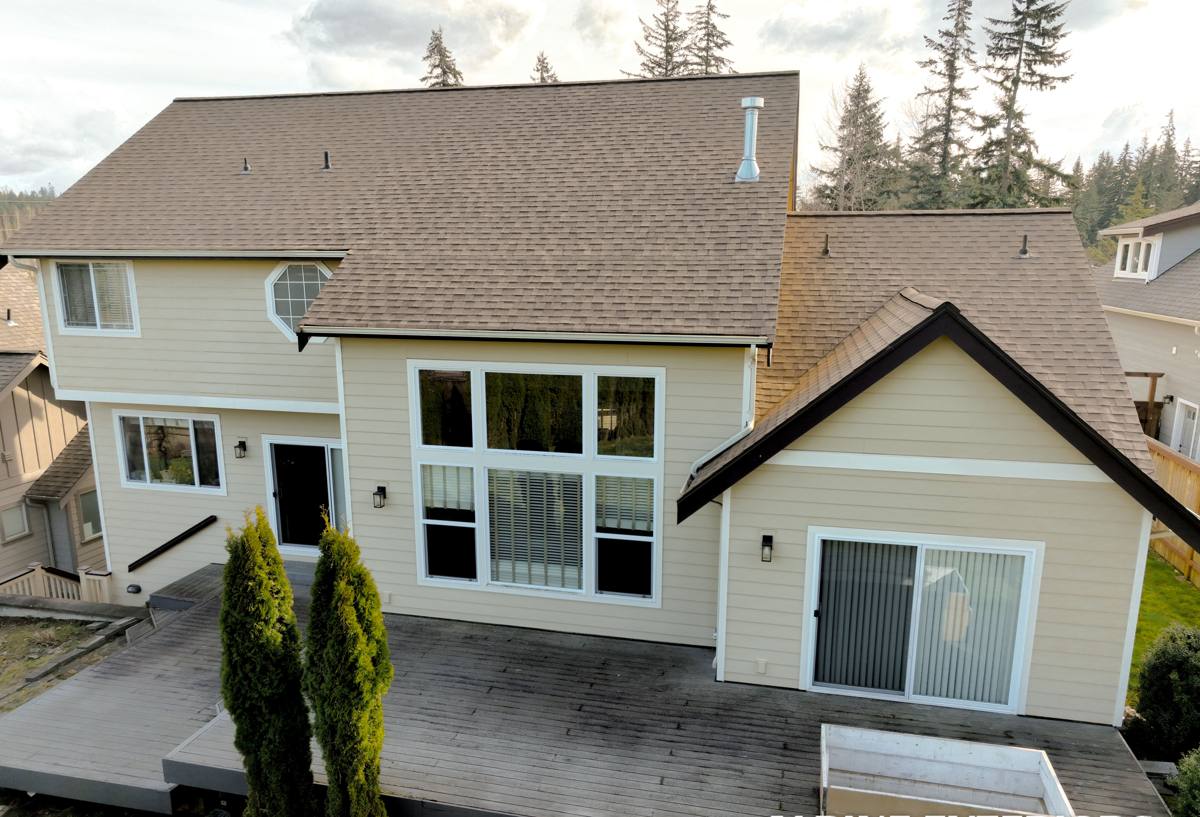
What Salt Air, Rain, and Moss Actually Do to Siding
Salt air
Airborne salt is corrosive to metal fasteners, flashing, and trim, and it accelerates the breakdown of paint films and cheaper composite materials. Homes even a few miles inland from Samish Bay still catch enough salt-laden wind to matter, especially on the sides of the house that face open water or open fields with no windbreak.
Driving rain
Skagit County storms often come with sustained wind, which pushes rain sideways into wall assemblies instead of letting it run straight down. That kind of wind-driven rain finds gaps in flawed caulking, poorly lapped house wrap, and butt joints that weren't flashed correctly. Once water gets behind the siding, it's the sheathing and framing underneath that pay the price — not just the siding face.
Moss and mildew
Shaded, damp exterior walls in this region grow moss and algae almost as a matter of course. On porous or absorbent siding materials, that growth holds moisture against the wall for extended periods, which is exactly the condition that leads to rot, delamination, and paint failure. On a dense, factory-sealed material, moss stays a surface issue you can rinse off rather than something that works its way into the material itself.
What a Correct Siding Installation Involves
A siding job is only as good as what's underneath it and how carefully it's detailed. For an Edison home, that means paying close attention to a handful of steps that are easy to rush and expensive to get wrong:
- A full inspection of the existing sheathing once old siding is removed, with any soft or water-damaged sections cut out and replaced before new material goes up
- A continuous weather-resistive barrier, properly lapped shingle-style so water sheds outward rather than working its way behind the seams
- Correct flashing at every window, door, and penetration — this is where most water intrusion problems actually start
- Manufacturer-specified fastener placement, spacing, and gaps at butt joints and corners, so the material can handle seasonal movement without cracking or buckling
- Careful attention to clearance at grade and at roof lines, so siding isn't sitting in standing water or trapping runoff
- Factory-finished material installed to keep field-cut edges primed and sealed, since a raw cut edge is the fastest way for moisture to get into any composite siding product
Every one of these steps matters more in Edison's climate than it would in a drier, calmer inland location. Skipping any of them doesn't usually show up as a problem in year one — it shows up in year five or six, as soft trim, staining, or siding that's pulling away from the wall.
Our Installation Process
We run the same disciplined process on every Edison-area project:
- On-site assessment — we look at wall orientation relative to wind and water exposure, existing moisture damage, trim and window condition, and any moss or algae staining that points to chronic damp areas
- Tear-off and sheathing check — old siding comes off, and we inspect and repair sheathing before anything new goes on; this is the step that gets skipped on cut-rate jobs and it's the one that matters most
- Weather barrier and flashing — house wrap and flashing installed and lapped correctly at every penetration, window, and door
- Siding installation to manufacturer spec — correct fastener type, spacing, and gapping for the specific Hardie product line being used
- Trim, caulking, and touch-up — factory-matched caulk and touch-up paint at cut edges and fastener heads
- Final walk-through — we go over the finished job with the homeowner before calling it done
Why We Only Install James Hardie Fiber Cement
We made a deliberate decision to install one siding system — James Hardie fiber cement — rather than offer a menu of options. That's not about limiting choice for its own sake; it's because the alternatives all carry trade-offs that show up hardest in exactly the conditions Edison deals with.
Vinyl siding is inexpensive and low-maintenance in mild climates, but it's a petroleum-based product that can warp in heat, become brittle in cold, and it isn't the same category of wind resistance or fire performance as fiber cement. Wood and cedar siding can look great, but they require ongoing painting, sealing, and vigilance against rot and insect damage — maintenance that's harder to keep up with in a persistently damp, moss-prone setting. Engineered wood products like LP SmartSide use a wood-strand core that, while treated, is still wood at its core and depends heavily on flawless caulking and painting to keep moisture out over the long run. We simply don't think any of those trade-offs make sense for the way weather behaves in this part of Skagit County.
James Hardie fiber cement is cement, sand, and cellulose fiber — non-combustible, dimensionally stable, and resistant to moisture absorption in a way wood-based products can't match. Hardie also builds region-specific "HardieZone" formulations, engineering the product for the moisture and climate conditions of the Pacific Northwest specifically, rather than a one-size-fits-all national spec. The factory-applied ColorPlus finish is baked on under controlled conditions, which gives far more consistent, long-lasting color than field-applied paint, and it comes with its own finish warranty backed by the manufacturer. That combination — the substrate and the finish — is why we standardized on it and why it's the only thing we put on a home.
How the Common Siding Options Compare
| Material | Moisture & Salt-Air Resistance | Moss/Algae Behavior | Maintenance Required | Typical Lifespan |
|---|---|---|---|---|
| Vinyl | Doesn't absorb water, but can warp/crack from wind and temperature swings | Growth sits on the surface but can trap moisture behind loose panels | Low, but panels are hard to repair invisibly | 15–25 years |
| Cedar / wood | Absorbs moisture readily; needs sealing to resist salt air and rain | Prone to moss and mildew without regular treatment | High — periodic painting, staining, sealing | 10–20 years without diligent upkeep |
| Engineered wood (LP SmartSide, etc.) | Treated wood-strand core; still moisture-sensitive at cut edges and joints | Can support growth if coatings fail or joints open | Moderate to high — depends on caulk/paint upkeep | Varies widely with maintenance |
| James Hardie fiber cement | Dense, cement-based; engineered moisture resistance for PNW climate zones | Growth stays on the surface and rinses off; doesn't feed into the material | Low — occasional wash-down and caulk check | Manufacturer-backed warranty; decades of documented field performance |
Local Considerations Specific to Edison
Edison's mix of older farmhouses, small residential lots, and homes set back from Samish Bay and the surrounding flats means a few things come up often in this area specifically:
Many homes here were built decades ago with original wood siding or early-generation replacement products, and by the time we get called out, there's often hidden moisture damage behind the visible surface — especially at window sills, corners, and anywhere trim meets the wall. Because Edison sits in open, low farmland with few tall windbreaks close to the water, wind-driven rain hits walls harder here than it does in more sheltered residential neighborhoods further from the bay. And because the area holds humidity and shade well along tree lines and drainage ditches, north-facing walls in particular tend to hold onto moss longer into the summer than homes on more exposed, sun-facing lots.
None of that is a reason to avoid siding work here — it's just context that shapes how we approach flashing details, ventilation, and where we pay extra attention during installation.
Living With Fiber Cement Siding in a Moss-Prone Climate
Correctly installed Hardie siding is genuinely low-maintenance, but "low-maintenance" doesn't mean "no maintenance." A little seasonal attention keeps it performing the way it's designed to:
- Rinse down shaded or north-facing walls once or twice a year to keep moss and algae from building up a visible layer
- Walk the exterior after major windstorms and check caulk lines at trim, window, and door edges for cracking or separation
- Keep gutters clear so runoff isn't sheeting down wall sections and holding moss growth in place
- Trim back vegetation and tree cover that keeps a wall section shaded and damp longer than the rest of the house
- Address any small paint chips or cut-edge exposure early, before moisture has a chance to work into an exposed edge
Why It Matters to Hire a Crew That Already Works in This Area
Siding installation isn't a one-size-fits-all trade. A crew that mostly works drier, more sheltered neighborhoods can do a technically fine install and still miss the details that matter most in a place like Edison — how much flashing overlap to use on a wall that catches wind-driven rain, which orientations need extra attention for moss and moisture, or how local permitting and inspection expectations work in Skagit County. We work this area regularly, which means we're not guessing at how the climate behaves here — we've already seen how these homes age and where problems tend to start.
That familiarity shows up in small decisions throughout a job: where we add extra flashing even when it's not strictly required, which wall sections get a closer look during tear-off, and how we sequence work around this area's rain patterns so a house isn't left exposed longer than it needs to be.
If you're weighing a siding replacement on an Edison-area home, we're glad to take a look and give you an honest read on what your house needs — no pressure, no upsell, just a straight assessment. Use the form below to request a free estimate.