 Anacortes Siding
 Conway's Low, Wet Ground Asks More of Your Siding
Conway sits down in the flat delta country along the Skagit River, low to the water table and close enough to the Salish Sea that salt-laden air rides in on the wind most of the year. That combination — flat, damp ground and marine air — is a harder environment for exterior building materials than most people realize. Siding here doesn't just need to look good; it needs to shed driving rain that comes in sideways off the water, resist the slow chemical creep of salt air on fasteners and finishes, and stand up to a moss season that, in this part of Skagit County, can run eight or nine months out of twelve.
We're based out of Anacortes and have worked homes throughout this stretch of Skagit County long enough to know that a siding job done for a dry-climate spec sheet doesn't hold up on delta ground. This page walks through what fiber cement siding actually needs to do right for a Conway-area home, what a correct installation looks like, and why we only install one product line to get there.
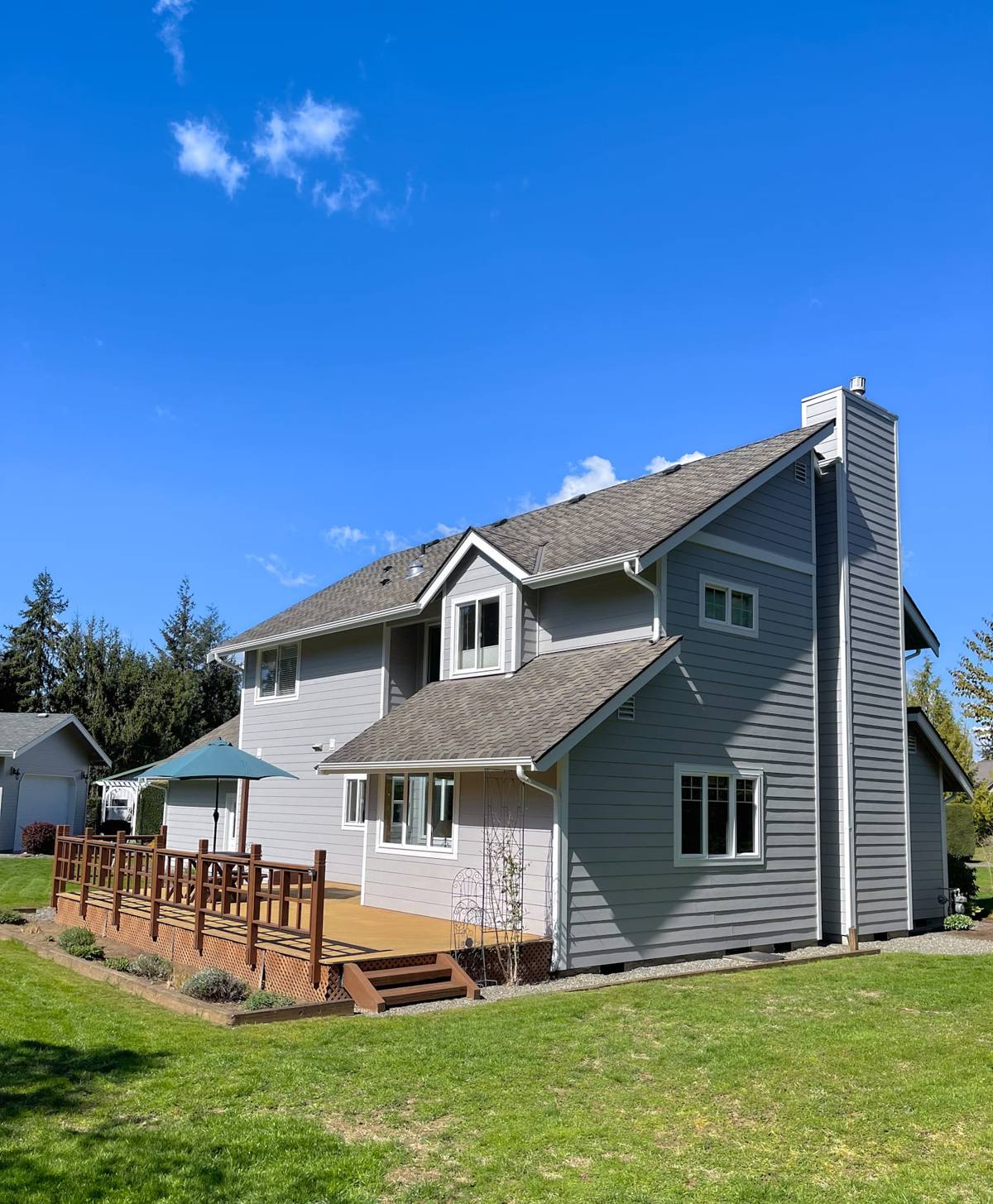
Why Fiber Cement Makes Sense on Low, Damp Ground
Fiber cement is cement, sand, and cellulose fiber pressed and cured into a dense, stable board. Unlike wood-based products, it doesn't have organic fiber structure for moisture to travel through and rot from the inside out. Unlike vinyl, it doesn't soften, warp, or go brittle with sun and cold cycling, and it won't melt or contribute fuel in a wildfire exposure. For a low-lying property where damp air sits longer than it does on a hillside or a windier point of land, that stability matters more than it would somewhere drier.
But "fiber cement" isn't one product — quality, formulation, and factory finish vary a lot between manufacturers, and that variation shows up fastest in exactly the conditions Conway has: standing moisture, salt exposure, and heavy moss and algae growth.
What the Climate Actually Does to Siding
- Driving rain forces water sideways into laps, joints, and butt seams, not just straight down a wall.
- Salt air accelerates corrosion on fasteners, trim flashing, and any exposed metal.
- Moss and algae hold moisture against the siding surface far longer than a clean, dry wall would, especially on north- and west-facing elevations.
- Low, flat terrain means less wind-drying between storms and more splash-back moisture near grade.
Why We Install Only James Hardie
We made a decision early on to stop installing anything other than James Hardie fiber cement siding, and Conway's climate is a good example of why. Hardie's HZ5 product line is engineered specifically for climates like the Pacific Northwest's — freeze-thaw cycling combined with sustained moisture — rather than a generic national spec. The ColorPlus factory finish is baked on under controlled conditions, which gives it more consistent UV and moisture resistance than a field-applied paint job, and it comes with a longer color warranty than most site-finished siding can offer.
We're not going to tell you every other siding product on the market is junk — that's not honest and it's not our call to make about a competitor's product. What we will say is that after years of installing and repairing siding in this exact climate, we found that other options — vinyl, engineered wood like LP SmartSide, primed spruce, cedar — each carry a real trade-off in a place like Conway: vinyl expands and contracts hard with temperature swings and can crack in a cold snap; engineered wood products are more sensitive to sustained moisture exposure at cut edges and require closer attention to caulking and touch-up; cedar and primed wood need a maintenance commitment most homeowners don't actually keep up with once the first few years pass. Fiber cement done right, from a manufacturer that engineers for this climate, removes most of that ongoing risk. That's why we standardized on Hardie and don't install the alternatives.
Product Lines That Fit Conway Homes
Most homes in this area — whether older farmhouses on delta ground or newer rural builds — do well with HardiePlank lap siding for the main field, HardieTrim for corners and window/door casing, and HardiePanel or HardieShingle where a project calls for a vertical or textured accent. The right mix depends on the home's style and how exposed each elevation is to weather, which is something we walk through during the estimate rather than guessing from a price list.
What a Correct Installation Involves
Fiber cement siding is only as good as the assembly behind it. A huge share of the siding failures we get called out to inspect aren't a material problem — they're an installation shortcut that let water get behind the board. On low, damp ground like Conway's, there's less margin for those shortcuts than there would be on a drier, more elevated lot.
The Details That Actually Matter
- Drainage plane / rainscreen gap — a code-compliant weather-resistive barrier with a drainage space behind the siding so incidental moisture can escape instead of sitting against the sheathing.
- Flashing at every penetration — windows, doors, hose bibs, light fixtures, and roof-to-wall transitions all need proper head and side flashing, not just caulk.
- Correct clearance from grade and hard surfaces — Hardie's own installation instructions call for minimum clearances above finished grade, roofing, and decks; on flat, low ground that clearance is the difference between a wall that dries out and one that wicks moisture continuously.
- Fastener placement and type — corrosion-resistant fasteners, set to manufacturer spec, matter more in salt air than in an inland climate.
- Joint and butt seam treatment — sealed and shingled correctly so wind-driven rain can't work its way in sideways.
Skip any one of these and the siding itself can be flawless while the wall behind it still rots.
Our Process on a Conway Job
We run every job the same way, adjusted for what the site actually needs:
- Walk and assess — we look at existing siding, trim, and any moisture staining or soft sheathing before quoting anything, and we're upfront if we find rot that needs to be addressed first.
- Confirm scope and product mix — plank profile, trim, and any accent panel or shingle areas, matched to the home's exposure.
- Prep and repair — remove old siding, repair or replace damaged sheathing, and install a proper weather-resistive barrier and drainage gap.
- Install to manufacturer spec — correct fastening, flashing, and clearances at every penetration and transition.
- Final walkthrough — caulking, touch-up, and cleanup, with a review of anything the homeowner should keep an eye on going forward.
Comparing Siding Options for a Conway Property
| Material | Salt Air / Moisture Behavior | Moss & Algae Resistance | Fire Resistance | Typical Maintenance |
|---|---|---|---|---|
| James Hardie Fiber Cement | Stable, non-combustible, engineered for marine/freeze-thaw climates | Factory finish resists staining; periodic cleaning still needed | Non-combustible | Occasional wash, no repainting for years |
| Vinyl | Can warp or crack with temperature swings | Traps moisture behind panels if installed loose | Combustible, can melt/deform in heat exposure | Low, but limited repair options once damaged |
| Cedar / Primed Wood | Absorbs moisture; prone to rot without upkeep | Needs regular treatment to resist moss and mildew | Combustible | Repainting/staining on a recurring cycle |
| Engineered Wood (e.g. LP SmartSide) | Sensitive to sustained moisture at cut edges/seams | Needs sealed edges and prompt caulk maintenance | Combustible | Regular inspection of joints and edges |
Living With Fiber Cement in a Moss-Heavy Climate
Even the right product needs some basic upkeep in a climate like this. None of it is complicated, but skipping it lets moss and algae get a foothold that's harder to remove the longer it sits.
- Rinse siding down at least once a year, more often on shaded north- and west-facing walls.
- Keep gutters clear so overflow doesn't run down the wall face and feed moss growth.
- Trim back shrubs and trees that keep siding shaded and damp longer after storms.
- Check caulking at trim joints and penetrations every year or two and touch up as needed.
- Have any soft spots, staining, or bubbling trim inspected promptly rather than waiting.
Why It Matters That We Already Work This Area
A crew that mostly works drier, inland jobs will size up drainage gaps and clearances the same way everywhere. A crew that works Conway, Anacortes, and the rest of Skagit County regularly knows which elevations take the worst of the driving rain, how much clearance really matters on flat delta ground, and how to schedule around the wetter stretches of the year so the weather-resistive barrier isn't exposed longer than it should be. We also know the local permitting expectations and how Skagit County inspections typically run, so there are fewer surprises mid-project.
If your Conway home needs new siding, or you're not sure whether what's on the walls now is doing its job, we're happy to take a look. Reach out for a free, no-pressure estimate — we'll walk the property, answer questions honestly, and give you a straight read on what the job actually needs.