 Anacortes Siding
 Window Replacement Built for Mount Vernon's Climate
Mount Vernon sits inland along the Skagit River, so it doesn't take the direct salt spray that homes right on the water deal with. But it still sits squarely inside the same weather pattern that shapes exterior work all over Skagit County: long stretches of driving rain off the Sound, valley fog and humidity that lingers longer than people expect, and a moss and mildew season that can run eight months out of the year. Wood trim around windows greens up fast here. Caulk lines fail sooner than the manufacturer's warranty would suggest. And older aluminum or single-pane windows that were fine for a few decades start showing their age all at once — fogged glass, soft sills, drafts you can feel standing three feet away.
None of that means Mount Vernon needs exotic materials or a different approach than the rest of the region. It means the basics — flashing, drainage, sealant choice, and correct fit — matter more here than they would in a drier climate, because there's less margin for a sloppy install to "get away with it."
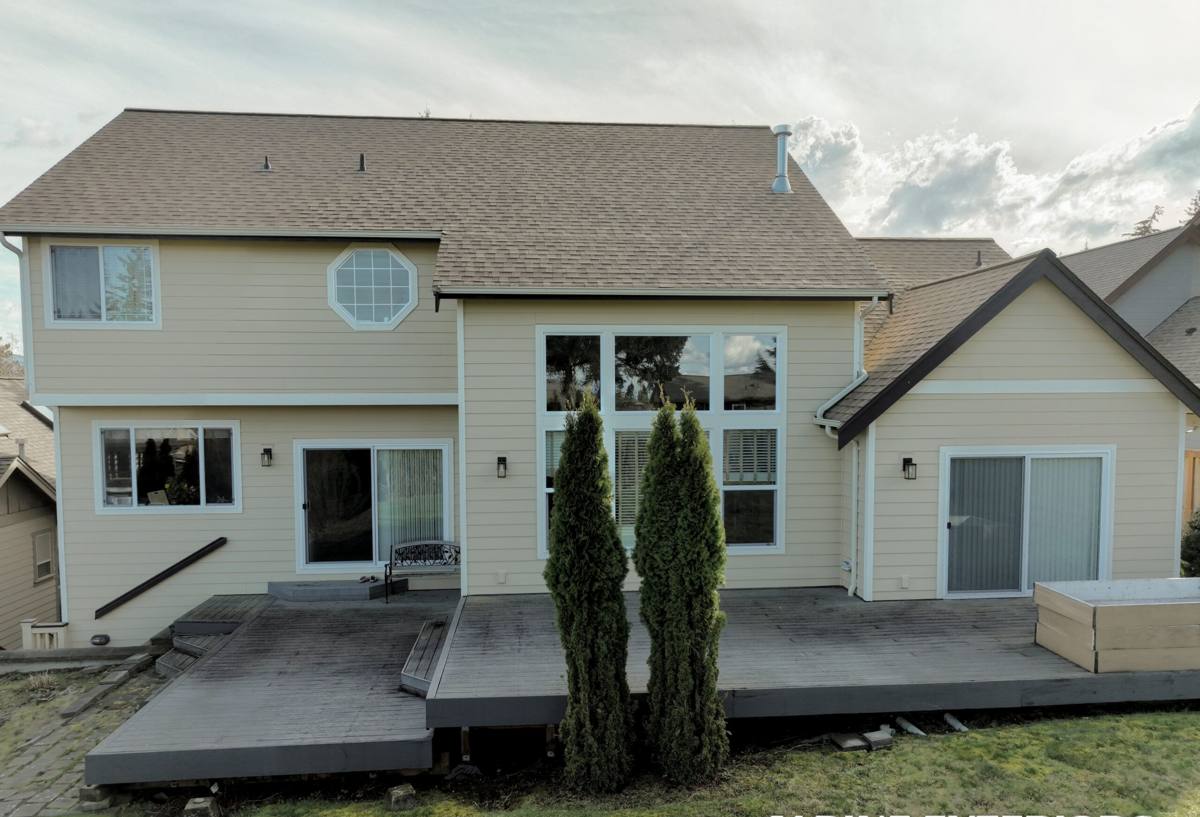
Signs a Mount Vernon Home Needs New Windows
Most homeowners call us after noticing one or two of these, not because they went looking for a project. Worth checking before winter if any of the following sound familiar:
- Condensation or fogging between the panes of a double-pane window (the seal has failed and can't be repaired, only replaced)
- Soft, spongy, or discolored wood at the sill or jamb — a sign moisture has been getting behind the trim for a while
- Windows that are noticeably harder to open and close than they used to be, or won't stay up without a prop
- A draft you can feel near the frame even with the window latched shut
- Visible daylight or gaps around the frame from outside
- Moss or black mildew staining that keeps coming back on the trim no matter how often it's cleaned
- Rising heating bills with no other explanation
Any one of these on its own might just need a repair. Several together, especially on a home built before the mid-1990s, usually means the windows themselves are past the point where repair makes sense.
What a Correct Window Replacement Job Actually Involves
Window replacement looks simple from the outside — old window out, new window in — but the parts nobody sees are what determine whether it lasts fifteen years or fails in five. In a climate that sees as much sustained rain as Skagit County does, three things matter more than the window brand itself:
Flashing and drainage
Water has to have a planned path out from behind the window, not just a caulk bead hoping to stop it at the surface. That means proper flashing tape or pan flashing at the sill, integrated with the house wrap or building paper already on the wall — not just sealant smeared around the trim after the fact.
Correct sizing and squaring
A window that's shimmed and leveled correctly opens and closes smoothly for decades. One installed slightly out of square will bind, let in drafts, and put uneven stress on the seals — which is often exactly what causes premature seal failure in older installs.
Insulation at the gap
The space between the window frame and the rough opening needs to be filled with a low-expansion foam or backer rod and sealant designed for that gap — not packed with fiberglass insulation, which does little to stop air movement, or overfilled with foam that bows the frame.
Get those three right and the window itself becomes the easy part.
Full-Frame vs. Insert Replacement: Which Fits Your Home
There are two basic approaches to replacing a window, and the right one depends on the condition of what's already there — not just personal preference.
Insert (pocket) replacement
The new window is built to fit inside the existing frame, which stays in place. This is faster, less invasive to interior and exterior trim, and usually costs less. It's a solid option when the existing frame is still square, dry, and structurally sound.
Full-frame replacement
The old window and its frame come out entirely, down to the rough opening, so flashing and insulation can be redone from scratch. This is more work and more cost, but it's the right call when there's any sign of water damage, rot, or a frame that's out of square — which, given how much rain this area sees over a home's lifetime, is common enough that we check for it on every job before recommending an approach.
We'll tell you honestly which one your home needs. Recommending insert replacement over a rotted frame just to save money on labor is the kind of shortcut that costs a homeowner far more a few years down the road.
Choosing Materials for Skagit County's Weather
Every window material has real trade-offs. None of them are a bad product — they're just suited to different budgets, maintenance expectations, and how much upkeep a homeowner wants to sign up for.
| Material | Moisture behavior | Maintenance | Typical cost position |
|---|---|---|---|
| Vinyl | Won't rot; seams and welds are the weak point over time | Low — occasional cleaning | Most affordable |
| Fiberglass | Dimensionally stable in wet-dry cycles; resists warping | Low | Mid to upper range |
| Wood-clad | Good performance if cladding and flashing are done right; exposed wood interior needs protection | Moderate to high | Higher |
| Aluminum | Conducts cold and can condense/sweat in humid interior air | Low | Varies |
For most Mount Vernon homes, we steer people toward vinyl or fiberglass for straightforward performance in a wet climate without a heavy maintenance schedule. Wood-clad windows can look great and hold up fine, but only when the cladding and exterior flashing are installed with real care — it's an installation-sensitive product, and we're upfront with clients about that before they commit to one.
Cost Factors Worth Understanding Before You Get Quotes
Two houses with the "same" ten windows can land at very different prices, and it's rarely about the salesperson. The real drivers are usually these:
| Factor | Why it moves the price |
|---|---|
| Insert vs. full-frame | Full-frame involves more labor, trim work, and material to redo flashing correctly |
| Existing damage | Rotted framing or sheathing found once the old window is out has to be repaired before the new one goes in |
| Window size and configuration | Larger openings, bay windows, and custom shapes cost more than standard sliders or double-hungs |
| Glass package | Upgraded low-E coatings or gas fills add cost but also cut heating and cooling loss |
| Number of stories | Second-floor windows take longer and require more setup |
| Trim and finish work | Matching existing interior trim, or repainting exterior trim, adds labor beyond the window itself |
We give a written, itemized estimate before any work starts, so none of this shows up as a surprise mid-project.
How Our Process Works
- Free on-site walkthrough — we look at every window being considered, not just the ones that are obviously failing, and check the condition of the surrounding frame and trim
- Honest recommendation on insert vs. full-frame replacement, with the reasoning explained, not just a number
- Written estimate covering materials, labor, and any anticipated trim or repair work
- Scheduled install with weather-aware timing — we plan around Skagit County's rain patterns rather than fighting them
- Flashing, insulation, and sealant done to the standard described above on every window, every time
- Final walkthrough so you can open, close, and inspect each window before we consider the job done
Why Local Experience in Mount Vernon Matters
A crew that works across Skagit County regularly knows the difference between a house that needs simple insert replacements and one where the trim looks fine but the sheathing behind it has been absorbing moisture for years. That kind of judgment comes from having pulled a lot of old windows out of homes built in this same weather, not from a sales script. It also means we're familiar with the permitting expectations local jurisdictions apply to exterior work, and we're not learning the region's rain patterns on your project.
Being based nearby in Anacortes and working throughout Skagit County also means if a warranty question or a sealant issue comes up two years after the install, we're not a long drive away and gone for good.
If you're weighing whether your Mount Vernon home's windows need repair, insert replacement, or a full-frame job, we're glad to take a look and give you a straight answer. Reach out for a free, no-pressure estimate using the form below — there's no obligation, and no pressure to decide on the spot.