 Anacortes Siding
 Why Conway Roofs Take a Different Kind of Beating
Conway sits low in the Skagit River delta, close enough to Skagit Bay and Puget Sound that salt-laden air is a constant, not an occasional visitor. Add the driving rain that rolls in off the Sound during fall and winter storm systems, and the deep shade many properties get from mature conifers and hedgerows along the fields and sloughs, and you have three separate stresses working on a roof at the same time. None of them are dramatic on their own. Together, over years, they're what actually ends an asphalt shingle roof's useful life in this part of Skagit County.
Salt Air and Metal Components
Salt-laden moisture speeds up corrosion on anything metal on a roof — nail heads, drip edge, step flashing, pipe boots with metal collars. Standard electro-galvanized fasteners can start showing rust streaks years before a roof in a drier inland area would see the same wear. Once a fastener corrodes, it loses grip on the shingle and the seal around it weakens, which is exactly where wind-driven rain finds its way in.
Moss, Shade, and Trapped Moisture
A lot of Conway properties back up to tree lines or sit close to farmland with irrigation ditches and standing moisture nearby, which keeps humidity high on the roof surface even when it isn't actively raining. Shingles that stay damp longer are shingles where moss and algae get a foothold faster. Moss doesn't just look bad — it holds water against the shingle mat, works its way under tabs as it grows, and can lift shingle edges enough for wind to grab them.
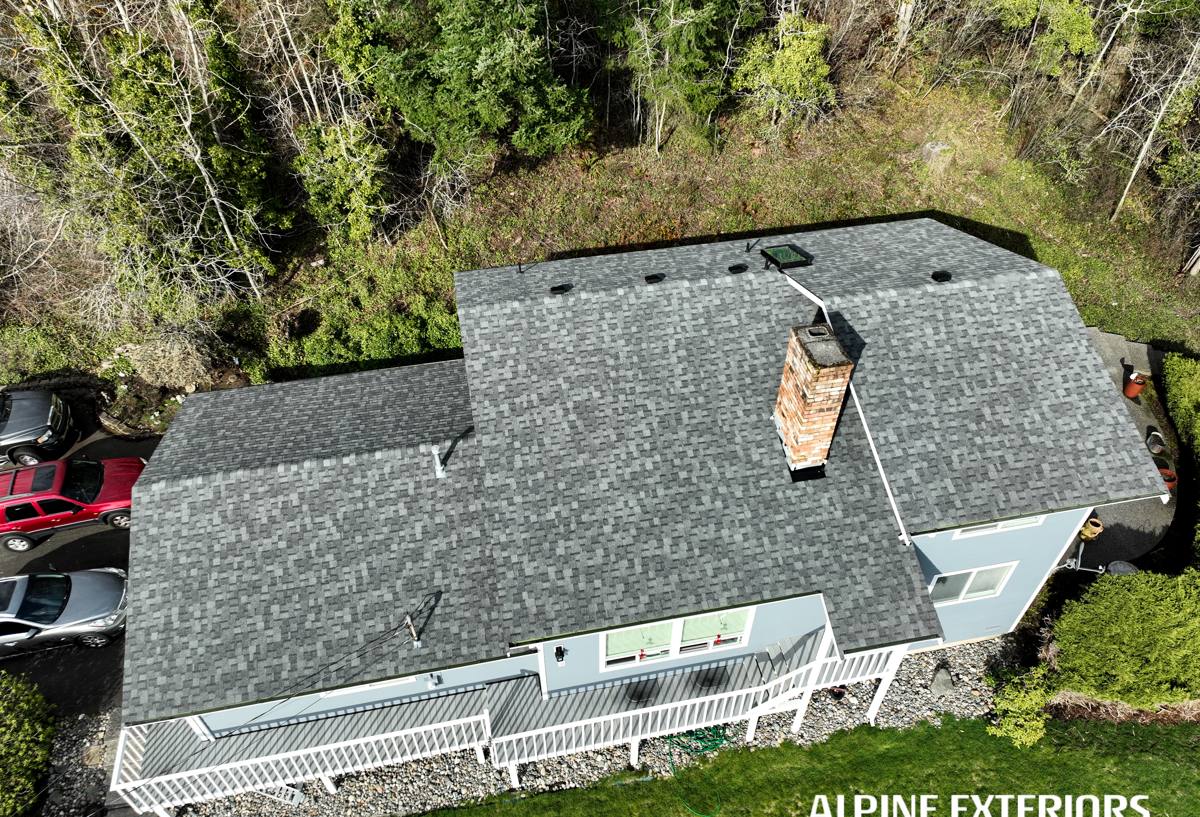
What an Asphalt Shingle Roof Actually Needs to Hold Up Here
A roof built to bare code minimums in a mild, dry climate is not the same roof you want on a home exposed to Conway's combination of salt air, sustained rain, and shade. The difference shows up in details most homeowners never see once the shingles are down.
Full Underlayment Coverage
We don't treat synthetic underlayment as an afterthought under the shingles. In a delta climate where wind-driven rain can push water sideways under shingle tabs, full underlayment coverage — with ice-and-water shield at eaves, valleys, and around every penetration — is the difference between a roof that sheds water and one that eventually leaks around a pipe boot or valley seam.
Balanced Attic Ventilation
Mild, wet winters mean attics here deal with condensation risk as much as heat. Intake vents at the eaves paired with exhaust at the ridge keep air moving so moisture doesn't sit under the deck and rot sheathing from underneath — a failure mode that has nothing to do with the shingles themselves but will still shorten a roof's life and cause hidden damage.
Corrosion-Resistant Fasteners and Flashing
Given the salt exposure, we don't cut corners on fastener and flashing material. Hot-dip galvanized or stainless fasteners and quality flashing metal cost more up front than the bare minimum, but they're one of the cheapest ways to add years to a roof's service life in this environment.
Correct Nailing Pattern for Open Exposure
Conway's flat delta terrain means some properties get more direct wind exposure than a similar home tucked into a wooded neighborhood closer to Anacortes proper. We nail to the pattern the manufacturer specifies for the local wind zone, not the fastest pattern — under-nailing is one of the most common causes of shingles lifting in a storm.
Choosing the Right Shingle for a Conway Roof
Not every asphalt shingle is built the same, and the differences matter more here than in a drier climate. The two things we weigh most for this area are algae resistance and wind rating, followed by how the shingle's warranty structure holds up under real coastal exposure rather than lab conditions.
Algae-Resistant Granules
Standard shingles rely on granules alone for UV protection and color. Algae-resistant (AR) shingles have copper- or zinc-infused granules mixed in specifically to slow the blue-green algae and moss growth that shows up as dark streaking. In a shaded, humid environment like parts of Conway, we consider AR granules close to mandatory rather than an upgrade.
Wind Rating
Shingles are rated for sustained wind speeds based on how they're installed — the rating on the wrapper only holds if the fastening and sealant strip activation are done correctly. We match the shingle's rated wind exposure to what the property actually sees, factoring in whether it sits in open farmland or a more sheltered, tree-lined lot.
| Shingle Tier | Typical Lifespan Here | Moss/Algae Resistance | Wind Rating |
|---|---|---|---|
| Standard 3-tab | Shorter end of the range in salt/shade exposure | Low unless AR-rated | Lower |
| Architectural/laminate | Mid-to-long range with proper ventilation | Moderate; better with AR granules | Higher |
| Premium AR laminate | Longest realistic range for this climate | Best available in asphalt | Highest |
We'll walk through which tier makes sense for your specific roof, your budget, and how much shade and salt exposure your particular lot actually gets — a south-facing open roof and a shaded, tree-lined roof two properties apart can have genuinely different needs.
Our Asphalt Shingle Roofing Process for Conway Homeowners
The steps below are the same order we follow on every re-roof, but the details inside each step — underlayment coverage, fastener choice, ventilation calculation — get adjusted to the property's specific exposure.
- On-site inspection and honest assessment of whether repair or full replacement makes sense
- Full tear-off to bare decking — we don't install over existing layers
- Deck inspection and replacement of any rotten or soft sheathing before anything else goes down
- Ice-and-water barrier at eaves, valleys, and penetrations, then full synthetic underlayment
- New drip edge and step/counter flashing at walls, chimneys, and any roof-to-roof transitions
- Shingle installation to manufacturer nailing specification for the local wind zone
- Ridge and intake ventilation balanced to the attic's actual size and layout
- Full site cleanup, including a magnetic sweep for stray nails
- Final walkthrough so you know exactly what was done and what to watch for going forward
What Actually Affects the Cost of a Conway Re-Roof
We'd rather explain what drives a price up or down than throw out a number that doesn't mean anything until we've seen the roof. The factors below are the real variables on almost every estimate we write in this area.
| Cost Factor | Why It Moves the Price |
|---|---|
| Roof size and pitch | More square footage and steeper pitches mean more material and labor time |
| Number of existing layers | Tear-off of multiple old layers adds disposal and labor cost |
| Deck condition | Rotten or soft sheathing found at tear-off has to be replaced before shingles go down |
| Ventilation upgrades | Adding or correcting intake/exhaust venting is worth doing once the roof is open |
| Shingle tier chosen | AR and premium laminate shingles cost more than standard 3-tab up front |
| Access and site conditions | Steep driveways, tight setbacks, or difficult staging on rural lots can add time |
We give a firm, itemized number after we've actually walked the roof — not a phone estimate — because deck condition and layer count are impossible to know for certain from the ground.
Maintenance That Matters in a Moss-and-Salt Climate
A correctly installed roof still needs some upkeep in this environment. None of it is expensive or time-consuming, but skipping it is how a 25-year shingle becomes a 15-year shingle.
- Clear gutters and valleys before the fall rains so water isn't backing up under shingle edges
- Treat moss growth early — a light application before it establishes is far easier than removing an established mat
- Never pressure-wash shingles; it strips granules and shortens their life
- Have pipe boots and flashing checked every few years — rubber collars and sealant degrade faster in salt air than the shingles around them
- Trim back overhanging branches to cut down on shade, debris, and the moss spores that come with both
- Walk the roofline (or have us do it) after any major windstorm to catch lifted or missing shingles before the next rain
Why a Crew That Already Works in Conway Makes a Difference
Conway isn't a big enough area that most roofing companies think about it specifically — it tends to get treated as an afterthought between bigger jobs elsewhere in Skagit County. Working here regularly means we already know which lots sit exposed to open wind off the delta versus which ones are sheltered under tree cover, and we size ventilation and fastening decisions accordingly instead of guessing. We're also familiar with the county's permitting requirements and typical inspection expectations, so there are no surprises partway through the job.
Just as important is response time. A roof problem after a fall storm doesn't wait for a convenient week, and a crew that's already working in the area can get eyes on a damaged roof faster than one dispatching from farther away.
If you're weighing repair versus replacement, or just want a straight answer about what your roof actually needs, we're glad to take a look and give you a free, no-pressure estimate — use the form below to get started.