 Anacortes Siding
 Mount Vernon's Climate Is Harder on Siding Than It Looks
Mount Vernon sits inland along the Skagit River, away from the open shoreline that defines much of Anacortes and the San Juan side of the county. That distance doesn't buy the kind of relief homeowners might expect. This is still Western Washington's marine climate zone, and the air moving up the Skagit Valley carries the same salt-tinged moisture that comes off Puget Sound, just delivered with a bit less wind and a bit more standing dampness. Add in the valley's farmland humidity, the tree cover on older residential lots, and a wet season that can run six months or longer, and you get siding conditions that are demanding in their own particular way.
Three things wear on exterior siding here more than almost anywhere else in the state: near-constant moisture exposure, driving rain that gets pushed sideways into wall assemblies during winter storms, and a moss and algae season long enough to leave a permanent mark on the wrong material. None of that is exotic or rare — it's just the baseline. The siding on a Mount Vernon home has to handle that baseline every single year, not just survive one bad winter.
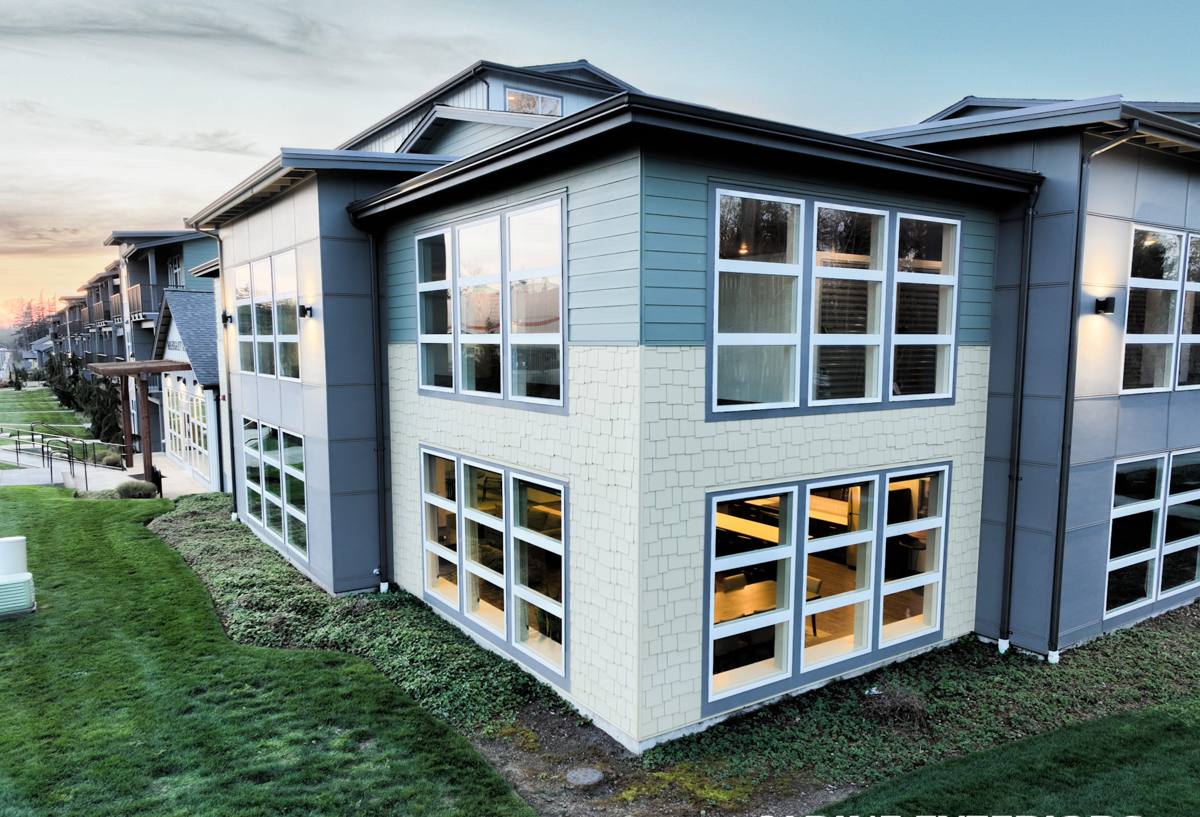
What This Climate Actually Does to a Wall System
Moisture That Doesn't Fully Dry Out
In a lot of the country, siding gets wet, then gets a real dry stretch to recover. Skagit County doesn't reliably offer that second half of the cycle for much of the year. Wall assemblies stay damp longer, which matters most at the material level — wood-based products swell, soften, or hold moisture against their fasteners, while poorly detailed water-resistive barriers behind the siding trap that moisture instead of shedding it.
Driving Rain and Wind-Loaded Water
Rain here doesn't just fall — winter storms push it laterally into lap joints, butt seams, and anywhere flashing is missing or under-lapped. A siding system that only handles vertical rainfall well will still leak on a home in this valley. Correct lap spacing, proper flashing at every horizontal transition, and a continuous drainage plane behind the cladding aren't optional details — they're the difference between a wall that sheds water and one that slowly absorbs it.
Moss, Algae, and Organic Growth
Shade, humidity, and a long wet season are exactly what moss and algae need to take hold on a north-facing wall or anywhere tree canopy blocks sun and airflow. On some siding materials that growth is cosmetic and easily washed off. On others, it signals moisture the material is actually absorbing, which is a different and more serious problem.
Why We Standardized on James Hardie for Homes Like These
We install James Hardie fiber cement siding exclusively — not vinyl, not LP SmartSide, not primed spruce or cedar, not Cemplank or Allura. That's a deliberate professional standard, not a sales preference, and it's rooted directly in what a Skagit County wall assembly has to survive year after year.
Non-Combustible, Dimensionally Stable
Fiber cement doesn't expand and contract with moisture the way wood-based siding does, and it doesn't soften or delaminate when it stays damp for weeks at a stretch. That stability matters in a climate where "dry" isn't guaranteed for long stretches of the year.
HZ5 Climate Engineering
James Hardie manufactures regional formulations matched to different climate zones, and Western Washington falls under the HZ5 line — engineered specifically for high-moisture, freeze-thaw-adjacent climates rather than a one-size-fits-all national product. That's a meaningful distinction in a county that sees this much sustained damp weather.
ColorPlus Factory Finish
Field-applied paint is only as good as the weather conditions it was applied in and how well it was maintained afterward — and in a climate with a short reliable painting window, that's a real limitation. James Hardie's ColorPlus finish is baked on in a controlled factory environment and backed by its own finish warranty, which removes a lot of the guesswork and touch-up maintenance homeowners here would otherwise face.
What a Correct Installation Involves
Fiber cement siding is only as good as the installation behind it. James Hardie's own installation instructions are detailed for a reason, and skipping steps is where most premature siding failures start — on any brand, not just this one.
| Installation Detail | Why It Matters in Mount Vernon |
|---|---|
| Continuous weather-resistive barrier | Backstops moisture that gets past the siding face during driving rain events |
| Proper flashing at windows, doors, and horizontal trim | Prevents the wind-driven rain common in valley winter storms from tracking behind the cladding |
| Correct fastener type, spacing, and penetration | Keeps panels secure through seasonal moisture cycling without splitting or working loose |
| Minimum clearance from grade, decks, and roof lines | Reduces splash-back moisture and standing dampness at the siding's most vulnerable edge |
| Caulking only where the manufacturer specifies it | Over-caulking traps moisture instead of letting the assembly drain and dry |
Every one of these is a manufacturer specification, not a matter of style. Skip one and the siding can still look fine for a year or two before the underlying problem shows up as staining, rot at the sheathing, or a warranty claim that gets denied because the install didn't meet spec.
Our Process on a Mount Vernon Project
The steps are the same on every home, but how they get applied changes based on the home's exposure, age, and existing wall condition.
- Assessment — we walk the exterior, check the existing siding and sheathing for hidden moisture damage, and note problem areas like shaded north walls or spots with a history of moss buildup.
- Removal and inspection — old siding comes off and the sheathing underneath gets a real look, not a guess. Any soft or damaged sheathing gets addressed before anything new goes on.
- Weather barrier and flashing — a continuous, correctly lapped drainage plane goes in first, with flashing detailed at every penetration and horizontal transition.
- James Hardie installation — panels, lap siding, or trim go up to manufacturer spec, with fastening and clearances checked as we go, not just at the end.
- Final inspection and walkthrough — we go over the finished exterior with the homeowner before calling the job done.
James Hardie Product Options for This Area
Most Mount Vernon homes end up choosing between a few core James Hardie product types, and the right one usually comes down to the home's architecture and the homeowner's maintenance preferences rather than performance — all of them are built for this climate.
| Product Line | Best Fit |
|---|---|
| HardiePlank lap siding | Traditional homes wanting a classic horizontal look; the most common choice in the area |
| HardiePanel vertical siding | Modern builds, accent walls, or gable ends where a clean vertical line is wanted |
| HardieShingle | Craftsman or cottage-style homes wanting a shingled look without the maintenance wood shingles require |
| HardieTrim | Corner boards, fascia, and window trim finished to match, avoiding the rot issues wood trim sees in this climate |
Cost Factors Worth Understanding Before You Get Quotes
Siding pricing varies enough by project that we won't put a number on the page that doesn't mean anything without seeing the home. What's more useful is understanding what actually moves the price, so quotes make sense when you compare them.
- Condition of the existing sheathing — hidden moisture damage found during tear-off adds real, necessary repair work
- Home size and wall complexity — dormers, multiple gables, and cut-up wall lines take more labor than a simple rectangular footprint
- Product selection — lap width, textured versus smooth finish, and trim details all affect material cost
- Height and access — two-story walls, steep grades, and limited equipment access add time
- Color and finish — ColorPlus factory colors versus a custom field-applied finish
Why Hiring a Crew That Already Works Mount Vernon Matters
A crew that regularly works Skagit County homes has already seen how this specific climate treats different wall orientations, roof lines, and older housing stock in the area. That's not a marketing point — it changes real decisions on the job, like which walls need extra flashing attention, where moss buildup tends to concentrate, and how local permitting and inspection expectations run in Mount Vernon and the surrounding county. A crew flying in from outside the region, or one that installs several different siding brands and treats them all the same, doesn't carry that same working knowledge of how this specific weather pattern interacts with a wall assembly over years, not just during the install.
Signs Your Current Siding May Already Be Struggling
- Persistent moss or algae staining that returns shortly after cleaning
- Soft spots, bubbling, or visible warping, especially near the bottom courses
- Paint that's peeling, chalking, or needing repainting more often than every several years
- Visible gaps at seams, trim, or window flashing
- Musty smell or soft drywall on interior walls that back up to exterior siding
- Siding that flexes or feels hollow when pressed near the base
Any one of these on its own isn't necessarily an emergency, but they're worth having a professional look at before the next wet season adds to the damage.
Get a Straightforward Look at Your Home
If you're weighing a siding replacement on a Mount Vernon home, we're glad to come take a real look — not a sales pitch, just an honest read on the condition of what's there now and what it would take to do it right with James Hardie. Fill out the form below for a free, no-pressure estimate.