 Anacortes Siding
 Sedro-Woolley's Roofing Climate: What Skagit County Actually Throws at a Roof
Sedro-Woolley sits inland along the Skagit River, but the roof over your head still answers to the same weather system that shapes this whole corner of Washington. Driving rain rolls through for months at a stretch, strong westerlies can carry salt-tinged marine air up the valley from Puget Sound, and the tree cover common on Sedro-Woolley lots keeps roofs shaded and damp long after a storm has passed. That combination is exactly what moss wants.
None of this is dramatic on its own. It's the accumulation that wears a roof out early: granule loss from repeated soaking and drying, moss roots working into shingle laps, corrosion creeping into exposed fasteners, and moisture wicking sideways under flashing that was never quite sealed right the first time. A roof built for a dry climate, or installed by a crew that doesn't normally work this valley, tends to show its age here years before it should.
What "New Roof Installation" Actually Means
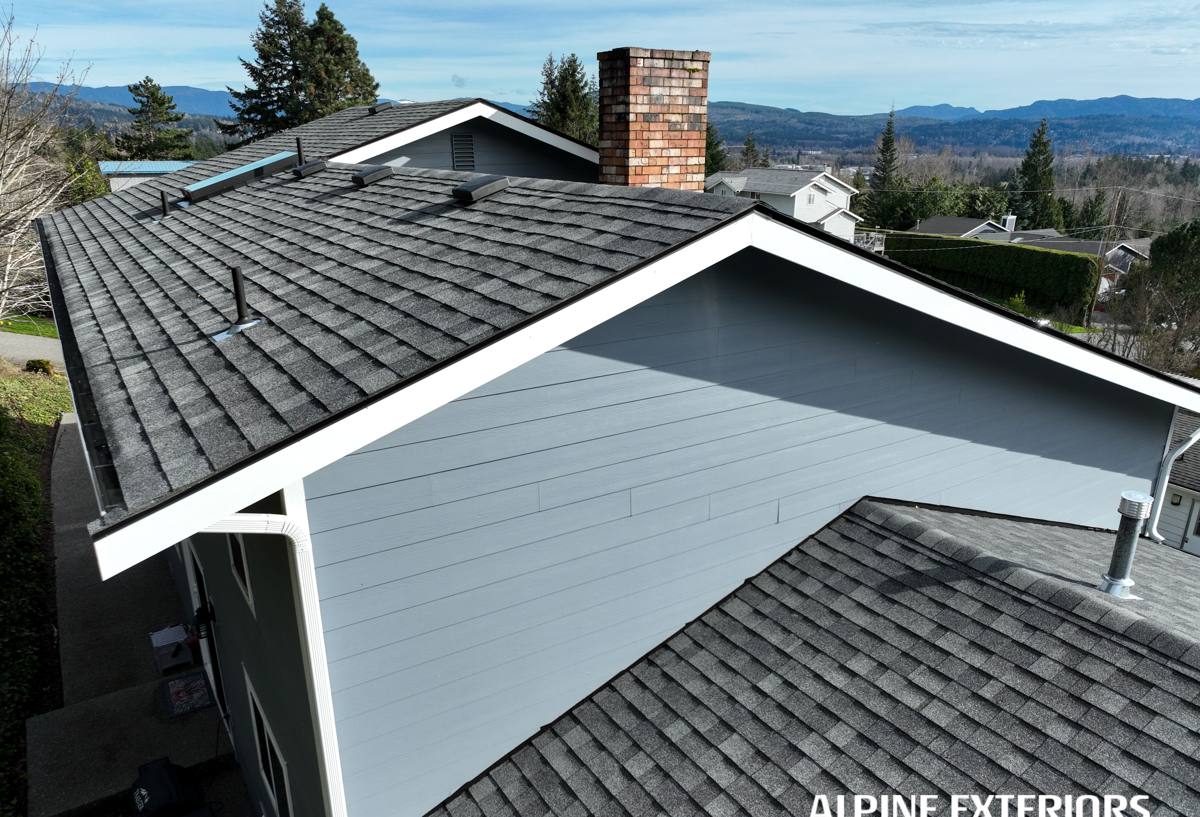
A new roof is more than swapping old shingles for new ones. Done right, it's a full system replacement, and every layer matters as much as the material on top.
Full Tear-Off, Not a Layer on Top
We remove the existing roofing down to the deck rather than installing over an old layer. Overlaying hides problems instead of fixing them — soft decking, trapped moisture, and old flashing all stay buried under the new material, which shortens the life of everything above it and can void manufacturer warranties. A tear-off also gives us the only real chance to inspect the deck itself.
Deck Inspection and Repair
Once the old roofing is off, we check the plywood or board decking for soft spots, delamination, and rot — common wherever a roof has been holding moisture longer than it should. Any bad sections get replaced before anything new goes down. Skipping this step is one of the most common ways a "new roof" fails early.
Underlayment, Ice-and-Water Shield, and Flashing
Synthetic underlayment goes down across the full deck as the roof's backup water barrier. Ice-and-water shield — a self-adhering membrane — gets added at eaves, valleys, and around penetrations where water is most likely to find a way in. New step flashing, counter flashing, valley metal, and chimney or skylight flashing are installed fresh rather than reused, since old flashing is one of the most common sources of hidden leaks.
Field Material and Ridge Detail
The shingles, metal panels, or other field material go on according to the manufacturer's nailing and exposure specs, followed by ridge venting and cap material to finish the roofline. Corners get cut here more than anywhere else on a rushed job, and it's usually where the first leak shows up.
Choosing a Roofing Material That Holds Up in a Wet, Shaded Valley
There's no single "best" roofing material — there's the right material for your home, your budget, and how much maintenance you're willing to keep up with. In a climate like this, moss and moisture resistance matter as much as looks.
| Material | Typical Lifespan | Moisture & Moss Behavior | Maintenance | Relative Cost |
|---|---|---|---|---|
| 3-Tab Asphalt Shingle | 15–20 years | Thinner profile holds less debris but has less mass to shed water at laps; more prone to early granule loss | Low, but shorter service life | $ |
| Architectural / Dimensional Shingle | 25–30 years | Thicker, layered profile sheds water and debris better; still needs periodic moss removal in shaded areas | Low to moderate | $$ |
| Standing Seam Metal | 40–50+ years | Smooth, steep-shed surface that moss struggles to establish on; excellent water shedding | Low | $$$ |
| Cedar Shake | 20–30 years with upkeep | Attractive but organic material that readily hosts moss and moisture in constant shade without regular treatment | High | $$$ |
For heavily treed Sedro-Woolley lots, we're honest with homeowners about the trade-off: cedar shake looks great, but in a shaded, damp yard it demands a maintenance schedule most people don't keep up with, and neglected shake shortens its own lifespan fast. Architectural shingles or metal tend to be the better long-term fit for shaded, moisture-prone sites — not because one product is "bad," but because they ask less of the homeowner over the years the roof has to perform.
Ventilation and Moisture Control — The Part You Don't See
A roof's surface material only does half the job. The other half happens in the attic, where balanced intake and exhaust ventilation keeps warm, moist air from condensing against the underside of the deck. Get this wrong and you can end up with rot from the inside, even on a roof that looks perfect from the ground.
- Ridge vents paired with soffit or eave intake vents keep air moving continuously across the underside of the deck
- Baffles at the eaves keep insulation from blocking that intake airflow
- Proper venting reduces the freeze-thaw stress that occasional cold snaps can put on a roof edge
- Good airflow also slows the moss and algae growth that thrives on a roof surface that never fully dries out
This is also where a lot of budget roofing jobs cut corners, because ventilation upgrades don't show up in a curb-view photo. We treat it as a standard part of a new roof installation, not an upsell.
Our Installation Process, Step by Step
- On-site inspection and written estimate — we look at the existing roof, deck condition where visible, ventilation, and any problem areas before quoting anything
- Material selection and permit pull — we help you weigh options against your budget and roof exposure, then handle the paperwork
- Site protection — landscaping, siding, gutters, and outdoor living areas get covered or protected before tear-off starts
- Full tear-off to bare deck — old roofing, underlayment, and flashing come off completely
- Deck repair — any soft, rotted, or delaminated sheathing is replaced
- Underlayment, ice-and-water shield, and new flashing — installed at eaves, valleys, and every penetration
- Field material installation — shingles or panels installed to manufacturer spec, with proper nailing and exposure
- Ridge venting and cap detail — the ventilation system is completed and finished
- Full cleanup, including a magnetic sweep — for stray nails and fasteners across the yard and driveway
- Final walk-through — we go over the finished roof with you before calling the job done
Permits, Codes, and Inspections
Reroofing work in Sedro-Woolley and the surrounding Skagit County area typically requires a building permit, with jurisdiction depending on whether the address falls inside city limits or in unincorporated county territory nearby. Permits exist for a reason: they trigger an inspection that confirms the deck, flashing, and ventilation were actually done to code, not just to eye.
Skipping the permit might save a little time up front, but it can come back to bite you at resale, during an insurance claim, or if a problem develops that a proper inspection would have caught. We pull the permit as a standard part of the job and coordinate the required inspections — it's not an extra step, it's part of doing the work correctly.
Signs Your Roof Needs Replacing, Not Just Patching
Not every roof problem calls for full replacement — sometimes a targeted repair is the right, honest answer. But certain signs point to a roof that's past the point where patching makes sense.
- Bald spots or heavy granule loss visible on the shingles or collecting in the gutters
- Shingles that are curling, cupping, or cracking across large areas of the roof, not just one spot
- Moss established at the butt joints, visibly lifting shingle edges rather than just sitting on the surface
- Daylight visible through the roof deck from inside the attic
- Soft or spongy spots underfoot when walking the roof
- A pattern of repeat leaks in different areas after previous repairs
- A roof at or past the manufacturer's rated lifespan for its material
- Missing, rusted, or damaged flashing around chimneys, skylights, or valleys
- Water staining or a musty smell developing on interior ceilings
If you're seeing two or more of these, it's worth getting an honest inspection before spending more money chasing individual leaks on a roof that's telling you it's done.
What Drives the Cost of a New Roof
Every roof is priced on its own specifics, but the same handful of factors move the number up or down on almost every job we quote.
| Cost Factor | How It Affects Price |
|---|---|
| Roof size and pitch | More square footage and steeper pitches mean more material, more labor time, and more safety measures |
| Number of existing layers | Tearing off multiple old roofing layers adds labor and disposal cost versus a single-layer tear-off |
| Decking condition | Rotted or soft sheathing found during tear-off requires repair or replacement, which is priced as it's discovered |
| Material choice | Asphalt, architectural shingle, and metal carry different material and installation costs, as shown above |
| Roof complexity | Valleys, dormers, chimneys, and skylights all add flashing detail and labor time |
| Site accessibility | Steep lots, limited driveway access, or tight setbacks can affect equipment staging and cleanup time |
| Permit and disposal fees | Local permit costs and dump fees are part of the total, not an add-on surprise |
We walk through these factors with every homeowner during the estimate so the number makes sense, rather than handing over a flat quote with no explanation behind it.
Why a Crew That Already Works Sedro-Woolley Matters
A roof isn't an abstract product — it's a system that has to perform against the specific weather pattern hitting your specific lot. A crew that works Sedro-Woolley and the wider Anacortes area regularly has already seen how shaded, tree-covered lots grow moss differently than open ones, how driving rain off the Sound behaves once it's pushed up the valley, and which flashing details tend to fail first on homes built during different eras in this area.
That local familiarity also means faster response if a warranty question or a follow-up item comes up after the job is done — you're not waiting on a crew that has to travel in from out of the area. We're based in Anacortes, we work Skagit County regularly, and we bring that same standard of work to every Sedro-Woolley roof, whether it's a full replacement or a smaller repair that came first.
If your roof is showing its age or you're just planning ahead, we're happy to take a look and give you a straight answer — no pressure, no upsell. Fill out the form below for a free estimate on your Sedro-Woolley roof.